Astrologically, Neptune is associated with illusion, imagination, spirituality, empathy, and the dissolution of boundaries. It represents the part of experience where reality is not perceived in a fixed or concrete way, but through impression, emotion, intuition, and symbolic meaning. Where other planets tend to describe defined structures or observable actions, Neptune describes states where those structures become less distinct or less reliable.
Neptune is often linked to experiences that blur the line between what is real and what is imagined or felt. This can include heightened creativity, spiritual sensitivity, artistic inspiration, idealism, and deep emotional resonance. At the same time, it can also relate to confusion, projection, uncertainty, and difficulty maintaining clear boundaries in perception or judgment.
Not all astrological traditions include Neptune.
Traditional astrologers generally exclude Neptune, Uranus, and Pluto because these planets were not part of the classical system used in ancient astrology. Similarly, many Vedic or sidereal astrologers—particularly in India—do not use Neptune in standard chart interpretation. Their frameworks rely on visible planets and lunar nodes, emphasizing established predictive methods. As a result, Neptune is typically only used in modern Western astrology, where it plays a major role in psychological and symbolic interpretation.
Within systems that do use it, Neptune is understood as a subtle and non-linear influence. It does not tend to manifest through clear, isolated events. Instead, it shapes perception over time, often in ways that are difficult to identify while they are happening.
The Discovery of Neptune & Its Entry into Astrology
Neptune was discovered in 1846, making it one of the later additions to the known solar system. Its discovery was the result of mathematical prediction and astronomical observation, most notably associated with the work of Urbain Le Verrier and John Couch Adams. Astronomers observed irregularities in the orbit of Uranus and concluded that another unseen planet must be influencing its motion. Neptune was then located based on these calculations.
This made Neptune unique even in terms of discovery. It was identified through inference before direct observation, meaning its existence was first understood through indirect effects rather than immediate visibility. This detail later became symbolically important in astrology, as Neptune is often associated with things that are not directly seen, but sensed, imagined, or inferred.
Neptune was not immediately integrated into astrology after its discovery. Like Uranus, it took time for astrologers to assign interpretive meaning to it. Its astrological development occurred gradually during the late 19th and early 20th centuries as modern astrology began expanding beyond the traditional seven-planet framework.
One of the key figures in this development was Alan Leo, who helped systematize modern astrological interpretation and played a major role in incorporating Neptune into psychological and symbolic astrology. Over time, Neptune became associated with themes such as spirituality, imagination, idealism, and states of consciousness that extend beyond ordinary material perception.
Illusion, Imagination & Dissolution of Boundaries
Neptune is associated with illusion, imagination, and the weakening of clear boundaries in perception, identity, and experience. In Roman mythology, Neptune is the god of the sea, storms, and earthquakes. He rules the ocean, a place that is vast, constantly moving, and difficult to define or control. This image of the sea helps explain the planet’s symbolic meaning: areas of life where clarity decreases and things become more fluid, indirect, and less structured.
Rather than relying primarily on logic or fixed categories, Neptune describes a way of experiencing reality shaped more by emotion, intuition, mood, and symbolism. Meaning is often indirect rather than explicit, formed through impression rather than clear definition. Understanding tends to come from what is sensed or suggested, rather than what can be clearly measured or stated.
Imagination is one of Neptune’s central expressions. It reflects the mind’s ability to move beyond what is immediately present. Under its influence, attention naturally extends to what something implies or evokes, not just what is physically there. This is why Neptune is commonly linked with creative fields such as music, film, poetry, and visual art, where meaning is carried through atmosphere, emotion, and suggestion rather than direct explanation.
As this influence develops, thinking becomes less linear and more associative. Ideas form through feeling, connection, and internal imagery rather than step-by-step reasoning. Experience can feel less concrete, with meaning emerging in a more personal and interpretive way.
Neptune is also associated with illusion. This usually does not refer to intentional deception. More often, it describes situations where perception is shaped by expectations, emotions, or personal hopes without the person realizing it. In these cases, a situation may seem more certain, meaningful, or aligned than it actually is when viewed objectively.
Over time, this can lead to confusion or disappointment when reality does not match the original impression. In many cases, the misperception only becomes clear later, once circumstances develop or emotions settle.
A core part of Neptune’s meaning is the weakening of boundaries. This idea is reflected in its mythological association with a sea god who governs floods, storms, and earthquakes—events in which stable structures break down and distinctions are disrupted. In interpretive terms, this shows up as less separation between inner and outer experience, between the self and others, and between imagination and reality.
This can increase sensitivity to emotions, environments, and other people. It can also support empathy and a stronger sense of connection. At the same time, it can make it harder to maintain emotional distance or evaluate situations with full clarity.
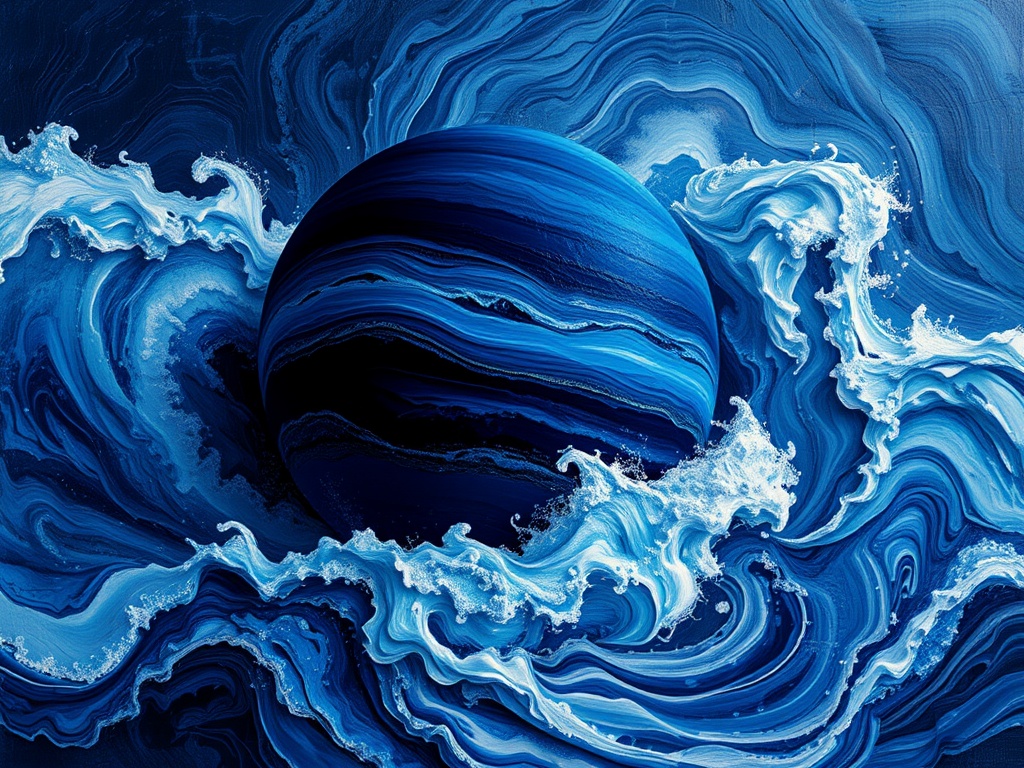
This lack of clear structure is also reflected in Neptune’s physical nature as a planet. It is located far from the Sun and receives very little sunlight. Visually, it appears as a smooth blue sphere with shifting cloud patterns rather than sharply defined surface features. Its appearance is diffuse rather than segmented, reinforcing its symbolic association with softened boundaries and reduced clarity.
As previously mentioned, Neptune was discovered indirectly. Astronomers noticed irregularities in the orbit of another planet and calculated that an additional planet must be influencing it. Neptune was later confirmed through observation. This indirect discovery reflects the same theme: understanding often comes through inference, intuition, or subtle signs rather than direct evidence.
Overall, Neptune represents areas of experience that are not fully fixed or clearly defined. It does not usually describe obvious external events. Instead, it shapes how experiences are interpreted internally and how meaning is formed.
This can be helpful when it supports creativity, empathy, or spiritual awareness. It can allow for a deeper understanding of meaning beyond literal interpretation. At the same time, it can create confusion when emotions or expectations strongly influence perception. Neptune does not remove meaning from experience—it makes meaning less fixed and more dependent on perspective.
Neptune in the Birth Chart
In a natal chart, Neptune shows where perception is more sensitive, fluid, or impressionable. The house placement indicates the area of life influenced, while the sign describes how Neptune’s energy is expressed.
For example, Neptune in the 1st house can create a personality that is adaptable, impressionable, or difficult to define in fixed terms. In the 2nd house, it may influence values and finances in ways that are less stable or more idealistic. In the 4th house, it can relate to blurred boundaries in family dynamics or an idealized view of home and early life. In the 7th house, it may indicate projection or idealization in relationships. In the 10th house, it can create uncertainty or fluidity in career direction and public identity.
Aspects to Neptune influence how strongly this sensitivity is expressed. Connections to personal planets often increase imagination, empathy, and intuition, but can also increase ambiguity in perception depending on context.
Neptune-Sun aspects can influence identity through ideals or spiritual orientation. Neptune-Moon aspects can heighten emotional sensitivity and receptivity. Neptune-Mercury aspects can increase intuitive thinking but also introduce ambiguity in communication. Neptune-Venus aspects often intensify romantic idealization and emotional projection in relationships. Neptune-Mars aspects can reduce clarity in direction or motivation, especially when action is influenced by emotional or idealized states.
Neptune does not eliminate personal agency, but it does influence how reality is perceived and interpreted. Because of this, awareness of projection and expectation becomes an important part of working with its influence.
Neptune in Transits
When Neptune forms significant transits, its influence is usually gradual and subtle rather than sudden or clearly defined. These periods tend to coincide with shifts in perception, awareness, and emotional orientation rather than immediate external events.
During Neptune transits, areas of life may begin to feel less certain or less structured. A person may experience confusion, uncertainty, or a gradual loss of clarity in a specific domain. At the same time, sensitivity, imagination, and emotional awareness may increase significantly.
These transits are often associated with periods where idealized views are challenged or slowly dissolved. This can lead to disillusionment, but also to deeper understanding and more realistic perception over time.
Neptune transits tend to work through gradual erosion of boundaries rather than direct confrontation. Because of this, their effects are often easier to recognize in hindsight than in the moment.
Generational Impactof Neptune
Neptune moves slowly, spending approximately 14 years in each zodiac sign, which makes its influence strongly generational rather than purely individual. Because it stays in one sign for such a long period, entire age groups are born under the same Neptune placement, creating shared themes in how they relate to imagination, belief, spirituality, and meaning.
At the collective level, Neptune is often associated with cultural shifts in art, music, film, and storytelling. It reflects periods where symbolism, emotion, and atmosphere become more dominant than strict realism or logical structure. During strong Neptune eras, cultural output tends to emphasize mood, feeling, and meaning over literal representation. This can also extend into religion, spirituality, and collective worldviews, where shared ideals and narratives become more emotionally driven or abstract.
Neptune is also closely linked to media and mass perception. Because it governs imagery, narrative, and emotional interpretation, it is often associated with how societies absorb and respond to information. In this sense, Neptune can reflect both inspiration and distortion at a collective level. It can amplify empathy, shared vision, and cultural imagination, but it can also correlate with confusion, misinformation, or idealized narratives that are not fully grounded in reality.
Each Neptune sign placement reflects a generational style of imagination and belief. These placements describe how large groups of people tend to collectively interpret meaning, construct ideals, and relate to spiritual or symbolic frameworks. While individuals express this differently depending on their personal chart, the generational backdrop shows the broader cultural tone shaping those experiences.
Neptune & Pisces
In modern astrology, Neptune is commonly associated with rulership of Pisces. This connection is based on shared symbolic themes such as spirituality, compassion, imagination, sensitivity, and the dissolution of boundaries. Pisces is often seen as the most fluid and emotionally permeable sign, and Neptune is viewed as the planetary principle that best expresses this quality. For this reason, many modern astrologers consider Neptune the ruler of Pisces.
This association developed after Neptune’s discovery in the 19th century, when modern astrology began expanding beyond the traditional seven-planet system. As Neptune’s symbolism was established, it was matched with Pisces because of their overlapping themes of intuition, idealism, and transcendence of material boundaries.
In traditional astrology, Pisces is ruled by Jupiter. This system predates Neptune’s discovery and is based only on the visible planets. Jupiter represents meaning, wisdom, growth, and structured belief, so Pisces in this context is less about dissolution and more about emotional understanding within a broader philosophical or spiritual framework.
The difference between Jupiter and Neptune as rulers of Pisces reflects a broader shift between traditional and modern astrology. Traditional systems emphasize structure, consistency, and visible planetary rulerships, while modern astrology incorporates the outer planets and places more emphasis on psychological and symbolic interpretation.
Overall, Neptune represents a principle of dissolution, imagination, and fluid perception in modern astrology. It describes areas of life where boundaries become less fixed and experience becomes more subjective, symbolic, and emotionally or intuitively driven.
At the individual level, Neptune highlights where clarity gives way to sensitivity, idealism, or uncertainty. In transits, it corresponds with gradual shifts in perception that often become clear only in hindsight. At the collective level, it reflects generational influences in culture, imagination, and shared belief systems.
Its meaning is a product of modern astrological development, shaped by interpretation rather than ancient tradition. Overall, Neptune describes the experience of moving beyond fixed boundaries into a more fluid and interpretive way of perceiving reality.