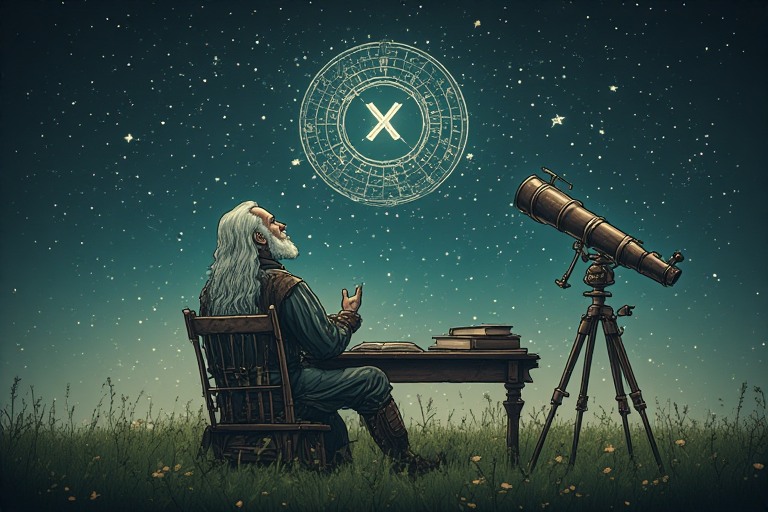
The Hermetic Lots, often called Arabic Parts, belong to a branch of astrology that treats the chart as a structured web of relationships rather than a simple collection of symbols. They are not planets, and they are not visible in the sky. Instead, they are calculated points that emerge from the interaction between fundamental elements such as the Sun, Moon, and Ascendant. Through this process, they transform relationships into locations, giving astrologers a way to map experiences that are not immediately obvious from planets alone.
What makes the lots especially compelling is that they operate at the intersection of mathematics and meaning. They take measurable distances and convert them into symbolic statements about life. In doing so, they reveal a hidden layer of the chart—one that speaks to how different forces combine to shape both circumstance and intention.
What the Hermetic Lots Represent
A Hermetic Lot is not an independent object but the result of a relationship. Each one is created by measuring the arc between two points and projecting that arc from a third. This creates a new position in the zodiac that encodes the interaction of all three components.
Because of this, lots often describe outcomes rather than raw traits. A planet might symbolize a drive or tendency, but a lot shows how multiple factors converge into a lived experience. This is why they are frequently associated with concrete topics such as health, success, relationships, or adversity. They translate abstract dynamics into specific areas of life.
Another important feature is that lots tend to bridge inner and outer reality. Some emphasize external conditions—what happens to a person—while others emphasize internal processes such as decision-making or desire. This duality gives them a unique role in interpretation, allowing astrologers to track both circumstance and response.
Historical Development & Transmission
The origins of the Hermetic Lots lie in Hellenistic astrology, where they formed part of a highly developed symbolic framework. Early astrologers were not content with simply observing planetary placements; they sought methods for extracting deeper meaning from the relationships between those placements.
Figures such as Vettius Valens and Dorotheus of Sidon made extensive use of the lots in both instruction and practice. Valens, in particular, demonstrates their importance by weaving them into predictive case studies, showing how they can correspond to real events and turning points.
Later, the tradition was preserved and expanded by scholars working in the medieval Islamic world. Astrologers like Abu Maʿshar and Al-Biruni cataloged numerous additional lots and integrated them into a broader interpretive framework. It is during this period that the term “Arabic Parts” became widespread, even though the conceptual foundation had already been established centuries earlier.
The survival of these techniques into the present is due in large part to modern translations and scholarship, which have made the original texts accessible again. As a result, the lots have experienced a revival, returning to a central place in traditional astrological practice.
Philosophical Foundations
The logic behind the Hermetic Lots reflects a worldview in which the cosmos is ordered through proportion and relationship. In this framework, meaning arises not only from individual elements but from the distances and connections between them.
This perspective is deeply influenced by Hermetic philosophy, which emphasizes the unity and coherence of the universe. The chart is treated as an integrated whole, where each part reflects the structure of the larger system. By converting relationships into positions, the lots make this hidden order visible.
A crucial philosophical distinction emerges through certain pairs of lots, especially those that divide experience into external and internal domains. This introduces a layered understanding of fate—one that includes both what happens to a person and how they respond. Rather than presenting life as purely determined or entirely self-directed, the lots suggest an ongoing interaction between circumstance and agency.
The Mechanics of Calculation
Every lot is defined by a precise formula. While the details differ, most follow the same general structure: one measures the distance between two points and adds that distance to a third point. The resulting position is then plotted in the zodiac.
The most well-known example involves the calculation of the Lot of Fortune, which uses the relationship between the Sun, Moon, and Ascendant. In a daytime chart, the arc from the Sun to the Moon is projected from the Ascendant. In a nighttime chart, the formula is reversed, measuring from the Moon to the Sun instead.
This reversal reflects the importance of sect, or the distinction between day and night charts. In diurnal charts, the Sun takes precedence, while in nocturnal charts, the Moon becomes more prominent. Adjusting the formula ensures that the lot remains aligned with the chart’s underlying structure.
Another key lot, the Lot of Spirit, is calculated using the same components but reverses the order of measurement relative to Fortune. This inversion is not just technical—it reflects a conceptual shift, distinguishing between external conditions and internal intention.
Once calculated, a lot is interpreted through its sign, house placement, and aspects, but its formula always remains central. The meaning of the Lot of Fortune, for instance, cannot be separated from the relationship between the Sun, Moon, and Ascendant that produced it.
The Central Pair: Fortune & Spirit
Among all the Hermetic Lots, the Lot of Fortune and the Lot of Spirit form the backbone of the system. Together, they create a polarity that divides life into two fundamental dimensions.
The Lot of Fortune is associated with the body, material conditions, and the flow of external events. It describes what happens to a person—health, environment, and circumstances that arise without deliberate intention. It is often linked to stability or instability in one’s physical and material life.
The Lot of Spirit, on the other hand, is connected to will, direction, and purposeful action. It represents what a person chooses to do within the conditions they are given. It is tied to agency, ambition, and the capacity to shape one’s path.
When these two lots are analyzed together, they reveal how inner intention interacts with outer reality. A strong alignment between them can suggest that a person’s actions harmonize with their circumstances, while tension between them can point to friction between desire and reality.
Additional Lots & Their Meanings
Beyond the primary pair, a wide range of additional lots expands the interpretive scope of the chart. Each one isolates a specific dimension of experience, allowing for more precise analysis.
The Lot of Eros is associated with attraction, desire, and the pursuit of connection. It can describe what draws a person toward others and how they experience longing. The Lot of Necessity deals with constraints, obligations, and pressures that limit freedom, often pointing to situations that must be endured rather than chosen.
The Lot of Courage reflects resilience and the capacity to confront adversity, while the Lot of Victory highlights success, recognition, and moments of triumph. In contrast, the Lot of Nemesis is linked to reversal, imbalance, and consequences that arise when things fall out of alignment.
These lots do not function as simple indicators of positive or negative outcomes. Instead, they define specific arenas of experience, each with its own internal logic. When activated, they bring their particular themes to the forefront of life.
Over time, astrologers developed many more lots, including those related to marriage, children, career, illness, and reputation. Some traditions also introduced highly specific derivatives, such as lots of siblings, inheritance, or even imprisonment, reflecting the desire to map every conceivable life circumstance within the chart.
Interpretive Techniques & Practical Use
In practice, Hermetic Lots are never interpreted in isolation. Their meaning emerges through context, especially through their rulers and their interaction with other chart factors.
The planetary ruler of a lot acts as a key to its expression. For example, the condition of the ruler of the Lot of Fortune can indicate whether external circumstances tend to support or challenge the individual. Similarly, the ruler of the Lot of Spirit can show how effectively a person is able to act on their intentions.
Timing techniques add another layer of depth. In zodiacal releasing, lots such as the Lot of Spirit and the Lot of Fortune are used as anchor points for dividing life into distinct periods. Each period emphasizes different themes, creating a structured narrative that unfolds over time.
Lots are also highly responsive to transits. When a planet forms a significant aspect to a lot, it can trigger events or shifts related to that lot’s domain. Because they are derived from core chart factors, they often act as sensitive indicators of change, sometimes coinciding with pivotal life moments.
Why the Hermetic Lots Matter
The enduring value of the Hermetic Lots lies in their ability to reveal structure beneath the surface of the chart. They provide a method for extracting meaning from relationships, allowing astrologers to move beyond isolated symbols and engage with the chart as an integrated whole.
They also offer a bridge between abstract symbolism and concrete experience. By tying mathematical relationships to specific life topics, they make astrology more precise and grounded. This is particularly important in predictive work, where clarity and specificity are essential.
At the same time, they demand a higher level of engagement. Their use requires not only technical skill but also interpretive sensitivity, as the astrologer must synthesize multiple layers of meaning into a coherent whole.
Ultimately, the Hermetic Lots stand as one of the most sophisticated tools developed within traditional astrology. Rooted in ancient practice and refined across centuries, they transform the chart into a dynamic network of relationships that can be measured, interpreted, and experienced.
Through the Lot of Fortune, the Lot of Spirit, and the many additional lots that expand the system, they reveal how circumstance and intention intertwine. They show that life is not simply a matter of fixed traits or isolated events, but a continuous interplay between forces both seen and unseen.
For those willing to engage with their complexity, the Hermetic Lots offer a deeper and more nuanced understanding of astrology—one that uncovers the hidden architecture shaping human experience.