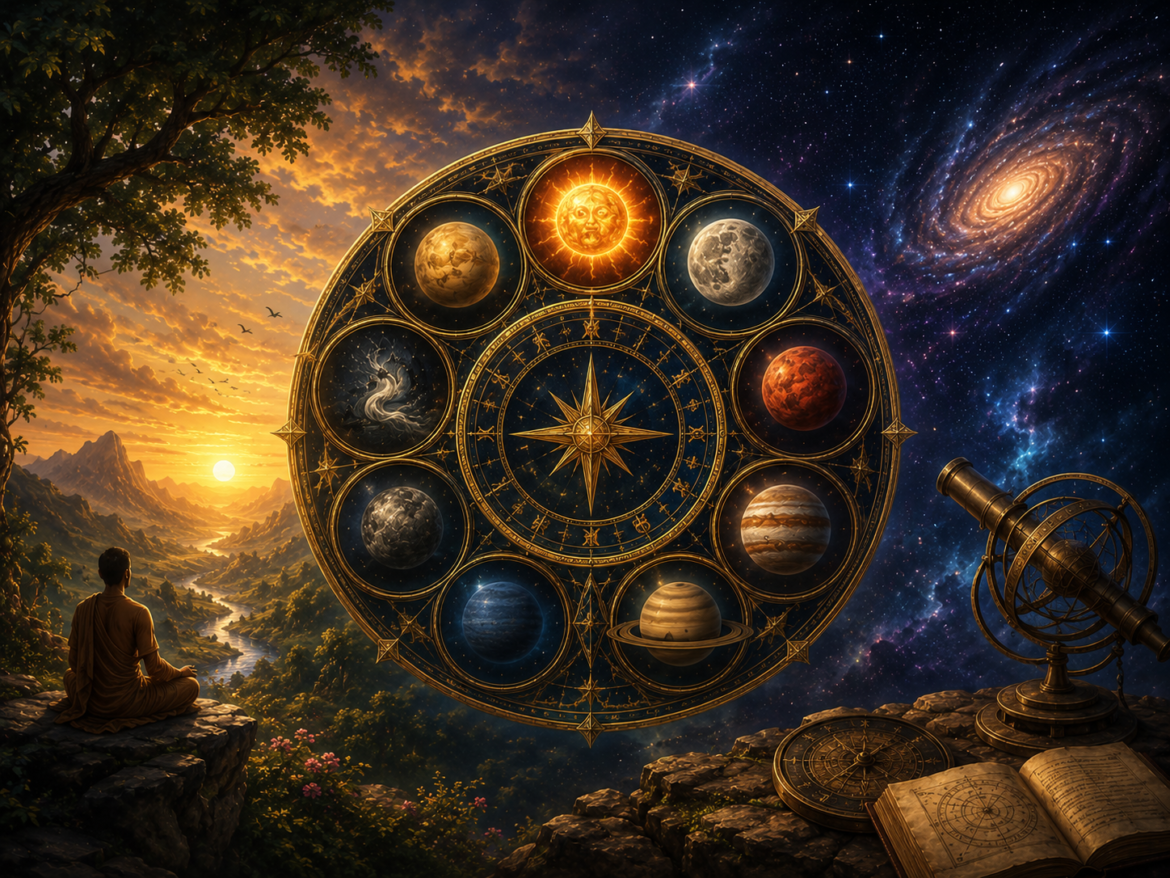
Mahadashas are one of the most important concepts in Vedic astrology. In fact, many astrologers consider them to be the foundation of predictive astrology because they help answer one of the most important questions a birth chart can raise, which is: WHEN?
A birth chart can reveal a tremendous amount of information about a person’s character, talents, challenges, desires, relationships, career potential, and overall life path. However, the chart itself does not always explain when specific themes are likely to become active. A chart may contain indications for marriage, wealth, career success, spiritual development, or major life changes, but the timing of those experiences is often revealed through the Dasha system.
According to Vedic astrology, life unfolds through a series of planetary chapters. During each chapter, a particular planet becomes more influential and begins directing the larger themes of a person’s experience. As a result, different periods of life often feel very different from one another. One chapter may revolve around education and personal growth, another may focus on career and achievement, while another emphasizes relationships, family, creativity, or spiritual development.
These planetary chapters are known as Mahadashas – or “Dashas” for short.
The Basics ofDashas
The word Mahadasha comes from Sanskrit and is usually translated as “great period” or “major cycle.”
A Mahadasha is a long-term planetary period during which one of the nine planets used in Vedic astrology becomes especially important. Each planet represents a unique collection of themes, motivations, experiences, and lessons. When a planet’s Mahadasha begins, the topics associated with that planet often become more prominent within the person’s life.
For example, Venus is associated with relationships, attraction, beauty, pleasure, creativity, prosperity, and personal values. During Venus Mahadasha, these subjects often become increasingly important. Saturn, by contrast, is associated with responsibility, discipline, endurance, hard work, and maturity. During Saturn Mahadasha, people frequently find themselves dealing with greater responsibilities and learning lessons that require patience and persistence.
The active Mahadasha does not replace the birth chart. Instead, it acts like a spotlight that illuminates particular parts of the chart and makes them more active than they were before.
Many astrologers compare Mahadashas to chapters in a book. The birth chart describes the entire story, while the Mahadasha helps reveal which chapter is currently unfolding.
The History of the Dasha System
The Dasha system originates from the ancient astrological traditions of India and has been used for many centuries.
Early astrologers recognized that understanding a person’s potential was only part of the challenge. They also wanted to understand timing. If a chart indicated success, when would that success arrive? If a chart showed marriage, when would the relationship appear? If a chart suggested spiritual growth, when would that development occur?
To answer these questions, astrologers developed various timing systems known collectively as Dashas.
Several Dasha systems exist within Vedic astrology, but the most widely used by far is Vimshottari Dasha. Today, when astrologers refer to a person’s Mahadasha, they are usually referring to the Vimshottari system unless otherwise specified.
The word Vimshottari means “120.” This refers to the total length of the complete planetary cycle, which spans 120 years. The nine planetary periods together add up to a total of 120 years and form the foundation of the system.
Why the Mahadashas Always Occur in the Same Order
One of the most common questions beginners ask is why the Mahadashas always occur in the same sequence.
Regardless of who you are, the order never changes.
After Venus, the sequence repeats back to the Sun.
This order is not arbitrary. It comes directly from the Nakshatras.
In Vedic astrology, the zodiac is divided into twenty-seven Nakshatras, often translated as lunar mansions. Each Nakshatra is assigned a planetary ruler. The rulers of the Nakshatras follow the same repeating sequence: Sun, Moon, Mars, Rahu, Jupiter, Saturn, Mercury, Ketu, and Venus.
Because the Mahadasha system is derived from the Nakshatras, it follows the exact same pattern.
This means the sequence itself never changes. What changes from person to person is the starting point. One person may begin life during a Venus Mahadasha, another during a Saturn Mahadasha, and another during a Moon Mahadasha. Once the starting point is established, however, the sequence continues in the same order for everyone.
The Nine Mahadashas
Each Mahadasha has a different duration and emphasizes different themes.
Sun Mahadasha lasts six years and is commonly associated with identity, confidence, leadership, authority, visibility, recognition, and personal purpose.
Moon Mahadasha lasts ten years and often emphasizes emotions, family, nurturing, security, intuition, sensitivity, and one’s inner life.
Mars Mahadasha lasts seven years and frequently increases ambition, courage, initiative, independence, competitiveness, action, the use of force, and occasionally conflict.
Rahu Mahadasha lasts eighteen years and is often associated with attachment, illusion, gains, worldly achievement, materialism, obsession, deception, manipulation, and dramatic life changes.
Jupiter Mahadasha lasts sixteen years and commonly emphasizes learning, wisdom, prosperity, spirituality, teaching, opportunity, and growth.
Saturn Mahadasha lasts nineteen years and frequently focuses on responsibility, discipline, hard work, endurance, maturity, structure, and long-term achievement.
Mercury Mahadasha lasts seventeen years and often highlights communication, learning, writing, commerce, business, networking, analysis, and intellectual development.
Ketu Mahadasha lasts seven years and is commonly associated with detachment, introspection, spiritual development, simplification, endings, loss, and the release of attachments.
Venus Mahadasha lasts twenty years and frequently emphasizes relationships, love, beauty, pleasure, prosperity, creativity, art, and personal fulfillment.
Together, these nine periods create the complete 120-year Vimshottari cycle.
How the Starting Mahadasha Is Determined
The starting point of a person’s Mahadasha sequence is determined by a Nakshatra.
Traditionally, astrologers examine the Nakshatra occupied by the Moon at birth. The planetary ruler of that Nakshatra becomes the first Mahadasha lord.
For example, if the Moon occupies a Nakshatra ruled by Jupiter, then Jupiter Mahadasha becomes the starting Mahadasha.
However, people are not all born at the beginning of a Nakshatra. Some are born near the middle, while others are born near the end. Because of this, individuals begin life with different amounts of their starting Mahadasha remaining.
One person may have only a few months left before the next Mahadasha begins. Another may have many years remaining.
This creates a unique sequence of planetary periods for every individual.
Moon Nakshatra vs. Ascendant Nakshatra
Although the traditional Vimshottari system uses the Moon’s Nakshatra as its starting point, some astrologers also calculate Mahadashas from the Ascendant Nakshatra (and sometimes even from the Sun or other planets).
The Ascendant, often called the Rising Sign, is the sign that was rising on the eastern horizon at the moment of birth. Like the Moon, the Ascendant also occupies a Nakshatra.
In this alternative approach, the ruler of the Ascendant Nakshatra becomes the starting point for the Dasha sequence rather than the ruler of the Moon’s Nakshatra.
Personally, I prefer to use the Ascendant Nakshatra as the anchor for Mahadasha analysis. While the Moon-based method remains the traditional approach, I have consistently found the Ascendant-based Dashas to be far more accurate when timing major life developments and externally observable events.
In my experience, Moon-based Dashas often describe a person’s emotional and subjective experience, while Ascendant-based Dashas frequently correspond more closely to what is actually happening in the external world. For this reason, I regularly examine Ascendant-based Dashas and consider them an extremely valuable tool for prediction.
How Astrologers Interpret a Mahadasha
Many beginners assume that interpreting a Mahadasha is simply a matter of looking up the meaning of the active planet.
In reality, the process is much more involved.
Suppose a person enters MoonMahadasha. An astrologer doesn’t just stop at the statement, “Moon represents feelings and security.” Instead, the astrologer locates the Moon in the birth chart and begins examining its placement.
Which sign is the Moon occupying?
Which house is the Moon located in?
Which houses does the Moon rule?
Is the Moon joined with other planets?
Is the Moon receiving aspects from other planets?
Is the Moon strong, weak, supported, or challenged?
The answers to these questions help determine how the Mahadasha is likely to unfold.
Because every chart is unique, two people can experience the same Mahadasha very differently.
The Importance of House Placement
One of the first things astrologers examine is the house occupied by the Mahadasha lord.
The houses represent different areas of life.
The 1st house relates to identity and personal development.
The 4th house relates to home, family, and emotional foundations.
The 7th house relates to relationships and partnerships.
The 10th house relates to career, reputation, and public life.
When a planet’s Mahadasha becomes active, the house it occupies often becomes one of the primary areas through which the Mahadasha expresses itself.
For example, if Venus occupies the 7th house, relationships may become especially important during Venus Mahadasha. If Saturn occupies the 10th house, career and professional responsibilities may become major themes during Saturn Mahadasha.
This is why house placement is considered one of the most important factors in Dasha interpretation.
The Importance of House Rulership
Astrologers also pay close attention to the houses ruled by the Dasha planet.
In Vedic astrology, every house begins in a particular zodiac sign, and every sign has a planetary ruler. As a result, planets become responsible for governing certain houses within the chart.
When a planet’s Mahadasha becomes active, the houses it rules often become activated as well.
For example, suppose Jupiter rules the 2nd house of finances and the 5th house of creativity and children. During Jupiter Mahadasha, themes involving money, family resources, creativity, education, and children may become especially important.
Many astrologers consider house rulership to be just as important as house placement when interpreting a Mahadasha.
The Importance of Planetary Strength
Not all planets are equally capable of expressing their influence.
Some planets are considered strong and well-positioned, while others may be weakened, challenged, or restricted.
A strong planet generally has an easier time expressing its positive qualities. A weakened planet may still produce its themes, but often through greater obstacles, delays, frustrations, or learning experiences.
This is one reason why two individuals can experience the same Mahadasha in dramatically different ways.
The Mahadasha may be the same, but the condition of the planet within the birth chart can be completely different.
What an Antardasha Is
Within every Mahadasha are smaller planetary periods known as Antardashas.
If the Mahadasha represents the major chapter of life, the Antardasha represents a smaller chapter within that larger story.
Each Mahadasha contains all nine planetary Antardashas. As a result, the emphasis shifts throughout the Mahadasha even though the larger theme remains the same.
For example, someone running Jupiter Mahadasha may experience Jupiter-Mars, Jupiter-Rahu, Jupiter-Saturn, Jupiter-Venus, and all the other Jupiter sub-periods over the course of that Mahadasha.
Each Antardasha introduces an additional planetary influence into the larger story.
How Mahadasha and Antardasha Work Together
The interaction between the Mahadasha lord and the Antardasha lord forms the basis of much predictive work in Vedic astrology.
The Mahadasha establishes the larger themes of the period, while the Antardasha determines which parts of those themes become especially active.
For example, Saturn Mahadasha may create a chapter focused on responsibility, discipline, and long-term achievement. When Venus Antardasha arrives, relationships, finances, creativity, and social connections may become more important within that broader Saturnian framework.
Similarly, Jupiter Mahadasha may emphasize growth and opportunity, while a Mars Antardasha increases ambition and action. A Moon Antardasha may shift attention toward family, emotions, and personal well-being.
In this way, the Mahadasha provides the larger storyline while the Antardasha describes the specific developments occurring within that storyline.
Why Mahadashas Are So Important
Many astrologers consider Mahadashas to be among the most powerful predictive tools available in Vedic astrology.
Transits often describe temporary influences lasting days, weeks, or months. Mahadashas, by contrast, describe the larger chapters of life that can unfold across many years.
They help explain why one period becomes heavily focused on relationships, another on career, another on finances, another on education, and another on spiritual growth.
Without the Dasha system, many important questions about timing become far more difficult to answer.
For this reason, Mahadashas remain one of the cornerstones of Vedic astrology.
Understanding the Larger Chapters of Life
At its core, the Mahadasha system is a method for understanding life’s larger chapters.
Rather than viewing life as a random sequence of events, Vedic astrology sees it as a gradual unfolding of different planetary influences, each bringing its own opportunities, challenges, priorities, and lessons.
Some periods encourage growth and expansion. Others demand discipline and responsibility. Some emphasize relationships and connection, while others encourage introspection and spiritual development.
Overall, Mahadashas provide a framework for understanding how the birth chart unfolds through time. By identifying the active planetary period and studying its placement within the chart, astrologers can gain valuable insight into the themes that are likely to define a particular chapter of life. Through this system, the changing seasons of life become easier to understand, helping reveal the larger story that is gradually unfolding over time.