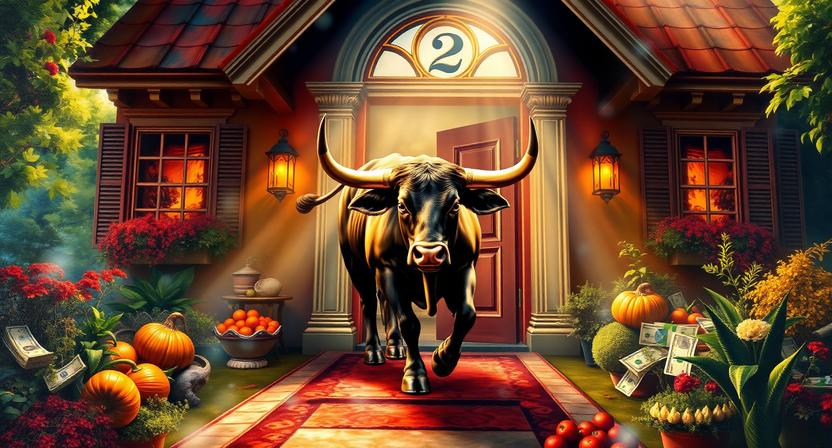
Article Summary: Everybody thinks of the 2nd House as the house of money. But in a more fundamental sense, it is simply the house that refreshes us both physically and emotionally. Like an ice cold drink on a hot summer day, the 2nd house is the change of pace we all crave. It shows what boosts and energizes you. And because its the natural house of Taurus, you will often find that planets and signs in the 2nd House coincide with food, your voice and material possessions.
TThe 2nd House in astrology is often reduced to a single word: money. But this reduction strips the house of its deeper meaning and flattens something that is far more primal, bodily, and essential. Money is only one symbolic expression of the 2nd House, and not even the most accurate one. At its core, the 2nd House describes what sustains life after it has arrived, what keeps the body alive, energized, and capable of continuing forward once the spark of existence has been ignited in the 1st House.
The 1st House is the moment of emergence — the body, the identity, the ego, the fact of being here. The 2nd House answers a quieter but equally important question: What keeps this being alive, nourished, protected, and reinforced? Before money existed, before markets and currencies and wages, there were still Second House concerns. There was food, warmth, shelter, clothing, stored resources, and the ability to preserve energy rather than constantly fight for survival.
The 2nd House is the house of support, continuity, and self-sufficiency. It shows what we gather, what we hold onto, and what we rely on to maintain ourselves over time.
Food & Nourishment
Food is one of the most literal and ancient expressions of the 2nd House. Before wealth could be abstracted into numbers, food was wealth. Grain, livestock, stored supplies, and preserved nourishment were the difference between survival and death. The 2nd House governs what you consume to sustain your physical form, and how you relate to nourishment as a stabilizing force in your life.
This is not merely about eating habits or diet preferences. The 2nd House speaks to your instinctual relationship with nourishment itself. Do you feel safe when you are well-fed? Do you hoard resources out of fear of scarcity, or do you trust that nourishment will come when needed? Are you attuned to your body’s signals of hunger and satiety, or do you override them in the name of productivity, control, or anxiety?
Because the 2nd House supports the 1st House, food here is not indulgence — it is maintenance. It is the fuel that allows the body to continue expressing itself in the world. A weak or challenged 2nd House can sometimes show disrupted eating patterns, inconsistent nourishment, or a complicated emotional relationship with food, while a strong 2nd House often reflects a natural understanding that the body must be fed in order to function.
On a symbolic level, food also represents what you take in from the world to reinforce your sense of self. What ideas, environments, or experiences make you feel more solid, more confident, more “yourself”? These too are forms of nourishment.
Material Possessions
Material possessions are another concrete expression of the 2nd House, but again, they are not about excess or display. The 2nd House governs what you own because it serves a purpose. Clothing, tools, furniture, personal items, and everyday objects that make life easier, safer, or more comfortable all fall under its domain.
These possessions act as extensions of the body. Clothes protect the skin. Beds support rest. Tools amplify physical ability. The 2nd House shows how we use material things to create stability and continuity in our lives. It also reveals our attachment to these objects and the emotional weight we assign to them.
Some people feel deeply unsettled without familiar belongings, while others can travel light with ease. These tendencies are often visible in the 2nd House. It also shows how we feel about ownership itself — whether having something makes us feel secure, burdened, empowered, or trapped.
Importantly, the 2nd House is not about status symbols. That belongs more to later houses concerned with social visibility. The 2nd House is private, intimate, and practical. It is what you rely on when no one is watching.
The Mouth & Voice
Traditionally, the 2nd House is associated with the mouth, throat, and voice. This makes sense when viewed through the lens of intake and output. The mouth is how nourishment enters the body, and the voice is how the self is expressed in a grounded, embodied way.
Speech connected to the 2nd House tends to be steady, deliberate, and rooted in personal experience. This is not the fast exchange of ideas seen elsewhere in the chart, but communication tied to survival, value, and truth as lived in the body.
Issues with the voice, throat, or mouth can sometimes reflect deeper 2nd House themes around being able to ask for what one needs, receive nourishment, or assert personal value. Singing, speaking, and even chewing are bodily acts of participation in life — all deeply 2nd House in nature.
Appetite & Cravings
The 2nd House shows appetite not as excess, but as precision. It reveals what the body and ego crave because that specific thing restores energy more effectively than anything else. Cravings arise from contrast. What we have too much of stops refreshing us, even if it technically sustains us.
If someone lives in constant noise, what they crave is quiet. If life is light, fast, and mentally demanding, they may crave heaviness, slowness, or grounding. The 2nd House points to what feels rich or revitalizing precisely because it is missing from the daily environment.
This applies to food, comfort, texture, pace, and even emotional tone. Appetite here is the body’s intelligence identifying what would best replenish depleted reserves. It is not about indulgence, but restoration. Satisfaction signals that the self has been properly supported, allowing the 1st House — the body and ego — to remain strong and coherent.
Cravings, in this sense, are not distractions. They are messages. The 2nd House shows what the self has a true taste for because that is what keeps life feeling livable, steady, and worth continuing.
What We Consume & Deplete
Because the 2nd House governs food and resources, it also governs consumption itself. To consume something is to take from it, and in doing so, to reduce it. The 2nd House shows what we draw energy from — but also what becomes smaller, depleted, or altered because we rely on it.
This does not apply only to materials. We consume time, attention, environments, and even people. Certain places refresh us while slowly wearing down the space itself. Certain relationships feed our stability while quietly draining the other party. The 2nd House reveals what we habitually “take a bite out of” in order to stay supported.
Seen this way, the 2nd House is not morally charged, but ecological. It asks where our sustenance comes from and at what cost. Every form of nourishment implies extraction. What we depend on is what we inevitably diminish, whether physically, emotionally, or energetically.
Understanding the 2nd House this way brings awareness. It shows not only what keeps us going, but what we are drawing down over time in order to do so — and whether that exchange is sustainable.
Vedic / Sidereal Astrology and the Second House
In Vedic astrology, the 2nd House carries a heavier emphasis on family resources, speech, food, and accumulated wealth. It is closely tied to lineage, upbringing, and the material foundation provided by one’s family of origin.
Speech and voice are particularly important in Vedic interpretations, as is the role of the 2nd House in sustaining life through proper nourishment and ethical resource management. The house is also associated with stored karma, showing what has been accumulated over time rather than what is actively pursued.
Vedic astrologers often treat the 2nd House as a house of continuity — what has been built, preserved, and passed down — rather than personal earning alone. This gives the house a more collective and ancestral tone compared to some Western interpretations.
Ultimately, the 2nd House is about keeping life going. It is not glamorous, dramatic, or loud, but it is essential. It reminds us that existence is not sustained by intention alone. Bodies must be fed. Energy must be restored. Resources must be gathered and protected.
The 2nd House teaches that self-worth is not something to be earned through achievement, but something reinforced through care. When we tend to our basic needs with respect and consistency, confidence follows naturally.
Seen this way, the 2nd House is not really about money at all. It is about the quiet, ongoing labor of supporting life and energy.