Pisces—the fish—is the twelfth sign of the zodiac. It is ruled by Jupiter, the planet of expansion, faith, and meaning, and is a feminine, mutable water sign. Feminine signs draw energy inward. They are more passive than they are active. Mutable signs change or alter already existing forms, as opposed to maintaining form or beginning it. And water signs are the emotional quadrant of the zodiac and of all life.
What Are The Most Important Themes of Pisces?
Subtraction (Loss) – Taurus is what builds us up and energizes us (food for example), whereas Pisces is the inverse – it represents being drained, fatigued, or depleted. It’s where things are subtracted from us instead of added to us. If Taurus is what we eat, then Pisces is what eats or feeds upon us, making us smaller in some way. I find this both fitting and a bit amusing considering that the mascot for Pisces is the fish, and sharks (a type of fish obviously) are one of the most famous examples of animals that occasionally prey upon or eat human beings.
Separation – Subraction doesn’t always mean that you lose part of your physical form or money or possessions. It can also mean that you lose closeness with people, places, objects or even dimensions. Pisces is the sign of separation; it implies distance between things. For example, when we sleep, a gap forms between our waking reality and our dream world. We are sucked away from the reality we normally live in, and resurface into a place that is completely personal and otherworldly. This is peak Pisces symbolism.
Sleep – Pisces is the sign that comes right before Aries, which is the sign of birth and awakening. If Aries is where we rise and get out of bed, then Pisces must be where we slumber. This is another reason why dreams fall under the domain of Pisces. The most intense dreaming usually takes place right before we wake up.
The fish is one of the most ancient and enduring symbols in human consciousness. Emerging from the depths of rivers, lakes, and seas, it has long represented the mystery of the unseen world—that which exists beneath the surface of ordinary awareness. Because water itself is often associated with the primordial state of creation, fish naturally became emblems of life arising from chaos. In many early cultures, they symbolized fertility, abundance, and the generative power of nature, their prolific reproduction reinforcing associations with multiplication and renewal. To ancient peoples who depended on waterways for survival, fish were not only sustenance but reminders that life flows from hidden sources.
In religious symbolism, fish frequently take on sacred meaning. In Christianity, the ichthys became a discreet emblem of faith among early believers, representing both Christ and spiritual nourishment. In Mesopotamian myth, the god Oannes was depicted as a fish-like being who rose from the sea to teach humanity wisdom, linking fish with revelation and civilizing knowledge. In Hindu tradition, the god Vishnu incarnated as Matsya, a great fish who saved sacred texts and guided humanity through a cosmic flood. Across these traditions, the fish is not merely an animal but a mediator between realms—moving effortlessly through depths that humans cannot inhabit, symbolizing guidance through overwhelming waters and protection amid dissolution.
Mythology also casts fish as creatures of transformation and liminality. In Greek myth, Aphrodite and Eros are said to have transformed into fish to escape danger, a story later linked to the constellation Pisces. Here, fish represent adaptability and survival through surrender rather than force. In East Asian traditions, the koi fish symbolizes perseverance and spiritual advancement, swimming upstream as an image of determination that eventually leads to transcendence. Throughout folklore, fish often appear in dreams, prophecies, and fairy tales as bearers of hidden treasure or secret wisdom, reinforcing their connection to the subconscious and intuitive realms.
Taken together, the symbolism of fish moves fluidly between abundance and asceticism, fertility and faith, survival and salvation. They inhabit thresholds—the boundary between surface and depth, conscious and unconscious, life and dissolution. Across cultures and centuries, the fish endures as a symbol of life emerging from invisible waters, a reminder that what sustains and transforms us often lies beneath what we can readily see.
The Symbolism Of Number 12
The number 12 has carried profound symbolic weight across civilizations. It structures time itself: twelve months in a year, twelve divisions of the zodiac, and traditionally twelve hours marking day and night. In ancient cultures, 12 often represented cosmic order and completeness, a number that suggested a cycle brought to fulfillment. The Babylonians favored a base-12 counting system; in Judaism there are the Twelve Tribes of Israel; in Christianity, twelve apostles gather around Christ; in Greek mythology, twelve Olympian gods preside over the cosmos. Again and again, 12 appears where a system reaches structural wholeness—where multiplicity is organized into an intelligible whole.
Mathematically and numerologically, 12 is considered highly composite and divisible (2, 3, 4, and 6 all divide it evenly), reinforcing its symbolism of integration and structural harmony. In numerology, it is often reduced to 3 (1 + 2), linking it to synthesis, expression, and expansion. Yet before reduction, the visual and conceptual pairing of 1 and 2 remains suggestive: the individual principle (1) standing beside duality (2). One can interpret 12 as unity entering polarity, or leadership moving into relationship. It marks the point where singular identity must reconcile with multiplicity—an idea especially resonant at the twelfth stage of any symbolic cycle.
It is also interesting—though admittedly symbolically playful—that when you break 12 apart, you get “one” and “two.” And considering that “two” sounds like “tooth,” one could whimsically read 12 as “one tooth.” This may take interpretive liberty, but symbolically it aligns strikingly with Piscean themes of erosion, surrender, and old age. If one imagines Pisces in human form, an evocative image might be that of a very old woman—wrinkled, quiet, and profoundly wise—who has weathered decades of bodily decline and is left with a single tooth after years of gradual loss. The image is not grotesque but poignant: what remains after time has stripped away excess. In this sense, 12 can symbolize the final stage of a cycle, when form has thinned and essence is revealed.
Across history and mysticism, then, 12 stands at the threshold between completion and dissolution. It closes the circle of the zodiac and prepares the way for renewal. Whether viewed as sacred structure and divine order or as the last fragile remnant before rebirth, the number 12 carries a dual message: fulfillment and fading, culmination and quiet surrender.
The Pisces Constellation
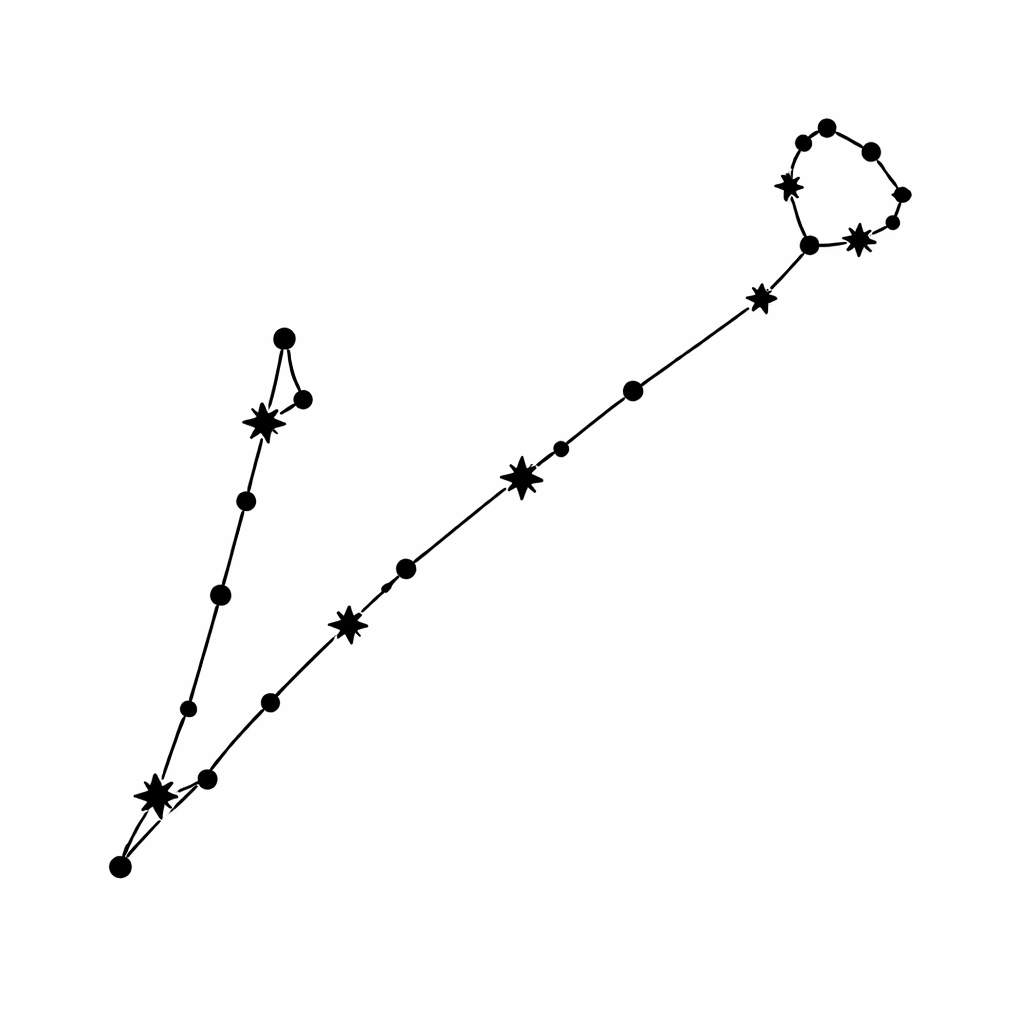
The constellation Pisces is one of the oldest recognized star patterns in the sky, tracing its origins back to ancient Mesopotamia. The Babylonians associated it with two fish tied together by a cord, a motif that has endured for over two millennia. Today, Pisces occupies a broad stretch of sky along the ecliptic, meaning the Sun, Moon, and planets regularly pass through it. Though it is one of the largest constellations by area, it is also among the faintest, composed mostly of dim stars that require dark skies to appreciate fully. Its subtle visibility reinforces its symbolic association with hidden realms and quiet influence, rather than bold or dramatic display.
The brightest star in Pisces is Alrescha, whose name comes from the Arabic phrase meaning “the cord.” Appropriately, Alrescha marks the knot where the two fish are bound together, visually and mythologically linking the pair. Other notable stars include Fumalsamakah, whose name means “the mouth of the fish,” and Revati, a star long honored in Indian astronomy and astrology as one of the lunar mansions (nakshatras). Unlike constellations anchored by a single brilliant star, Pisces is defined more by its shape and story than by luminosity. Its faintness has historically made it something of a challenge for observers, giving it an elusive, almost dissolving quality in the night sky.
Pisces also contains several deep-sky objects of interest. The spiral galaxy Messier 74 (often nicknamed the “Phantom Galaxy”) lies within its boundaries and is a favorite target for astrophotographers due to its nearly face-on orientation. Though not visible to the naked eye, Messier 74 is significant to astronomers because of its well-defined spiral arms and active star-forming regions. The constellation is also home to the Pisces Dwarf galaxy, a small satellite galaxy of the Milky Way discovered in the 20th century, adding another layer of quiet cosmic intrigue to this understated region of space.
Astronomically, Pisces marks the location of the vernal equinox point in antiquity, though due to axial precession this point has shifted over time. During the so-called “Age of Pisces,” roughly associated with the last two millennia, the Sun rose in Pisces at the spring equinox—an alignment that has fueled centuries of symbolic interpretation. Whether viewed through mythology, observational astronomy, or cultural symbolism, Pisces occupies a unique place in the sky: expansive yet faint, ancient yet evolving, a constellation that invites patience and reflection rather than immediate spectacle.
Pisces In Tropical vs. Vedic Astrology
The interpretation of Pisces differs meaningfully between tropical and Vedic astrology, largely because the two systems are built on different astronomical frameworks. Tropical astrology is season-based, anchoring the zodiac to the vernal equinox, so Pisces always occupies the final 30 degrees of the seasonal cycle regardless of the shifting constellations. In this framework, Pisces symbolizes the psychological culmination of experience—the dissolution of ego boundaries before rebirth into Aries. It is often interpreted through a modern lens as intuitive, imaginative, compassionate, and sometimes escapist, emphasizing inner states, emotional permeability, and spiritual longing.
Vedic astrology (Jyotish), by contrast, uses a sidereal zodiac aligned more closely with the observable constellations. As a result, what tropical astrology calls Pisces may not correspond to Pisces in a Vedic chart. In Jyotish, Pisces (Meena) is ruled by Jupiter and is deeply connected to dharma, liberation, and divine grace. While compassion and spirituality are still central themes, the emphasis tends to be more metaphysical and karmic than psychological. Pisces is associated with moksha (spiritual liberation), pilgrimage, charity, withdrawal from worldly ambition, and the final release from the cycle of rebirth. Rather than framing Pisces primarily as sensitive or dreamy, Vedic interpretation often highlights renunciation, wisdom born of suffering, and the soul’s readiness to detach from material entanglement.
Another key difference lies in planetary rulership. Modern tropical astrology frequently assigns Neptune as the ruler of Pisces, reinforcing themes of illusion, mysticism, and transcendence. Vedic astrology does not use Neptune in its traditional framework; Pisces is ruled solely by Jupiter. This gives the sign a more philosophical and ethical tone in Jyotish, rooted in higher knowledge and spiritual counsel rather than fog, confusion, or dissolution. Even when Vedic astrologers acknowledge Neptunian symbolism in a modern context, it is secondary to Jupiter’s expansive and protective influence.
Ultimately, tropical astrology tends to interpret Pisces through the lens of psychological sensitivity and symbolic imagination, while Vedic astrology situates Pisces within a larger karmic and spiritual architecture aimed at liberation. Both systems recognize Pisces as the final sign of the zodiacal cycle, but tropical astrology often emphasizes emotional and creative expression, whereas Vedic astrology underscores surrender, faith, and the transcendence of worldly identity.
Origin & Word Resonance
The word Pisces comes directly from Latin, where piscēs is the nominative plural of piscis, meaning “fish.” The singular form, piscis, referred broadly to fish as aquatic creatures, while piscēs simply meant “fishes.” When the Romans adopted and formalized much of the Hellenistic zodiac, they retained this Latin term to designate the twelfth sign. The simplicity of the name is striking: unlike some zodiac signs whose names evolved through layered mythological reinterpretation, Pisces preserves a direct linguistic link to its most literal image—the two fish bound together in the sky.
The Latin piscis belongs to the Proto-Indo-European root peysk- (or pisk-), which also meant “fish.” From this root developed related words across Indo-European languages. In English, we see its descendants in terms such as “piscine” (pertaining to fish) and “piscatory” (relating to fishing). French retains poisson, Italian pesce, and Spanish pez, all tracing back to the same Latin source. This shared lineage reflects how central fish were to ancient societies, not only as sustenance but as symbols embedded in language itself. The etymology reinforces Pisces’ association with water, fertility, and sustenance, themes that long predate astrological codification.
In Greek, the constellation was known as Ikhthyes (Ἰχθύες), also meaning “fishes.” The Greek word ichthys later became significant in early Christianity as an acronymic symbol for Jesus Christ, further intertwining linguistic history with religious symbolism. When Roman scholars translated Greek astronomical works, they rendered Ikhthyes into Latin as Pisces, cementing the term in Western astrological tradition. Over time, the word moved unchanged into English through medieval Latin texts, where it retained both its literal meaning and its astrological significance.
Thus, the origin of “Pisces” is linguistically straightforward yet culturally layered. Its root meaning—simply “fish”—anchors the sign in something ancient and elemental. At the same time, its transmission through Greek and Roman scholarship situates it within the broader history of astronomy, mythology, and sacred symbolism. The etymology itself mirrors the sign’s nature: fluid, continuous, and carried across civilizations like a current moving through time.
How To Interpret Pisces In A Birth Chart
When I interpret Pisces in a birth chart, I immediately look for three core themes: depletion or loss, sleep or altered states, and separation or distance. No matter how poetic or spiritual the sign may sound in theory, in lived experience it very often manifests through one (or more) of these tangible realities. Pisces dissolves, softens, erodes, and diffuses whatever it touches. Depending on its house placement, planetary involvement, and condition, that dissolving quality can express as something subtle and internal—or unmistakably concrete.
If Pisces is connected to the 10th House, for example, I frequently see career paths that involve physical relocation, foreign countries, or long stretches away from family. The profession itself may require detachment, retreat, or working behind the scenes. Sometimes the public image feels vague or difficult to define.
If Mars is in Pisces, I often notice that conflict, competition, or excessive exertion becomes draining rather than energizing. The person may feel that direct confrontation weakens them, or that their courage ebbs quickly under pressure. When Pisces colors action, effort tends to leak rather than surge.
In the 4th House, especially if afflicted, Pisces can show up through themes of absence or withdrawal in the home. I have seen charts where a parent—often the mother—struggles with sleep disorders, chronic fatigue, escapism, or emotional unavailability. Other times it manifests as literal distance: separation from one’s homeland, growing up near large bodies of water, or experiencing a sense of drifting within the family structure. The specifics vary endlessly, but the underlying current remains consistent: something dissolves, something recedes, something grows quiet.
What fascinates me is how adaptable these three motifs are. In the 2nd House, loss may involve finances or fluctuating resources. In the 7th House, separation may define partnerships. In the 3rd House, fatigue can affect the willpower or communication. Pisces does not operate loudly; it operates gradually. It wears things down, thins them out, or carries them away like a tide. Yet it can also open doors to rest, surrender, and spiritual awareness through those very processes. However you slice it, when Pisces is activated in a chart, depletion, sleep, or separation almost always weave their way into the native’s lived reality in some form.
Pisces closes the zodiac not with force but with release. Its symbolism spans ancient fish myths, sacred waters, and a faint constellation that avoids spectacle. Wherever Pisces appears—astronomically, mythologically, or in the birth chart—it points to thresholds: the edge between worlds, where form begins to soften. It may appear as compassion or confusion, retreat or transcendence, erosion or enlightenment. What unites these expressions is a movement away from density and toward subtlety. Pisces reminds us that every cycle ends and every identity eventually loosens its grip, returning to the vast interior ocean from which new life quietly emerges.