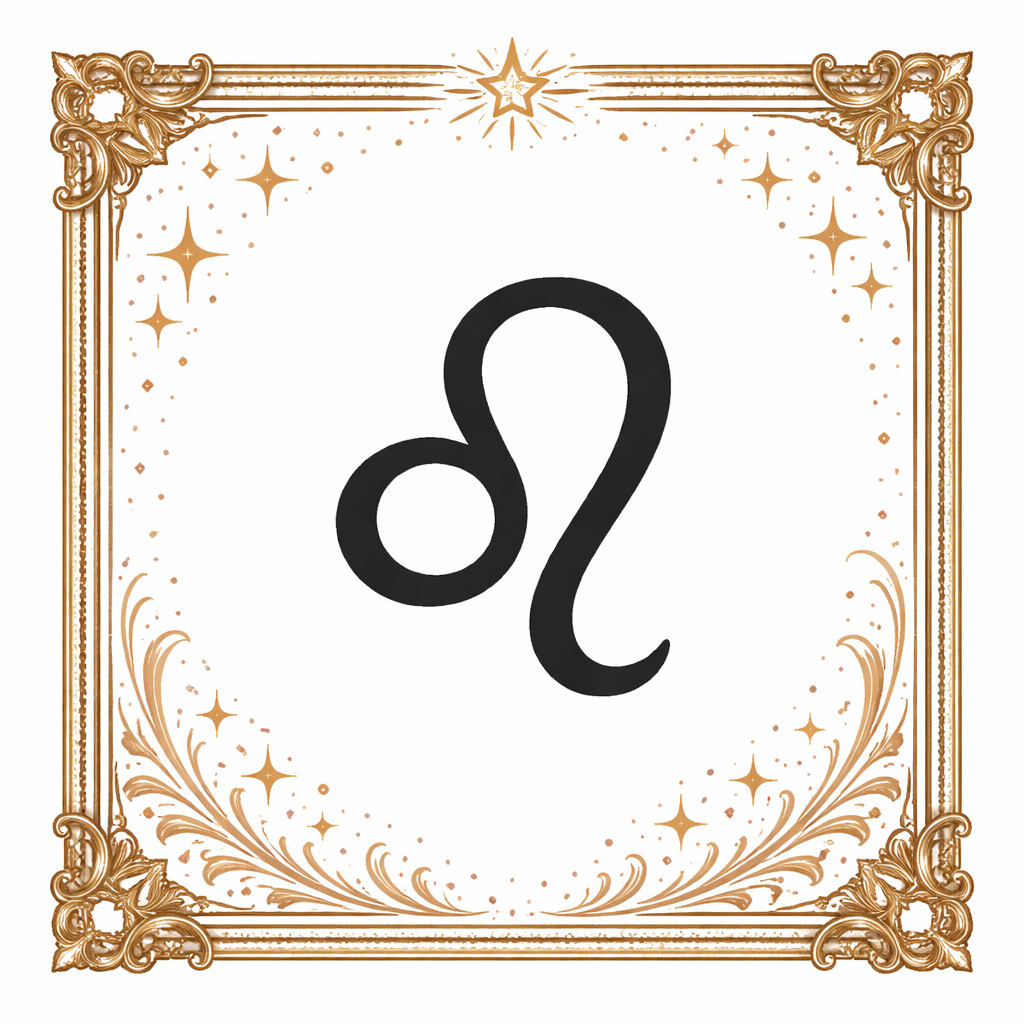
Leo– the lion– is the fifth sign of the zodiac. It is a masculine, fixed fire sign and is the only sign ruled by the Sun. Masculine signs are outwardly expressive, and Leo channels that energy through creativity, confidence, and bold self-projection. As a fixed sign, Leo sustains what it ignites, holding steady in its passions and standing firmly in its identity. Its element, fire, radiates warmth and vitality, making Leo charismatic, demonstrative, and vividly alive to the moment. Where some signs retreat into reflection or diffuse themselves into the atmosphere, Leo moves through declaration—guided not by hesitation, but by creative will, personal pride, and the steady glow of an inner sun—constantly seeking to shine, to inspire, and to animate the world with its presence.
Leo Words & Phrases
acclaim, actor, applause, arena, arrogant, attention, authority, banner, basking, big cat, blessed, blessings, boastful, bratty, brilliance, center of attention, center stage, charisma, child at heart, children, confidence, creativity, crown, Dad, dignity, drama, dramatic display, dynasty, egotistical, emblem, endowed, entertainer, entitled, exhibition, expression, fame, Father, fatherhood, flair, “full of yourself”, gamble, games, gifts, gifted, glamorous, glitter, glory, gold, golden, golden light, “hard to miss”, heart, heartbeat, heir, heir to the throne, highlighted, high noon, honor, icon, identity, illuminated, inspiration, king, lion, lionhearted, lucky, luck, majesty, monarch, monarchy, movie star, nepotism, nobility, noticeable, pageantry, performance, play, playfulness, pop star, pride, privilege, proud, prominence, progeny, publicity, public, queen, radiant, radiance, regal, regality, recognition, risk, rock star, royal blood, royalty, ruler, shining, sire, son, sovereignty, soul, spotlight, spoiled, sports star, stage, star, sun, sunlight, sunshine, talent, theater, the one who inherits, throne, unique, visible, visibility, “front and center”
The Symbolism Of The Lion
Across civilizations, the lion has stood as one of humanity’s most enduring symbols of royalty, power, and visible authority. In ancient Mesopotamia, lions appeared in royal art as emblems of dominance and divine sanction, most famously in the Ishtar Gate of Babylon. Kings were often depicted hunting lions—not merely as sport, but as a ritual display of their right to rule. To conquer the lion was to prove mastery over chaos itself. The animal became a living metaphor for sovereignty: fierce, commanding, and impossible to ignore.
In ancient Egypt, the lion carried solar and protective meaning. The goddess Sekhmet embodied both destruction and healing, linking the lion to the scorching power of the sun and the blazing force of divine will. Lion-bodied statues guarded temples and tombs, most famously the Great Sphinx of Giza, fusing human intelligence with leonine strength. Here the lion symbolized vigilance, radiance, and sacred guardianship—an animal whose presence marked something important, even holy.
Greek mythology cast the lion as a creature worthy of heroic confrontation. The Nemean Lion, slain by Heracles, possessed an impenetrable hide, making it nearly invincible. Once defeated, its skin became the hero’s cloak—a visible sign of triumph and inherited power. In this story, the lion represents a trial of worthiness; to wear its image is to embody courage and earned glory. The symbol evolves from adversary to emblem, from beast to badge.
Across medieval Europe, lions roared across coats of arms, banners, and royal crests. In heraldry, the lion signified nobility, bravery, and dynastic legitimacy. The “lion rampant” stance—upright, claws extended—projected animation and readiness, a creature perpetually front and center. Even in regions where lions did not naturally live, the image endured as shorthand for majesty and inherited right. The animal’s symbolic life far exceeded its physical habitat.
In Asian traditions, the lion took on a more mythical form. The stone guardian lions—often called “foo dogs” in the West—stand watch at temples and palaces throughout China, embodying protection, prosperity, and status. In India, the lion is associated with royalty and divine power, appearing as the mount of the goddess Durga and as the emblem of emperors. Whether solar, royal, heroic, or protective, the lion consistently symbolizes a being meant to be seen—radiant, commanding, and unmistakably significant.
Throughout history, the lion has rarely represented subtlety. It stands for presence that cannot be diminished, for a spirit that claims space rather than waits to be granted it. Across myth and monarchy alike, the lion is the creature of the throne, the emblem of the crown, and the image of a power that shines openly rather than hides.
The Symbolism Of Number 5
The number 5 has long been associated with human life, movement, and dynamic balance. Physically, it mirrors the human form: two arms, two legs, and a head—five outward extensions from a central core. Many ancient traditions viewed five as the number of embodied experience, since we navigate the world through five senses: sight, sound, touch, taste, and smell. In this way, five symbolizes contact with the tangible world—participation rather than withdrawal, engagement rather than abstraction.
In ancient philosophy, five often marked the point where stability meets animation. The Greeks spoke of five elements, adding aether to earth, water, air, and fire—suggesting a bridge between the material and the divine. In Chinese cosmology, the Wu Xing system identifies five phases—wood, fire, earth, metal, and water—describing cycles of generation and control that structure reality itself. Here, five does not represent rigidity, but circulation: a living system in motion, constantly transforming.
Religions and sacred traditions also elevate the symbolism of five. In Islam, there are Five Pillars that structure spiritual life. In Judaism, the Torah consists of five books. In Christianity, Christ is traditionally depicted with five sacred wounds. Across these traditions, five signifies a complete framework for expression—something whole, yet active. It is not the static completeness of four, nor the abstract harmony of six; it is structure infused with vitality.
In numerology, 5 is the number of freedom, curiosity, and expansion through experience. It represents the urge to explore, to test limits, and to learn by direct encounter. Where one initiates and four stabilizes, five disrupts equilibrium just enough to generate growth. It is associated with versatility, adaptability, and the courage to step beyond what is familiar. At its highest expression, five reflects magnetism and personal dynamism—a presence that attracts attention because it is vividly alive.
Also, I think it is worth pointing out that in the English language, the word “five” sounds quite similar to the words “fever” and “favor”. A fever is when heat concentrates in the body, which is very reminiscent of Leo considering that Leo is fixed fire. As for “favor”, Leo represents blessings and gifts, which are words that are closely related. If someone favors you, they are likely to give you things of value.
The Leo Constellation
The constellation Leo is one of the oldest recognized star patterns in the sky, its outline unmistakably shaped like a reclining lion. Ancient astronomers in Mesopotamia identified it thousands of years ago, associating it with kingship and seasonal heat. By the time of Ptolemy in the 2nd century CE, Leo was formally cataloged as one of the 48 classical constellations, and it remains one of the 88 modern constellations recognized today. Its visibility and bold outline have helped it endure as one of the most easily recognizable figures in the night sky.
Leo’s brightest star is Regulus, whose name means “little king” in Latin. Regulus sits almost directly on the ecliptic—the apparent path of the Sun—making it especially significant in both astronomy and astrology. In ancient Persia, it was one of the Four Royal Stars, guardians of the heavens associated with power and watchfulness. Astronomically, Regulus is not a single star but part of a multiple-star system, adding hidden complexity beneath its brilliant surface.
Another distinctive feature of Leo is the “Sickle,” a curved pattern of stars that forms the lion’s head and mane. This arc resembles a backward question mark, with Regulus marking the base. To the east lies the star Denebola, whose name derives from Arabic, meaning “the lion’s tail.” Denebola is relatively close to Earth in astronomical terms and is known for its rapid rotation, which causes it to bulge slightly at its equator. Together, these stars create a figure that is both visually striking and symbolically cohesive—head, heart, and tail stretched across the spring sky.
Leo is also home to several notable deep-sky objects. The “Leo Triplet”—a grouping of spiral galaxies including Messier 65 and Messier 66—offers astronomers a dramatic glimpse into galactic structure and interaction. These galaxies, visible through moderate telescopes, remind observers that Leo is not only mythic but cosmically expansive. When visible in the Northern Hemisphere during late winter and spring, the constellation stands high and clear, commanding attention in much the same way its symbolic lion has done throughout history—prominent, luminous, and difficult to overlook.
Leo In Tropical vs. Vedic Astrology
In tropical astrology, Leo is defined by the seasonal zodiac used in most Western systems. The tropical zodiac begins at the vernal equinox, meaning the signs are anchored to the Earth’s relationship to the Sun rather than to fixed stars. In this framework, Leo corresponds to the height of summer in the Northern Hemisphere—a time of maximum light, heat, and visibility. As a result, tropical Leo is often interpreted through themes of self-expression, creativity, confidence, and personal radiance. It symbolizes the fully illuminated self: identity made visible, individuality on display, and the urge to shine without apology.
In Vedic astrology, also known as Jyotisha, Leo (Simha) is measured using the sidereal zodiac, which aligns the signs with the actual constellations in the sky. Because of the precession of the equinoxes, the sidereal zodiac currently runs roughly 23–24 degrees behind the tropical zodiac. This means someone considered a Leo in tropical astrology may fall into Cancer in the Vedic system, depending on birth date. The astronomical reference point shifts—but so does the interpretive emphasis.
Philosophically, the two traditions approach Leo differently. Tropical astrology tends to frame Leo psychologically, emphasizing personal identity, creative selfhood, and authentic expression. It often highlights the individual’s need to be recognized and appreciated. Vedic astrology, by contrast, places stronger focus on dharma, authority, lineage, and rightful sovereignty. Simha is ruled by the Sun (Surya), which in Vedic thought represents the soul (atman), vitality, and the kingly principle. Rather than centering on ego expression alone, Vedic Leo is frequently interpreted as the seat of responsibility, honor, and the moral weight of leadership.
Another key distinction lies in predictive technique. Vedic astrology integrates Leo into systems such as dashas (planetary periods) and divisional charts, where the Sun’s strength, dignity, and placement can profoundly alter outcomes related to status, father figures, career authority, and reputation. Tropical astrology, while also considering rulership and dignity, typically emphasizes character development and psychological themes. In short, tropical Leo often asks, “How do you shine?” while Vedic Leo asks, “What is your rightful role, and how do you uphold it?” Both see Leo as solar and sovereign—but one frames it as expressive identity, the other as sacred authority aligned with destiny.
Origin & Word Resonance
The word Leo comes directly from the Latin “leo,” meaning lion, the term used in ancient Rome to describe the animal. Latin leo itself was borrowed from the Greek leōn (λέων), showing how deeply rooted the word is in the classical Mediterranean world. Linguists trace both forms back even further to a Semitic source, likely related to the Hebrew word lāvīʾ (lion). This layered transmission—Semitic to Greek to Latin—reveals how central the lion was to early civilizations that traded, warred, and shared mythologies across regions.
In ancient Greece, the lion already carried mythic weight through stories such as the Nemean Lion defeated by Heracles. When the Romans absorbed Greek mythology and astronomical knowledge, they retained both the constellation and its name with minimal alteration. Thus, Leo entered the Roman zodiac largely unchanged. From Latin, the term passed into Old French and then Middle English, eventually becoming standardized in modern English as both the name of the constellation and the astrological sign.
Interestingly, the root leo also influenced personal names and titles. The name “Leo” has been used by numerous popes and rulers throughout history, reinforcing its connotation of strength and authority. Because Latin served as the scholarly and liturgical language of Europe for centuries, Leo remained the formal astronomical term even as everyday words for lion varied across languages. Today, when we say “Leo,” we are speaking a word that has traveled through millennia—carrying with it echoes of empire, mythology, and celestial mapping—all anchored to the enduring image of the lion.
How To Interpret Leo In A Birth Chart
When I evaluate Leo in a birth chart, I start with one simple idea: Leo represents the king. A king is not self-made. A king inherits. He is born into visibility, resources, protection, and status. Because of that symbolism, Leo often shows where something in the chart carries built-in favor, privilege, or advantage. Not necessarily earned. Not necessarily deserved. Just given.
And this does not have to describe the native directly. It can describe whoever or whatever that house or planet represents. If Leo rules the 7th house, the spouse may be the one who is lucky, gifted, well-connected, or accustomed to attention. If the Moon is in Leo, the mother may be the one who is charismatic, dramatic, spoiled, favored, or somehow treated like royalty. If Leo is on the 10th house cusp, the career itself may involve prominence, publicity, or association with influential people. When I see Leo, I look for where the crown sits — and who is wearing it.
The other major way Leo manifests is through attention and sustained illumination. Leo is fixed fire. Fire is light, and fixed signs hold their position. So Leo represents light that stays on something. A spotlight. When Leo activates an area of life, that area becomes visible. It draws notice. It becomes difficult to ignore. Sometimes that visibility feels glamorous. Sometimes it feels exposing. But either way, it is highlighted.
So in practice, I interpret Leo by asking: Where is the favor? And where is the light being held steady? Because wherever Leo appears, something is often blessed, publicly emphasized, or treated as inherently important.
Leo ultimately represents blessing and illumination. It is the symbol of the crown, the spotlight, and the golden thread of favor that runs through a chart. Whether expressed through inherited advantage, natural talent, proximity to power, or sustained public attention, Leo marks what is treated as significant. It shows where something stands out — not quietly, but visibly. As fixed fire, it is light that does not flicker; it holds its glow. Across mythology, numerology, astronomy, and chart interpretation alike, Leo consistently points to what is highlighted, honored, and difficult to overlook — the place where life says, this matters.