
Key Takeaways: Taurus, the second sign of the zodiac, is primarily concerned with nourishment, material support, and tangible security, providing what is necessary to sustain life once it has begun. Across astrology, numerology, mythology, and the night sky, Taurus consistently embodies the energy that boosts, strengthens, and fuels both the body and the ego/spirit that inhabits it.
As an earth sign, Taurus is concerned with what is tangible, measurable, and materially real. Earth signs deal with substance — land, body, money, food, structure, and physical resources. They are oriented toward what can be built, touched, maintained, and relied upon. Taurus does not operate in abstractions; it operates in physical reality and material stability.
Its modality is fixed, which means it sustains, preserves, and stabilizes whatever it touches. Fixed signs do not initiate cycles, nor do they adapt them — they hold them in place. In Taurus, this shows up as endurance, persistence, and resistance to change. Once something has begun, Taurus maintains it. This is the signature of staying power and consolidation.
Taurus is also feminine (or receptive) in polarity. Feminine signs absorb, internalize, and respond rather than initiate. They consolidate rather than provoke. In Taurus, this creates a temperament that is patient, steady, and deliberate rather than reactive or impulsive.
Finally, Taurus is ruled by Venus. Venus governs attraction, value, pleasure, beauty, and worth. Under Venus’ influence, Taurus becomes attuned to comfort, enjoyment, sensuality, and acquisition. It seeks not only to survive, but to enjoy survival — to cultivate a life that feels stable, pleasing, and secure.

Taurus Words & Phrases
accessories, “adam’s apple” , adornment, assets, beef, beauty, beauty supplies, beverage, bolster, boost, boulders, bountiful, bulls, clothes, consume, cows, decor, decorations, eat, “ego booster”, energize, enrich, fashion, femininity, fertile, food, formation, fuel, furniture, gems, garments, ground beneath your feet, hoarding, indulgence, jewels,, makeup, materials, materialistic, money, mouth, “nice change of pace”, nourishment, nutrition, plant, pleasure, plentiful, possessions, possessiveness, refreshment, reinforce, resources, revitalize, rocks, sediment, sing, speak, stabilize, strengthen, support, tangible, taste, teeth, territorial, the earth, throat, tongue, tooth, two, voice, vittles, wealth

The Symbolism Of The Bull
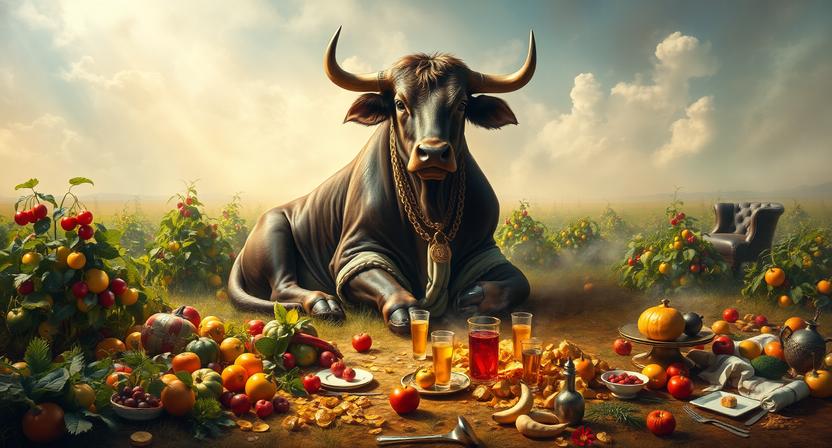
The bull is one of the most ancient and widespread sacred symbols in human history. Across early agricultural civilizations, it represented fertility, physical strength, and material abundance. Because bulls were essential for plowing fields, protecting herds, and sustaining food production, they became living emblems of survival and prosperity. In this sense, the bull was never just an animal — it was wealth on four legs. This symbolism aligns directly with Taurus, the zodiac sign concerned with land, resources, nourishment, and tangible security.
In ancient Egypt, the sacred Apis bull was venerated as a manifestation of divine vitality and earthly power. It symbolized life-force embodied in physical form — not abstract spirit, but spirit grounded in flesh. That theme of embodied divinity mirrors Taurus’ connection to the body, the senses, and the physical world. Taurus is not concerned with ideas floating above reality; it is concerned with what can be touched, tasted, owned, and sustained. The bull’s sacred status reinforced the idea that material life itself is not separate from the divine — it is an expression of it.
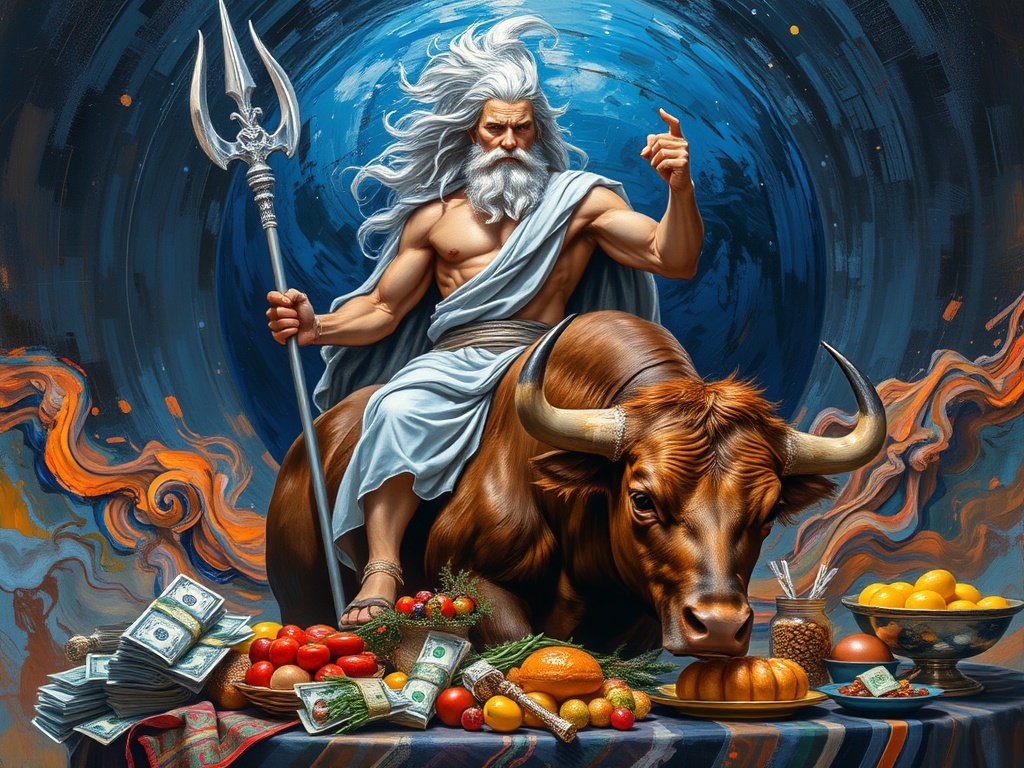
In Greek mythology, Zeus famously transformed into a bull to carry Europa across the sea. This story highlights another dimension of bovine symbolism: sensual magnetism and irresistible attraction. The bull is not only powerful; it is compelling. It draws attention. This reflects Taurus’ rulership by Venus, the planet associated with beauty, pleasure, and attraction. Taurus energy does not chase aggressively — it attracts steadily, confidently, and physically.
In Mesopotamian and Minoan cultures, bulls were associated with kingship, virility, and territorial dominance. Bull-leaping rituals in ancient Crete demonstrated both reverence and respect for the animal’s power. The bull stood for grounded authority — not fleeting force, but enduring, territorial strength. This connects directly to Taurus’ fixed modality. Like the bull, Taurus does not move easily once planted. It holds its ground. It protects what belongs to it.
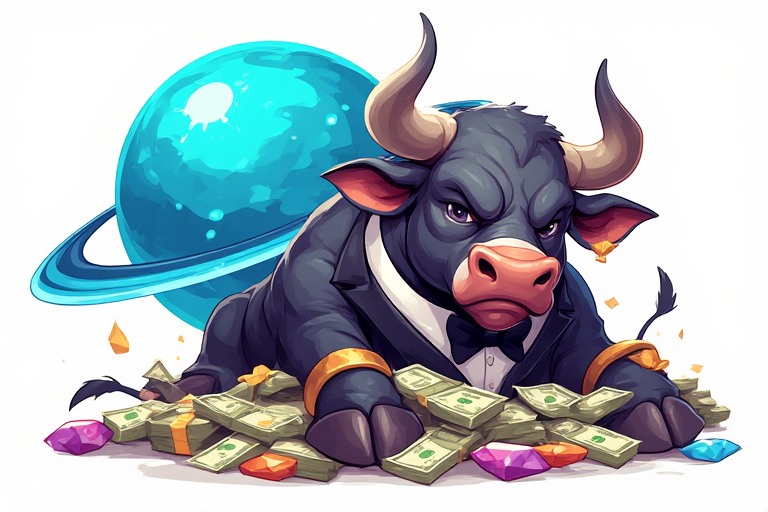
Even in modern symbolism, phrases like “bull market” reflect upward growth, financial expansion, and material gain — themes deeply resonant with Taurus’ association with wealth and assets. Across cultures and centuries, the bull consistently represents stability, fertility, nourishment, and possession. These are not accidental parallels. They form the mythological backbone of Taurus itself: strength that sustains, power that produces, and presence that refuses to be uprooted.

The Symbolism Of The Number 2
In mainstream numerology, the number 2 represents duality, partnership, and cooperation.
It is the first number that introduces the awareness of “other.” With 1, there is only assertion and identity. With 2, there is reflection, polarity, and relationship.
Because of this, the number 2 is commonly associated with diplomacy, emotional sensitivity, mediation, and balance. Its strength lies in its ability to harmonize opposing forces rather than overpower them.
Most modern numerological traditions describe 2 as receptive and intuitive. It is often linked with patience, tact, and the desire to maintain peace. Rather than initiating action, it responds and adjusts. Rather than competing, it collaborates.
In this sense, the number 2 preserves continuity by maintaining equilibrium. Its support is subtle and relational — it holds things together through understanding and emotional awareness.
By contrast, Taurus is best understood as the principle of material support and energetic reinforcement. As the second sign of the zodiac, Taurus represents what sustains the individual after identity has emerged. It governs food, resources, physical strength, and the ground beneath one’s feet.
If the first sign declares “I am,” Taurus ensures that the body has the fuel and stability to continue being. Its function is not mediation between people, but reinforcement of the organism itself.
The distinction is clear: mainstream numerology interprets 2 as relational balance, while Taurus embodies structural and biological support.
Both occupy the second position in their respective systems, yet they operate on different levels. Numerology’s 2 harmonizes between entities; Taurus stabilizes the entity through substance, nourishment, and endurance.

The Constellation of Taurus

Taurus is one of the oldest recorded constellations in the sky, with origins tracing back more than 4,000 years. It was recognized by ancient Mesopotamian astronomers and later cataloged by Claudius Ptolemy in the 2nd century CE. The constellation represents a bull, and in Greek mythology it is associated with Zeus, who transformed into a white bull. Because of its prominence and bright stars, Taurus has long been used as a seasonal marker, especially in the Northern Hemisphere, where it dominates the winter sky.
One of the most striking features of Taurus is Aldebaran, a giant orange star that forms the eye of the bull. Aldebaran is not only the brightest star in the constellation but also one of the brightest stars visible from Earth. It lies about 65 light-years away and is significantly larger and more luminous than the Sun. Aldebaran appears to be part of a V-shaped cluster known as the Hyades, though it is actually closer to us and not gravitationally bound to that group.
Taurus is also home to two of the most famous star clusters in the sky. The Hyades cluster is the nearest open star cluster to Earth, making it an important object for astronomical study. Nearby is the stunning Pleiades, also known as the Seven Sisters. The Pleiades have been observed and mythologized by cultures all over the world, from ancient Greece to Indigenous American and Japanese traditions (where they are known as Subaru). This cluster contains hundreds of stars, though only six or seven are easily visible to the naked eye under normal conditions.
Another remarkable object within Taurus is the Crab Nebula. This nebula is the remnant of a supernova explosion recorded by Chinese astronomers in 1054 CE. At its center lies a rapidly spinning neutron star, or pulsar, which emits beams of radiation detectable from Earth. The Crab Nebula remains one of the most studied objects in astrophysics, offering insight into stellar death and cosmic radiation.
Astronomically, Taurus lies along the ecliptic, the path the Sun appears to travel through the sky, which is why it is also one of the zodiac constellations. During late April and May, the Sun passes in front of Taurus from Earth’s perspective. The constellation is best viewed between November and March, when it rises high in the evening sky. With its bright stars, prominent clusters, and deep-sky objects, Taurus stands as one of the most visually rich and scientifically significant constellations in the night sky.

Taurus In Tropical vs. Vedic Astrology
The meaning of Taurus differs in emphasis between tropical (Western) astrology and Vedic astrology (Jyotish), even though both systems recognize Taurus as a fixed earth sign ruled by Venus. The divergence comes largely from framework, house emphasis, and cultural interpretation.
In tropical astrology, Taurus is most commonly associated with personal values, material stability, sensuality, and financial resources. It governs money, possessions, pleasure, beauty, and physical comfort. The sign is often described as steady, patient, resistant to change, and security-oriented. While it certainly relates to stability, Western astrologers usually frame that stability in terms of individual assets and personal enjoyment rather than collective or familial structure. Taurus in this system is strongly tied to self-worth and the accumulation of tangible resources.
In Vedic astrology, however, Taurus (known as Vrishabha) carries a more lineage-oriented tone in many interpretive traditions. While it still governs wealth and material stability, there is often a stronger association with family continuity, speech, food, and stored resources — especially because Taurus naturally corresponds to the 2nd house themes in Jyotish. The 2nd house in Vedic astrology is explicitly connected to family of origin, accumulated wealth, early upbringing, speech patterns, and sustenance. As a result, Taurus in Vedic contexts can take on a more ancestral or familial dimension than it typically does in tropical astrology.
Another key difference lies in philosophical orientation. Tropical astrology is season-based, anchored to the vernal equinox, and tends to interpret signs through psychological and developmental lenses. Vedic astrology is sidereal and places heavier emphasis on karma, lineage, and inherited conditions. Because of this, Taurus in Jyotish may be interpreted less as “my personal comfort” and more as what sustains the family line, preserves resources, and stabilizes inherited structures.
In short, tropical astrology generally frames Taurus as individual material stability and sensual embodiment, whereas Vedic astrology more readily links Taurus to family wealth, food, speech, and continuity of lineage. Both systems agree on Taurus as a sign of stability and preservation, but they differ in whether that stability is primarily personal or ancestral in scope.

Origin & Word Resonance
The word Taurus comes from Latin taurus, meaning bull, which itself derives from the Greek tauros and the ancient Proto-Indo-European root *tauro- referring to a wild ox or aurochs. The continuity of this word across civilizations reveals how deeply embedded the bull archetype is in human history. Long before formal astrology, the bull symbolized agricultural strength and sustaining power. It was not merely an animal; it was the force that plowed fields, generated food, and made settlement possible. When the constellation of Taurus was named, it carried this older symbolism forward into the sky.
The English word bull comes from Old English bula, rooted in Germanic language traditions. While linguistically unrelated, its phonetic similarity to bolster is symbolically striking. To bolster means to support, reinforce, or prop something up so it does not collapse. That image mirrors the astrological function of Taurus as the second sign of the zodiac. Taurus stabilizes what has already emerged. It represents food, rest, resources, and the physical ground beneath one’s feet. In structural terms, it provides material reinforcement of identity. Just as a bolster supports the body, Taurus supports the organism through nourishment and replenishment.
There is also a compelling sound pattern surrounding the number two. The word two descends from Old English twā, yet in modern pronunciation it is indistinguishable from too and closely resembles tooth. Though these words do not share a common root, the symbolic resonance is difficult to ignore. Taurus governs the mouth and throat — the mechanisms of ingestion and taste. Teeth, or “tooth,” are what break down food so the body can extract energy. The second sign, associated with consumption and sustenance, aligns poetically with the sound of two and tooth symbolism. Whether coincidence or subtle linguistic symmetry, the pattern reinforces the same theme: what comes second is what sustains.

How To Interpret Taurus In A Birth Chart
When reading charts, I find that Taurus usually manifests as either food, speech or possessions. It is without a doubt the most material of all the signs and it typically shows up as such in readings.
If a planet is sitting in Taurus and becomes active, then you will commonly see the person associated with that planet begin to eat more, speak more, or become more concerned with their possessions/resources. The person may also become more fashionable or concerned with decoration, as Taurus is the most aesthetically inclined and feminine of all the signs.
Also, because Taurus is the bull, you would be shocked at how often Taurus simply manifests as steak or beef products. People tend to over-complicate astrology in my experience. But believe it or not, it can really be that simple. Taurus is the bull. If it becomes active, then cows or bulls might become more noticeable or relevant in your life somehow.
Taurus embodies the principle of support and reinforcement in every dimension it touches. As a fixed earth sign, it consolidates and sustains what has been initiated, providing stability through resources, food, pleasure, and material security. Its ruling planet Venus infuses this energy with attraction, aesthetics, and indulgence, making the process of preservation not only functional but also pleasurable. From the symbolic bull to the phonetic resonance of “bolster” and “two,” Taurus demonstrates a consistent focus on maintaining the self through nourishment, grounding, and physical reinforcement.
Across astrological systems, Taurus maintains its role as the stabilizing second sign. While tropical astrology emphasizes personal material security, Vedic astrology extends Taurus’ reach to family, lineage, and ancestral sustenance. The constellation itself, along with its prominent stars and clusters, reinforces this sense of enduring presence. In every lens—whether symbolic, numerological, or astronomical—Taurus represents the force that ensures continuity, strengthens the body, and upholds the structures necessary for survival and growth.