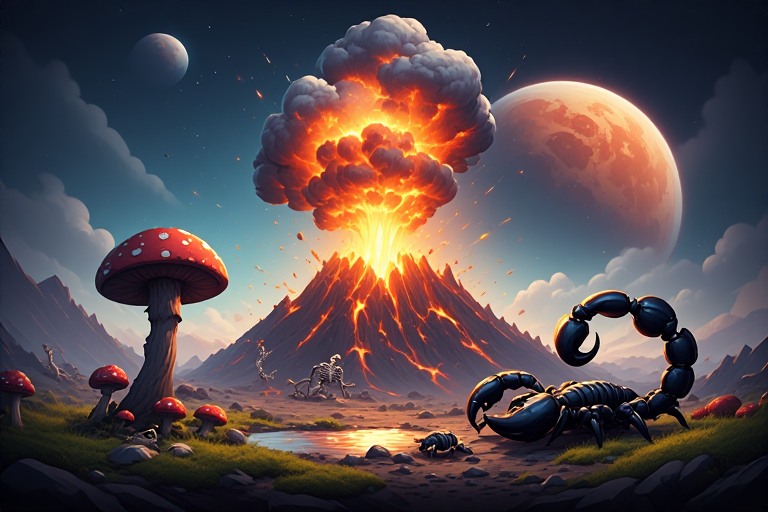

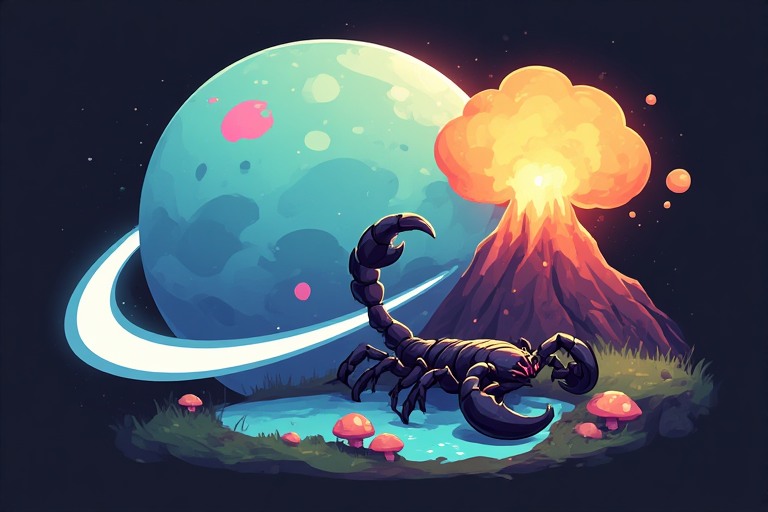
Scorpio—the scorpion—is the eighth sign of the zodiac. It is ruled by Mars – the warrior planet – and is a feminine, fixed water sign. Feminine signs turn energy inward, and Scorpio directs that force into private emotional depths, instinctive perception, and unspoken undercurrents. As a fixed sign, Scorpio sustains and intensifies—it does not initiate lightly, nor does it release easily—holding fast to what it feels, desires, or distrusts. Its element, water, places it in the realm of emotional truth, memory, and psychological fusion, making Scorpio penetrating, magnetic, and acutely aware of hidden motivations.

Scorpio Words & Phrases
agitation, alteration, ambush, annihilation, anus, astrology, ate (past tense of eat), autumn, being dead, bereavement, blind, catastrophe, cataclysm, chamber, clandestine, concealment, concealed, contamination, corruption, crisis, criminal, darkness, Day of the Dead, death, decay, defilement, degeneration, destruction, devastation, disturbance, drug dealers, elimination, emergency, eruption, esotericism, excretion, exhaust pipe, exposure, fear, feminine fighting tactics, fixed water, forensic, geyser, glacier, gun, Halloween, hidden, homicide, horny, horror, ice, inheritance, intensity, jealousy, kundalini, lake, libido, life force, life or death scenario, magic, manipulation, Mars, metamorphosis, “mind blowing”, mushroom, mystic, mysticism, natural disaster, obsession, occult, oozing, other people’s resources, pain, poison, pollution, poop, power, pressure, privacy, “private parts”, probing, psychiatry, PTSD, pus, rebirth, rectum, regeneration, resentment, revenge, scab, scorched earth, scorpion, secrecy, secret, seer, shedding, shocking, silence, snake, sorcery, sphincter, spider, sting, subterranean, sudden events, surgery, survival, swelling, syringe, taboo, tantric, taxes, taxing, the dead, the genitals, torment, toxicity, toxins, transformation, trauma, underworld, unexpected, unpredictable, venom, volcano, vulnerability, witchcraft

The Symbolism Of Scorpions
The scorpion has long symbolized lethal protection and hidden power, appearing in some of humanity’s earliest mythologies. In ancient Mesopotamia, the Scorpion-Men guarded the gates of the sun god Shamash, standing watch at the threshold between worlds. They were not merely monsters, but guardians of sacred transitions—figures who protected divine light by confronting those unprepared for it. This theme of threshold-keeping echoes the scorpion’s real-world behavior: small, silent, often unseen, yet capable of delivering a decisive and unforgettable strike. Across cultures, the scorpion becomes an emblem of forces that dwell at the edge—between life and death, light and darkness, vulnerability and defense.
In ancient Egypt, the goddess Serqet (also spelled Selket) was depicted with a scorpion upon her head. She was both a protectress against venom and a guardian of the dead, associated with funerary rites and safe passage into the afterlife. Here the scorpion is not merely destructive; it is paradoxically protective and purifying, capable of both harm and healing. This duality—poison as both threat and medicine—runs deeply through religious symbolism. The creature that wounds is also the one that teaches vigilance, respect, and spiritual preparedness.
In Ancient Greece, the scorpion appears in the myth of Orion. Sent by the earth goddess Gaia (or in some versions Artemis), the scorpion was dispatched to humble the boastful hunter. After their battle, both were placed among the stars as the constellations Orion and Scorpius—forever positioned so that when one rises, the other sets. This celestial opposition reinforces the scorpion’s association with cosmic justice and inevitable consequence. Pride meets its reckoning; excess meets its limit. The sting becomes a corrective force, restoring balance through confrontation.
Across desert cultures of North Africa and the Middle East, the scorpion carried practical as well as symbolic weight. It represented survival in harsh environments, embodying resilience, secrecy, and strategic defense. Its ability to thrive where few others could survive made it a potent emblem of endurance under pressure. In later mystical traditions, including strands of alchemy and esoteric thought, the scorpion came to represent the first stage of transformation—the dark, putrefying phase where old forms decay before renewal becomes possible. Here the sting is not merely destructive; it initiates a necessary death that precedes rebirth.
Throughout history, the scorpion has never been a symbol of softness. It signifies intensity, vigilance, danger, and sacred boundaries. Whether guarding the gates of the sun, protecting the dead, humbling the arrogant, or surviving the desert night, the scorpion embodies transformative confrontation—the idea that what wounds us may also awaken us, and that hidden forces often hold the greatest power.

The Symbolism Of Number 8
The number eight has carried rich symbolic meaning across civilizations, often representing power, continuity, and regeneration. In mathematics, 8 turned on its side becomes the lemniscate—the symbol of infinity—suggesting something without beginning or end. In Ancient Egypt, the Ogdoad consisted of eight primordial deities who embodied the chaotic waters before creation, linking the number to pre-creation depth and latent force. In China, eight is considered especially fortunate because its pronunciation (ba) resembles the word for prosperity, making it a number associated with material success and expansion. Across cultures, eight frequently marks a transition beyond completion—moving past the stable structure of seven into a new phase of renewal after fulfillment.
Religiously, eight often signifies rebirth and resurrection. In Christianity, Christ is said to have risen on the “eighth day,” symbolizing life beyond the seven-day cycle of creation. Baptismal fonts were historically octagonal for this reason—eight representing spiritual regeneration. In Buddhism, the Noble Eightfold Path lays out the disciplined steps toward liberation, framing eight as a number of transformative alignment. Numerologically, eight is associated with ambition, mastery, karma, and material consequence—the understanding that what is set in motion returns with weight. It is the number of cause and effect, of cycles that culminate in tangible results.
There is also an intriguing linguistic layer: the word eight is a homonym for ate, the past tense of eat. Symbolically, that shift from present consumption to completed digestion is meaningful. If Taurus rules eating—intake, nourishment, what is being consumed—its opposite sign, Scorpio, corresponds to what has already been processed. Not what you eat, but what you have ate. From a biological standpoint, digestion culminates in elimination. In that sense, Scorpio’s association with waste, decay, and excretion reflects the logical outcome of Taurus’ appetite and accumulation. Consumption and elimination, intake and purge, are part of the same cycle.
This polarity mirrors the deeper symbolism of eight itself: what goes in must come out; what begins must end; what is taken must be transformed. The number eight does not merely represent abundance or power—it represents the consequences of embodiment. It is the point at which experience is metabolized. Just as the body turns food into energy and waste, eight symbolizes the stage where life’s raw materials are broken down into essence and residue. In this way, eight stands as a number of material consequence and transformative processing—a reminder that nothing consumed disappears; it changes form.

The Scorpio Constellation

The constellation Scorpius is one of the most visually striking and easily recognizable patterns in the night sky. Unlike many constellations that require imagination to discern, Scorpius genuinely resembles a scorpion, complete with a curved tail and stinger. It lies along the ecliptic—the apparent path of the Sun—making it one of the zodiac constellations. Because of its southern declination, it is best viewed in the summer months in the Northern Hemisphere and appears especially prominent in the skies of the Southern Hemisphere, where it climbs high and luminous.
At the heart of Scorpius burns Antares, a massive red supergiant whose name means “rival of Ares” (Mars), due to its fiery hue that often rivals the red planet in brightness. Antares is so large that if placed at the center of our solar system, it would extend beyond the orbit of Mars. The constellation is also rich in deep-sky objects because it lies in the direction of the Milky Way’s galactic center. Within its boundaries are star clusters such as Messier 4—one of the closest globular clusters to Earth—and Messier 6 and Messier 7, both visible with binoculars under dark skies. Nebulae and dense star fields crowd this region, giving Scorpius a sense of depth and intensity.
Mythologically, Scorpius is most famously linked to the tale of Orion. In Greek tradition, the scorpion was sent to strike down the boastful hunter, and both were immortalized in the heavens as the constellations Orion and Scorpius placed on opposite sides of the sky. In some versions, the scorpion was dispatched by Gaia, and in others by Artemis. When Scorpius rises, Orion sets—an eternal chase written into the cosmos. This celestial opposition reinforces the constellation’s symbolism of confrontation, humility, and inevitable reckoning.
Astronomically, Scorpius once held even greater zodiacal territory. In antiquity, its claws extended into what later became the constellation Libra; the scales were originally considered the scorpion’s pincers by Babylonian astronomers. Over time, they were separated into distinct constellations, but the historical connection remains. Scorpius is also home to one of the densest regions of stars visible to the naked eye, as we are looking toward the inner structure of our galaxy.
Visually dramatic, mythologically charged, and astronomically rich, Scorpius stands as one of the sky’s most compelling figures—a constellation that combines brilliant stellar fire, galactic depth, and mythic intensity in a single sweeping arc across the heavens.

Scorpio In Tropical vs. Vedic Astrology
The sign of Scorpio exists in both tropical (Western) and Vedic (Jyotish) astrology, but it is framed differently in each system. Tropical astrology is season-based and tied to the equinoxes, meaning its zodiac is anchored to Earth’s relationship to the Sun rather than the fixed stars. Vedic astrology, by contrast, is sidereal and star-aligned, adjusting for the precession of the equinoxes and grounding its symbolism in observable constellational space. While both systems agree that Scorpio is a fixed water sign associated with intensity, secrecy, and endurance, Jyotish tends to express these themes through concrete karmic outcomes—longevity, inheritance, vulnerability, hidden enemies—rather than primarily psychological language.
One of the most significant differences concerns planetary rulership. In modern tropical astrology, Scorpio is commonly said to be ruled by Pluto, discovered in 1930 and associated with transformation, destruction, and rebirth. In Vedic astrology, however, Scorpio is unequivocally ruled by Mars, just as it was in classical Western astrology for over a thousand years. Mars gives Scorpio its sharpness, courage, volatility, and survival instinct. Pluto, while symbolically compelling, is a distant and invisible body that was never part of the classical rulership framework that structured the zodiac for centuries.
As an astrologer, I am personally of the opinion that Mars still rules Scorpio. Every major classical authority—from Hellenistic to Medieval to Renaissance astrologers—assigned Scorpio to Mars within an elegant and symmetrical planetary scheme. The seven visible planets each governed two signs in a system rooted in astronomical visibility and philosophical coherence. It was only in the last century that modern astrologers, without broad collective consensus, chose to elevate Pluto as Scorpio’s ruler. In doing so, they disrupted the natural balance of sign rulerships and broke with thousands of years of tradition and proven predictive methodology that relied on Mars as Scorpio’s governor.
This does not mean Pluto symbolism is without value; many modern astrologers find it descriptively useful for discussing psychological depth and collective transformation. But descriptively useful is not the same as structurally foundational. From a traditional standpoint, Scorpio’s intensity, secrecy, sexuality, and resilience are fully explained through Mars—particularly Mars operating through water: emotional, strategic, contained, and enduring. In my view, restoring Scorpio to Mars reestablishes structural coherence in the zodiac and reconnects contemporary practice with a lineage of astrology that demonstrated remarkable consistency and effectiveness for centuries.

Origin & Word Resonance
The word Scorpio ultimately traces back to the Latin scorpiō, meaning scorpion. This Latin term itself derives from the Greek skorpiós (σκορπιός), used in ancient texts to describe the venomous arachnid known for its curved tail and stinger. Linguists generally connect the Greek word to an Indo-European root associated with piercing, cutting, or stabbing, an etymology that vividly reflects the creature’s defining act—the strike. From the beginning, then, the word carried a sharpness within it, embedded in language long before it became a zodiacal emblem.
In classical antiquity, Scorpio was used not only zoologically but astronomically. The Romans adopted the Greek constellation lore and Latinized its name, placing Scorpio among the twelve signs along the ecliptic. Over time, the term expanded beyond the animal itself to represent the constellation and astrological sign, absorbing layers of symbolic meaning—danger, intensity, secrecy, and transformation. The linguistic journey mirrors the symbolic one: a literal stinging creature becomes a celestial marker and eventually a psychological archetype.
Interestingly, the English word scorpion comes from the same Latin root, passing through Old French before entering Middle English. Scorpio remained closer to the classical Latin form and is typically reserved for astronomical and astrological contexts, while scorpion refers to the animal. This distinction preserves a subtle difference between creature and symbol. One crawls across desert sand; the other moves across the heavens.
The etymology reinforces the deeper symbolism associated with the sign. A word rooted in piercing and striking suggests precision, potency, and consequence. Even at the linguistic level, Scorpio carries an inherent sense of impact—something that penetrates, leaves a mark, and is not easily ignored. Language itself preserves the sting.

How To Interpret Scorpio In A Birth Chart
When I see Scorpio strongly placed in a birth chart—whether rising, on an angle, or tightly connected to personal planets—I immediately prepare for intense and life-altering experiences. Scorpio rarely whispers. It erupts. It confronts. It exposes. In my experience, this sign almost always indicates something shocking, disruptive, or psychologically profound entering the native’s life. Events tied to Scorpio energy tend to feel like they come out of nowhere—like a volcano erupting without warning or a gun suddenly going off in a silent room. Even when the outer circumstances look subtle, the internal impact is dramatic. Scorpio does not do mild.
When Scorpio is activated by transit or progression, I tell my clients to expect the unexpected. This is the sign of darkness and hidden forces, so what surfaces often startles you precisely because it was concealed. Secrets come out. Truths are revealed. Buried emotions explode to the surface. You might meet a person who feels magnetic, dangerous, or utterly unique—someone who shakes your equilibrium and leaves you changed. Or you may witness something so improbable that it feels supernatural, defying logic to the point where it almost seems like magic. Scorpio has a way of blowing the mind wide open, forcing you to confront realities you didn’t know were there.
Psychologically, Scorpio in a chart shows where you are not content with surface-level experience. You want depth, intensity, authenticity—no matter the cost. But that desire often invites crisis. The house Scorpio occupies is rarely calm territory; it becomes the arena of transformational upheaval, where stability is periodically disrupted so that something more powerful can emerge. I have seen Scorpio bring sudden losses, sudden passions, sudden revelations—moments that divide life into “before” and “after.” It is the energy of irreversible turning points.
Yet here is the paradox: while Scorpio shocks us, it also strengthens us. The eruptions it triggers are not random; they are catalytic. After the smoke clears, you are different—harder, wiser, more perceptive. Scorpio strips away illusion through confrontation. It startles you awake. In my years of practice, I have come to recognize that wherever Scorpio lives in your chart, that area of life will never be ordinary. It will be intense, extreme, unforgettable. It will carry the signature of dramatic revelation and permanent transformation—and once you’ve lived it, your worldview is never quite the same again.
In summary, Scorpio governs topics that are intense and often uncomfortable, including death, sex, waste, shared resources, and psychological extremes. The constellation Scorpius and its red star Antares reflect its visibility and historical importance. The number eight reinforces themes of consequence and processing—what happens after something has been consumed or set in motion. In modern astrology, Scorpio is often linked to Pluto, while traditional and Vedic astrology assign rulership to Mars. Regardless of the system, Scorpio consistently points to events that disrupt normal life. When activated in a birth chart, it often correlates with sudden developments, exposure of secrets, and permanent change. Scorpio does not describe mild experiences. It marks areas of life that involve pressure, confrontation, and irreversible outcomes.