
Key Takeaways: Aries is a ram. And what do rams do? THEY RAM THINGS. You will often find that when Aries becomes active in your chart, collisions or crashes increase. Pushing increases. Something or someone begins to exert FORCE against something else. This doesn’t always imply danger. It could be that you start to push and exert force against a barbell in the gym (lifting weights). It depends on your particular chart. Aries is also the 1st sign of the zodiac, so the symbolism of the number 1 is very evident here. If Aries is active then expect victories, novelty, and events where things are happening for the FIRST time.
Aries – the ram – is the first sign of the zodiac. It is a masculine, “moveable” fire sign. Masculine signs tend to be more active as opposed to reactive. They make life happen instead of sitting back and waiting for life to come to them, and Aries is certainly no exception. Being a moveable sign, Aries tends to always be on the go and represents things that typically involve motion and force. This is also reflected in its element, fire, which makes its an energetic and restless sign that is full of desire and passion for life.

Aries Words & Phrases
advance, adrenaline, aggression, aggressive action, anger, are (homonym of “Ares”), assertive, assault, attack, audacious, awaken, baby, battle cry, batter, being alive, being awake, beginnings, big bang theory, blaze, bold, breakthrough, burst, champion, charge, collide, combust, confront, conquer, conscious, courage, dash, daring, detonate, dominate, drive, dynamic, erection, explosion, fearless, fiery, fierce, first, first impression, first step, flare, flare-up, force, forge ahead, forward motion, fresh, gallop, getting “it” up, getting up, go-for-it, head, headbutt, headfirst, headlong, headstrong, ignite, impetuous, impulse, impulsive, inception, independent, initiate, innocent, kickoff, launch, leader, leap, male, mar, masculinity, men, momentum, new, “newbie”, newborn, overcome, penetration, pierce, pioneer, pioneering, plunge, primal force, primary, propel, puncture, push, ram, rash, react, red, redness, relentless, resistance, risk, rising, rush, self, selfish, smash, spark, spearhead, sprint, spring, sprout, start, staring a fire, strike, surge, thrust, trailblazer, triumph, unstoppable, victory, warrior, warrior spirit, won (homonym of “one”)

The Symbolism Of The Ram
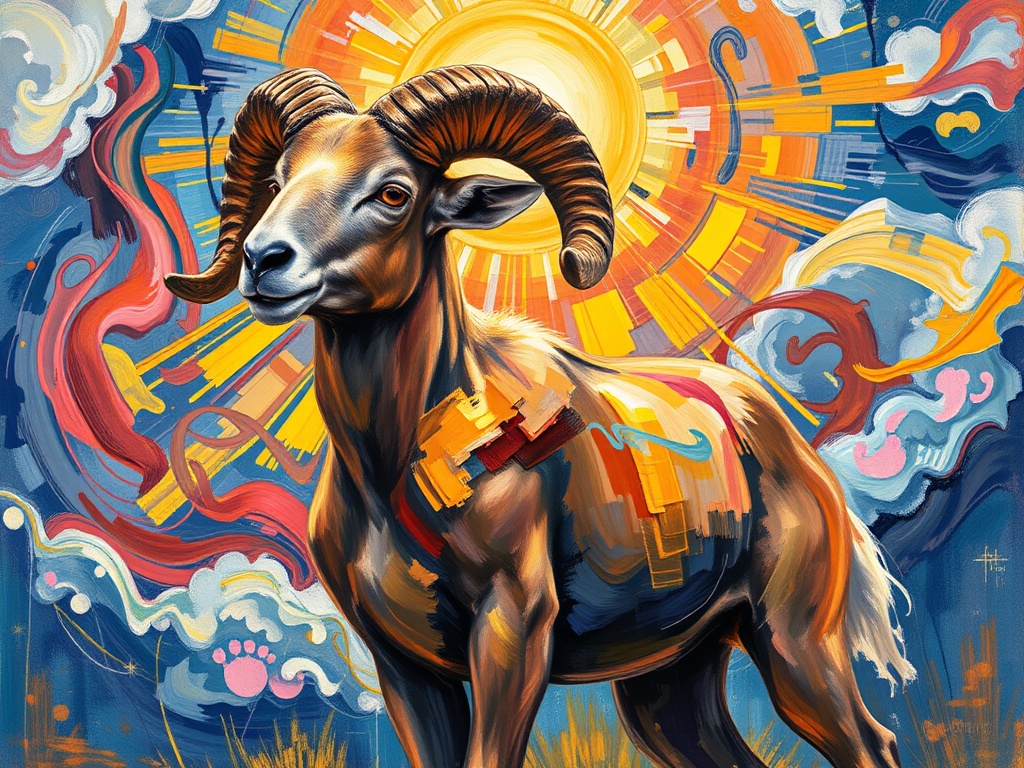
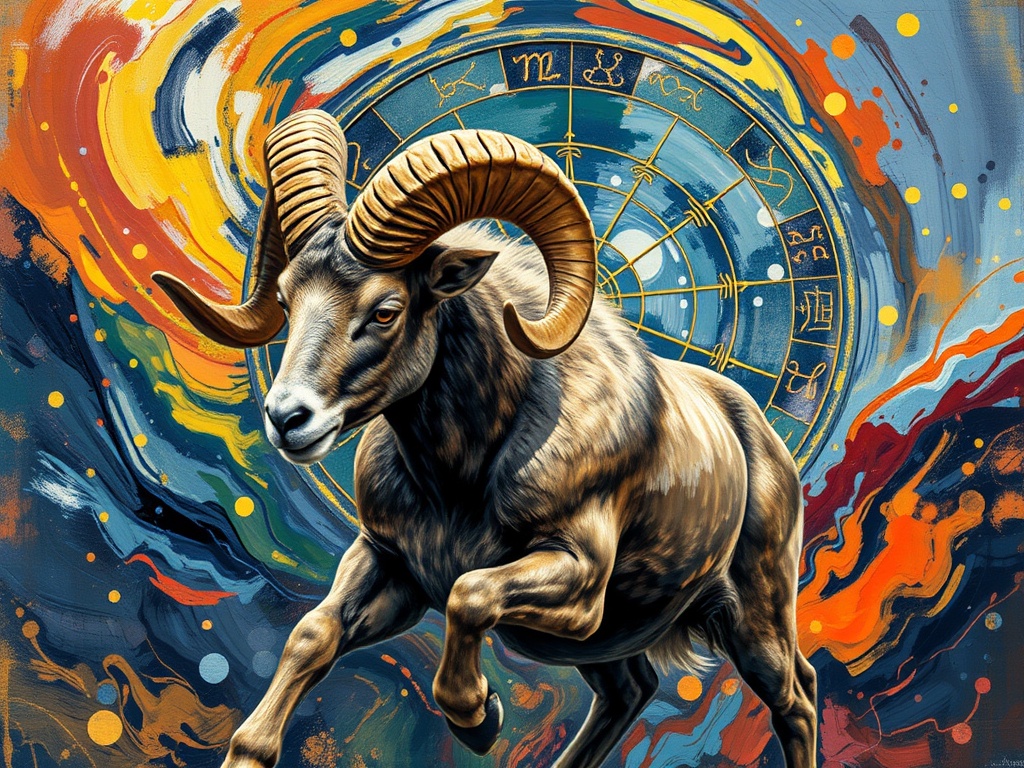
The ram is the quintessential symbol of Aries, perfectly capturing the zodiac sign’s bold, energetic, and pioneering spirit. In mythology, rams often represent courage, assertiveness, and leadership, qualities that define Aries’ approach to life. Just as the ram charges forward with determination, Aries individuals are naturally initiative-driven, unafraid to blaze new trails and confront challenges head-on. The story of the Golden Fleece in Greek mythology, with the magical ram whose hide Jason and the Argonauts sought, mirrors the Aries archetype: fearless pursuit of goals, a willingness to take risks, and a drive to achieve greatness through action.
In Egyptian tradition, the ram was associated with Khnum, the god of creation and vitality, highlighting themes of renewal and dynamic energy. Aries, ruled by Mars, carries this same force of life and action, bringing energy and ambition wherever it goes. The ram’s horns, often curved yet pointed forward, symbolize the combination of strength and focus—just as Aries channels raw energy into leadership and decisive action. These attributes make the ram an ideal emblem for a zodiac sign that thrives on initiative, assertiveness, and self-expression.
Literature and allegory often portray the ram as stubborn yet purposeful, reflecting Aries’ dual nature: bold and fearless, yet guided by instinct and passion. The ram’s forward motion and determination echo Aries’ desire to break boundaries and explore new possibilities. Just as the ram charges obstacles without hesitation, Aries individuals tend to embrace challenges directly, learning and growing through action and experience rather than hesitation.
Historically, rams were both symbolic and practical in human societies, providing resources and participating in ritual practices, which elevated them as sacred creatures. Similarly, Aries’ energy is often applied in tangible ways—through leadership, innovation, and the pursuit of meaningful endeavors. The ram’s vitality, courage, and relentless drive encapsulate the essence of Aries, making it a living symbol of passion, action, and unyielding determination, qualities that define the first sign of the zodiac.

The Symbolism Of Number 1
In numerology, the number 1 is the principle of origin, identity, and emergence. It is the first spark — the moment something moves from nonexistence into existence. One is not a pair, not a reflection, not a response. It simply is. Because of this, the number 1 represents individual will, autonomy, and self-definition. It does not derive meaning from comparison; it generates meaning by standing alone. In many traditions of numerology, 1 is associated with leadership, initiative, and the courage to act without waiting for permission.
This symbolism aligns seamlessly with the zodiac sign Aries, the first sign of the zodiac cycle. In astrology, Aries marks the beginning of the astrological year at the spring equinox — a point of ignition and renewal. Just as the number 1 signifies the start of the numerical sequence, Aries signifies the start of the zodiacal wheel. Both carry the archetype of inception and raw momentum. They do not look backward; they push forward. They are concerned less with reflection and more with activation.
There is also a strong connection between the number 1 and the planetary ruler of Aries, Mars. Mars symbolizes action, assertion, and the drive to initiate. Numerologically, 1 is the force that says “I will,” and astrologically, Mars is the energy that makes that will tangible. Together, they describe self-propelled force, the instinct to move first and figure it out later. Where other numbers may represent cooperation or balance, 1 represents self-starting impulse.
On a deeper symbolic level, the number 1 and Aries both represent pure identity before complication. One has not yet divided into two. Aries has not yet learned compromise, partnership, or diplomacy — themes that appear later in the zodiac. Both embody the stage of existence where the primary concern is simple: to exist as oneself. In that sense, the numerology of 1 helps us understand Aries not merely as “bold” or “aggressive,” but as the fundamental act of being — the first declaration of “I am.”

The Aries Constellation

The constellation of Aries is one of the twelve zodiac constellations and has a rich history in both astronomy and mythology. Its name, Latin for “ram,” reflects the animal that it represents, and it has been recognized as a ram in cultures across the ancient world. Aries is relatively small and faint compared to other zodiac constellations, covering about 441 square degrees of the sky, which makes it the 39th largest constellation. Despite its modest size, Aries is easily identifiable by its three brightest stars, forming a distinctive line or curve that suggests the shape of a ram’s head and horns.
The three primary stars of Aries are Hamal, Sheratan, and Mesarthim. Hamal, the brightest, is an orange giant located roughly 66 light-years from Earth, shining at a magnitude of 2.0. Sheratan, slightly dimmer, lies about 59 light-years away, while Mesarthim is actually a binary star system approximately 164 light-years distant. Interestingly, Mesarthim was the first binary star system to be identified through spectroscopy, a discovery that helped astronomers understand stellar composition and motion. These stars have historically guided sailors and travelers and continue to hold significance in astrological traditions, marking the head of the ram in the zodiac band.
Aries is also home to several interesting deep-sky objects, though it is not as rich in bright nebulae or star clusters as some larger constellations. Among its notable features is NGC 772, a spiral galaxy located about 130 million light-years from Earth, known for its prominent spiral arms and active star-forming regions. The constellation is best visible in the Northern Hemisphere during late autumn and winter, reaching its highest point in the sky around 10 p.m. in December. For astronomers and stargazers, Aries serves as a marker for the vernal equinox in tropical astrology, historically used to track the changing seasons and the beginning of spring.
The mythology of Aries further enhances its significance. In Greek myth, it is associated with the golden ram whose fleece became the legendary Golden Fleece sought by Jason and the Argonauts. This myth links the constellation to themes of adventure, courage, and the pursuit of treasure, echoing the qualities attributed to the Aries zodiac sign. Across cultures, the constellation has often symbolized leadership, initiative, and vitality, reflecting its role as the first sign of the zodiac and the starting point of the celestial circle. Today, while astronomy focuses on its stars and deep-sky objects, the constellation of Aries continues to inspire both scientific study and symbolic interpretation, bridging the worlds of observation and mythology.
If you want, I can also create a Watermare-style chart for the constellation Aries, summarizing its stars, distances, magnitude, and interesting features in a clean, visual format. Do you want me to do that?

Aries In Tropical vs. Vedic Astrology
Aries is the first sign of the zodiac in both tropical and sidereal astrology, but the way it is interpreted differs due to the alignment of the zodiac with seasons versus constellations. Tropical astrology, the system most common in the West, anchors Aries to the vernal equinox, marking the start of spring in the Northern Hemisphere. Here, Aries represents new beginnings, initiative, and outward expression, embodying the energy of renewal. The focus in tropical astrology is symbolic and psychological, emphasizing how Aries’ fiery energy manifests in personality, ambition, and self-expression.
Sidereal astrology, used mainly in Vedic traditions, aligns the zodiac with the actual constellations. Because of the precession of the equinoxes, sidereal Aries currently falls slightly behind tropical Aries, which can shift an individual’s Sun sign. In sidereal interpretation, Aries retains its martial and energetic qualities, but the emphasis is often more practical and destiny-oriented, relating to the real-world outcomes of one’s actions. This system also considers the nakshatras, or lunar mansions, within Aries, which add layers of nuance such as karmic patterns, temperament, and life purpose.
Another difference is in seasonal and temporal associations. Tropical Aries is always tied to spring and the idea of awakening energy, linking it to cycles of personal growth and renewal. Sidereal Aries is more fixed to the actual star field, highlighting external events, societal roles, and karmic lessons rather than symbolic metaphors. Tropical astrology focuses on inner drive and self-expression, while sidereal astrology frames Aries’ energy in terms of action, duty, and the consequences of initiative in the physical world.
Ultimately, both systems see Aries as courageous and pioneering, but tropical astrology emphasizes personality, motivations, and self-expression, whereas sidereal astrology emphasizes tangible actions, timing, and karmic patterns. Understanding these distinctions allows astrologers to explore the same fiery sign from complementary perspectives, offering a richer view of Aries’ bold and headstrong nature.

Origin & Word Resonance
The word Aries has a fascinating origin rooted in both language and symbolism. In Latin, Aries literally means “ram,” reflecting the zodiac sign’s symbolic animal. Its use as a star or constellation name dates back to antiquity, when early astronomers and astrologers associated the constellation with the ram from Greek mythology, particularly the golden ram whose fleece became the legendary Golden Fleece. The Latin word Aries itself comes from the earlier Greek term Krios, which also means ram, preserving its long-standing association with strength, courage, and initiation. This etymological history reinforces the sign’s connection to beginnings, leadership, and the assertive energy that defines Aries in astrology.
Interestingly, the word Aries has a number of homonyms and near-homonyms that reveal deeper layers of meaning. For example, Aries is sometimes pronounced as “Ares,” which evokes the name of the Greek god of war, reinforcing the zodiac sign’s fiery, assertive, and pioneering qualities. Beyond mythology, Ares also phonetically echoes the English word “are,” a fundamental verb meaning “to be.” This connection is particularly striking in astrological terms because Aries rules the first house, which concerns identity, self-expression, and the question of what you are. The resonance between “are” and Aries highlights the sign’s intrinsic focus on existence, presence, and individuality—qualities that define both the sign and the house it governs.
Homonyns and phonetic overlaps like this demonstrate how language can layer symbolic meaning over time. The connection to “are” aligns with Aries’ role as the starting point of the zodiac, emphasizing the emergence of the self into the world. Meanwhile, the link to Ares, the god of war, underscores the sign’s courage, assertiveness, and willingness to initiate action, suggesting that identity is not merely a passive state but something that is enacted through choice, energy, and engagement with life. In this way, the word Aries is not only a linguistic label but also a symbolic key, uniting concepts of being, leadership, and self-realization into a single, resonant term.

How To Interpret Aries In A Birth Chart
In my experience reading charts, Aries most frequently shows up in two clear and repeatable ways: as impact or as inception. It either marks a point where something has forcefully collided, or it signals that something entirely new is springing into motion. Those themes surface again and again. I’ll often see two people or objects brought into abrupt contact — through an accident, argument, athletic clash, mechanical failure, or some other aggressive interaction — or I’ll see a situation where something is being started for the first time, with raw momentum and little hesitation.
So when a planet or house falls in Aries, I instinctively look for friction or “firstness”. Aries tends to describe the initial strike, the spark that sets events in motion, the surge that pushes things forward before refinement or reflection has time to intervene. And just as commonly, it correlates with anger — quick, hot, and immediate. Aries doesn’t simmer; it reacts. That flash of irritation, that sharp impulse to confront, compete, or assert oneself, is one of its most consistent and recognizable expressions.
Aries is a sign of primordial energy, action, and initiation. From the Ram charging forward to the explosive, penetrating, and aggressive force that drives every action, its language is rich with symbols of leadership, daring, and cosmic spark. These words, phrases, constellations, mythology, Vedic insights, and etymological connections capture the raw, dynamic, and pioneering force Aries brings into every beginning, every challenge, and every new adventure.
….