This post contains affiliate links, from which we may earn a commission.*
Buying your first telescope can be exciting, especially if you’ve always been fascinated by the stars, planets, and the mysteries of the universe. Whether your interest comes from astronomy, astrology, or simply a desire to explore the night sky, choosing the right telescope isn’t always easy. Some models promise enormous magnification, while others come with bundles of accessories that look impressive on paper but may not make much difference when you’re actually observing the night sky.
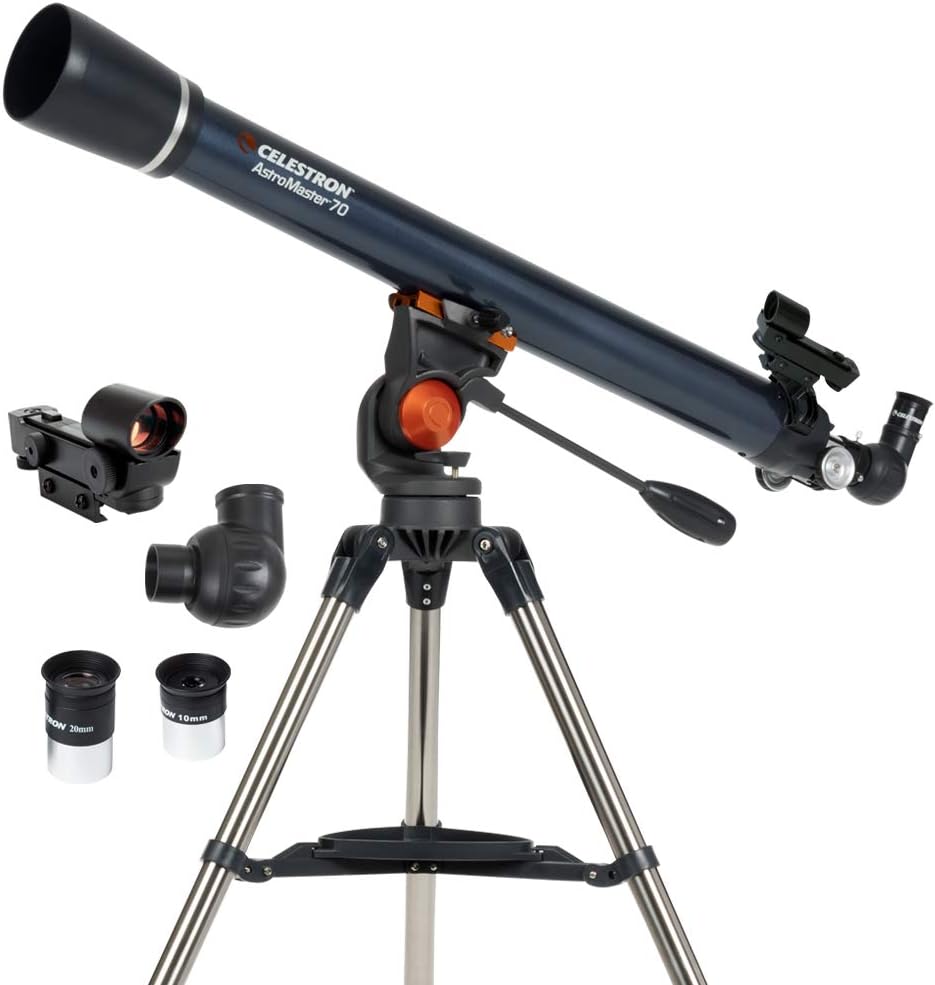
The Celestron AstroMaster 70AZ is a beginner-friendly refractor telescope designed for people who want to explore the Moon, planets, and brighter celestial objects without spending hundreds of dollars on advanced equipment. It typically sells for around $180–$200, depending on the retailer and current promotions.
But is this telescope worth the money, or would you be better off choosing something else? In this review, we’ll examine its specifications, potential advantages, drawbacks, and real-world observing capabilities to help you decide.
The Celestron AstroMaster 70AZ is a refractor telescope, meaning it uses a lens at the front of the optical tube to collect and focus light. Refractors are popular with beginners because their optics generally require little maintenance and don’t need the regular mirror alignment associated with many reflector telescopes.
Here are the main specifications for the standard AstroMaster 70AZ, not the shorter AstroMaster LT 70AZ.
Optical design: Refractor
Aperture: 70 mm (2.76 inches)
Focal length: 900 mm
Focal ratio: f/13
Included eyepieces: 20 mm and 10 mm
Magnification with included eyepieces: 45x and 90x
Mount: Manual alt-azimuth
Finderscope: StarPointer red-dot finderscope
Included accessories: Erect-image diagonal, two eyepieces, finderscope, adjustable tripod, and astronomy software
The 70 mm aperture determines how much light the telescope can collect. Although this is modest compared with larger astronomical telescopes, it can still provide enjoyable views of several bright celestial objects.
The 900 mm focal length and relatively long focal ratio make this model better suited to lunar and planetary observing than to wide-field views of large sections of the sky.
What Can You See Through the Celestron AstroMaster 70AZ?
Before purchasing any telescope, it’s important to understand what it can realistically show you. Images taken by professional observatories often involve enormous instruments, long exposures, and extensive image processing. A small beginner telescope won’t reproduce those photographs.
However, observing celestial objects with your own eyes can be rewarding even when the views are relatively small or faint.
The Moon
The Moon is one of the most suitable targets for the AstroMaster 70AZ.
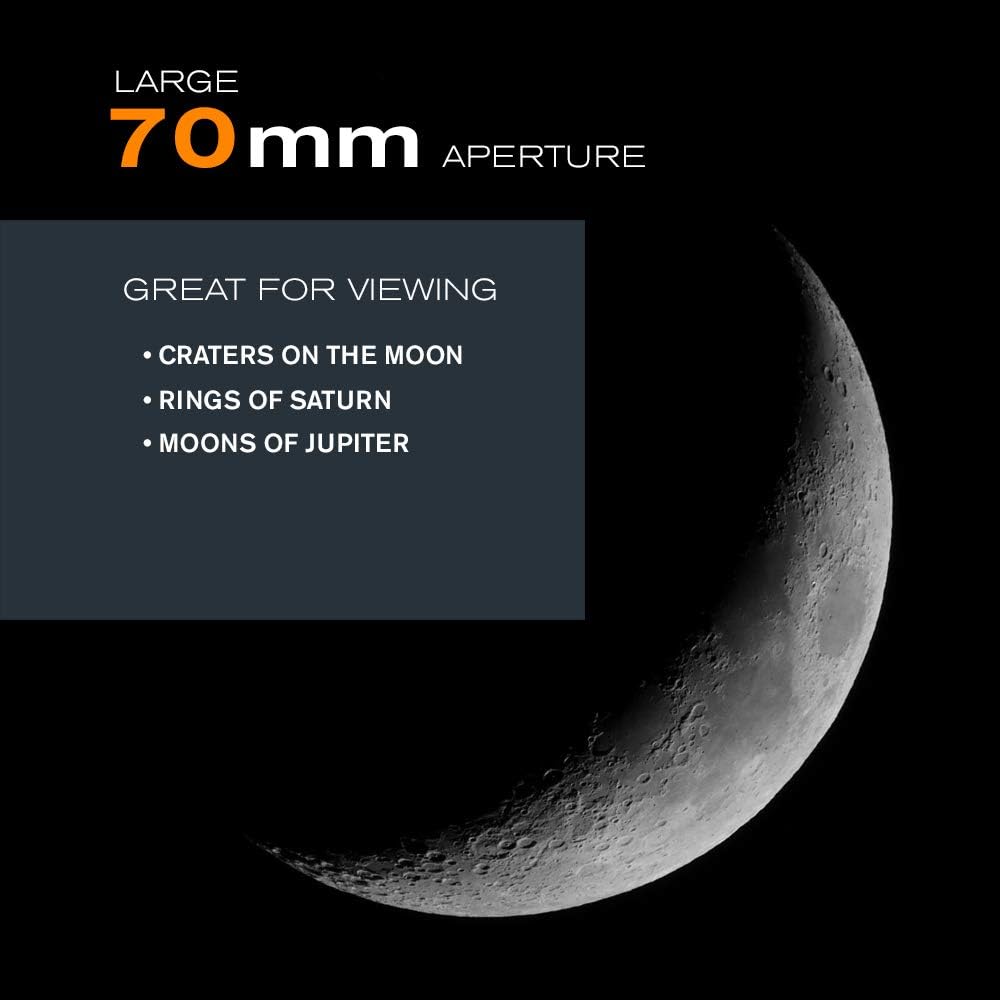
Its 70 mm aperture can reveal craters, mountain ranges, and other prominent lunar features. You’ll also notice that the appearance of the Moon changes throughout the month as sunlight illuminates different portions of its surface.
Observing near the boundary between the illuminated and dark portions of the Moon can be especially interesting. Shadows in this region make craters and other surface features easier to distinguish.
For beginners who want to explore the night sky without immediately tackling difficult targets, the Moon provides an excellent starting point.
Jupiter & Saturn
The AstroMaster 70AZ can also provide views of the brighter planets.
Jupiter’s four largest moons can appear as tiny points of light near the planet. Under favorable observing conditions, you may also be able to distinguish its two most prominent cloud belts.
Saturn is another rewarding target. Its rings can be visible through a telescope of this size, although the planet will appear relatively small and won’t reveal the intricate detail seen in professional photographs.
The amount of detail you can observe depends on atmospheric turbulence, the planet’s position in the sky, the telescope’s optical quality, and how carefully you focus the image.
Venus can also be observed, including its changing phases.
Star Clusters & Deep-Sky Objects
The telescope can show some brighter star clusters and other prominent objects beyond our solar system. However, this is where its limitations become more apparent.
Its relatively small aperture restricts the amount of light available for viewing faint galaxies and nebulae. Many deep-sky objects will appear as dim patches rather than colorful structures, and some will be difficult to observe, particularly under light-polluted skies.
If your primary goal is exploring faint galaxies and nebulae, a larger-aperture telescope would generally be a better choice.
The AstroMaster 70AZ is more appealing to someone whose main interests are the Moon and brighter planets.
Pros of the Celestron AstroMaster 70AZ
1. Relatively Simple Setup
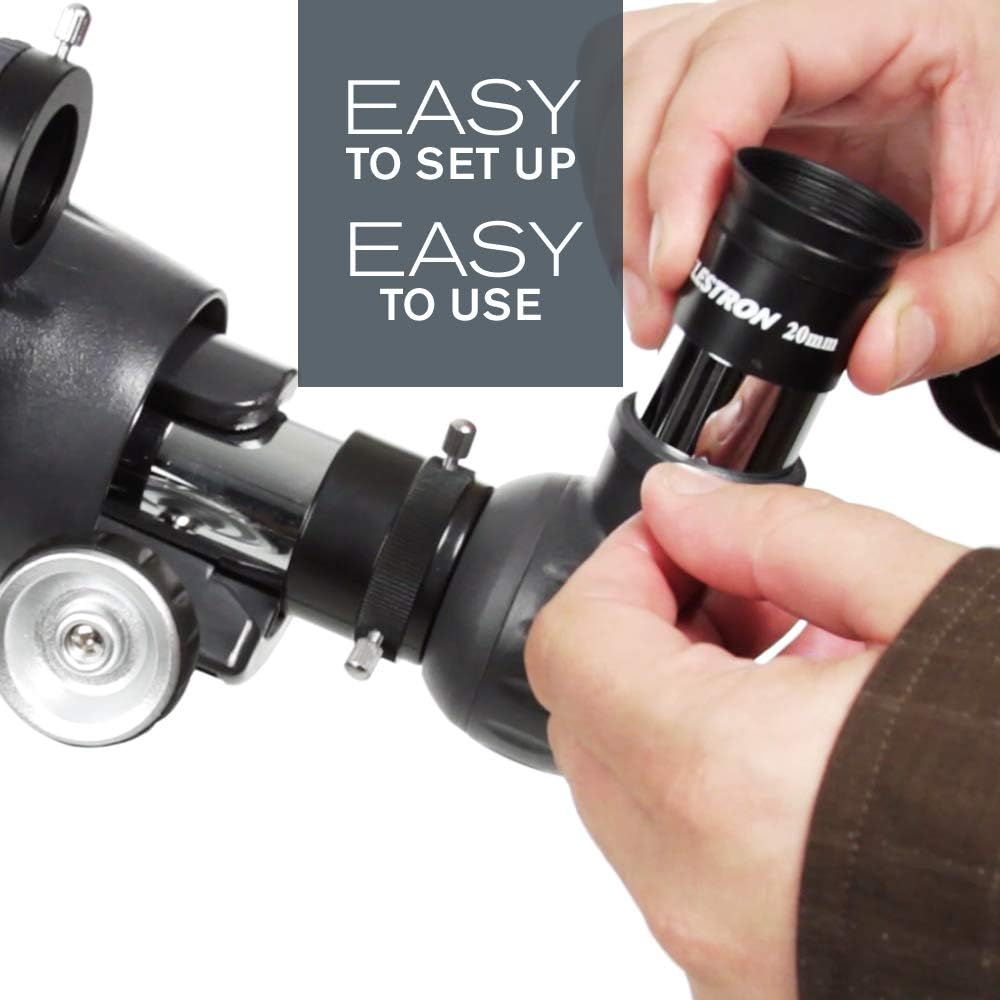
One advantage of the AstroMaster 70AZ is its straightforward design. Celestron describes the telescope as requiring no tools for its normal setup, and the mount and tripod are supplied preassembled.
Its refractor optics also generally require less routine maintenance than the mirrors in many reflector telescopes.
The manual alt-azimuth mount moves up and down and from side to side, making its basic operation relatively intuitive. You don’t need to learn how to operate an equatorial mount or align a computerized tracking system before you can begin observing.
That simplicity can make the telescope approachable for someone who has never owned astronomical equipment.
2. Well Suited to Lunar and Planetary Observing
The AstroMaster 70AZ’s 900 mm focal length and f/13 focal ratio make it a sensible design for observing the Moon and brighter planets.
Its relatively long focal ratio also helps control chromatic aberration, a type of color fringing that can occur with inexpensive refractor optics.
The telescope won’t reveal every planetary detail, but it can introduce beginners to lunar craters, Jupiter’s moons, and Saturn’s rings without requiring a large or complicated instrument.
3. No Batteries or Electronics Required
The AstroMaster 70AZ is entirely manual. It doesn’t require batteries, electronic tracking, or a computerized alignment procedure to observe celestial objects.
You simply point the telescope toward your target, focus the image, and adjust its position as the object moves across the sky.
This keeps the observing process relatively uncomplicated and avoids the additional cost and setup associated with electronic systems.
The trade-off is that you’ll need to locate objects yourself and periodically reposition the telescope to keep them in view.
4. Useful Accessories Included
The standard AstroMaster 70AZ comes with two eyepieces, a red-dot finderscope, an erect-image diagonal, and astronomy software.
The 20 mm eyepiece provides 45x magnification, while the 10 mm eyepiece provides 90x magnification.
Having two magnification options gives beginners some flexibility when switching between targets. The finderscope also helps when aiming the telescope at objects that would otherwise be difficult to locate through the main optical tube.
The included accessories provide a starting point without requiring you to purchase several additional components immediately.
5. Portable Enough for Different Observing Locations
The complete setup weighs approximately 10.8 pounds, making it relatively manageable compared with many larger telescopes.
You could move it between observing locations at home or transport it to a darker location when you want to escape city lights.
Its weight isn’t exceptionally low, and the long optical tube still requires some care when carrying and storing it. Nevertheless, it offers a reasonable balance between portability and the focal length needed for lunar and planetary observing.
Cons of the Celestron AstroMaster 70AZ
1. Limited Light-Gathering Ability
The telescope’s biggest optical limitation is its 70 mm aperture.
Aperture affects how much light a telescope collects and how much fine detail it can potentially resolve. Larger telescopes generally have an advantage when observing faint objects, particularly galaxies and nebulae.
The AstroMaster 70AZ can provide worthwhile views of brighter targets, but it isn’t designed to deliver impressive views of the full range of deep-sky objects.
If you already know that faint galaxies and nebulae are your main interest, consider a larger-aperture telescope before spending your money.
2. The Mount Can Make Observing Frustrating
One of the more significant drawbacks reported in independent reviews is the mount’s handling and stability.
The telescope uses a manual alt-azimuth mount, but making small, precise adjustments can be challenging. Movement caused by touching the telescope while focusing can also shift the target out of view.
These problems become more noticeable at higher magnifications because the field of view is narrower and small movements have a greater effect on the image.
This matters because a telescope’s usefulness depends on more than its optics. Even a reasonably capable optical tube can be frustrating if the mount makes it difficult to keep an object centered.
Beginners should take this limitation seriously, particularly if they expect a smooth, effortless observing experience.
3. Deep-Sky Viewing Is Limited
Although the AstroMaster 70AZ can show some brighter star clusters, it isn’t an especially strong choice for observing faint deep-sky objects.
Its small aperture limits the light it collects, while its long focal ratio makes it less suitable for wide-field observing.
If you want to sweep across large star fields or explore a broad selection of galaxies and nebulae, another telescope design may serve you better.
This isn’t necessarily a flaw for someone interested primarily in the Moon and planets, but it is an important limitation to understand before purchasing.
4. The Included Eyepieces Offer Limited Flexibility
The two included eyepieces provide 45x and 90x magnification. These are useful starting points, but the supplied set doesn’t include a lower-power eyepiece for wider views.
A wider field of view can be helpful when locating objects and observing large star clusters. The included 20 mm eyepiece may feel somewhat restrictive for those purposes.
You can purchase additional eyepieces separately, but doing so increases the overall cost. Before investing in accessories, it’s worth deciding whether this telescope’s basic design matches the types of objects you most want to observe.
5. Not a Good Choice for Serious Astrophotography
The AstroMaster 70AZ is primarily a visual observing telescope.
Its manual mount doesn’t automatically track celestial objects, and its design isn’t intended for long-exposure deep-sky astrophotography.
You may be able to take casual smartphone photographs of the Moon by positioning a phone over the eyepiece, but that is very different from photographing faint galaxies and nebulae with a dedicated camera and tracking mount.
If astrophotography is your main goal, you’ll want to investigate equipment specifically designed for that purpose.
Is the Celestron AstroMaster 70AZ Good for Beginners?
It can be, provided you understand its strengths and limitations.
The telescope’s straightforward optical design, simple manual operation, and included accessories make it approachable for someone who wants to begin exploring the Moon and brighter planets.
However, the mount may require patience, especially when making fine adjustments or trying to keep a planet centered at higher magnification.
Beginners should also be realistic about what a 70 mm telescope can reveal. It won’t produce the dramatic views seen in professional space imagery, and its performance on faint objects will be limited.
I’d consider it for someone who wants a relatively simple introduction to lunar and planetary observing. I would be more hesitant to recommend it to someone who wants a telescope that can comfortably grow with ambitious deep-sky observing interests.
Celestron AstroMaster 70AZ vs. the AstroMaster LT 70AZ
If you’ve been shopping for this telescope on Amazon, you may have noticed another model with a similar name: the Celestron AstroMaster LT 70AZ.
Despite the similar names, these are different models.
The standard AstroMaster 70AZ reviewed here has a 900 mm focal length, while the AstroMaster LT 70AZ has a shorter 700 mm focal length. Both have a 70 mm aperture, but their optical tubes and observing characteristics differ.
The standard model’s longer focal length makes it more oriented toward lunar and planetary observing. The shorter LT model is more compact and offers a wider potential field of view with suitable eyepieces.
Make sure you check the full product name and specifications before purchasing. Reviews and accessories for one model shouldn’t automatically be assumed to apply to the other.
Is the Celestron AstroMaster 70AZ Worth the Price?
At around $180–$200, the AstroMaster 70AZ is competing with other beginner telescopes that offer different combinations of aperture, portability, and ease of use.
Its strengths are its relatively simple refractor optics, suitability for the Moon and brighter planets, and straightforward manual operation.
Its weaknesses are its modest aperture, limited deep-sky capabilities, and a mount that can make accurate pointing more difficult than a beginner might expect.
Before purchasing, compare its current price with alternatives in the same budget range. A larger-aperture reflector might offer better light-gathering ability for the money, although it may involve different setup, maintenance, and portability considerations.
Also, don’t choose a telescope based solely on its advertised maximum magnification. Higher magnification doesn’t automatically produce a clearer image. Optical quality, aperture, atmospheric conditions, and mount stability all influence the actual observing experience.
Final Verdict: Should You Buy the Celestron AstroMaster 70AZ?
The Celestron AstroMaster 70AZ is a reasonable entry-level option for people who want to explore the Moon, brighter planets, and selected star clusters without investing in advanced equipment.
Its uncomplicated refractor design and included accessories make it approachable, while its long focal length is well suited to lunar and planetary observing.
However, the mount’s limitations and modest aperture are meaningful drawbacks. If you want smooth, precise adjustments or hope to explore faint galaxies and nebulae, you may find that another telescope offers a more satisfying experience.
My recommendation is to consider the AstroMaster 70AZ if your main interests are the Moon and brighter planets and you value a relatively simple setup. If you want the most light-gathering ability for your budget, or you expect to pursue deep-sky astronomy seriously, compare larger-aperture alternatives before making a decision.
Ultimately, the best telescope is the one that matches your interests, budget, and willingness to learn. The AstroMaster 70AZ can be an introduction to the night sky, but it’s worth understanding its limitations before deciding whether it’s the right introduction for you.