In astrology, every planet represents a fundamental force that shapes human experience. Some planets describe how we think, others describe how we feel, and others explain how we form relationships or structure our lives. Mars belongs to a different category altogether; it represents the force that turns potential into action. Without Mars, life would remain passive. Ideas might exist and desires might arise, but nothing would actually move forward.
Mars symbolizes the raw impulse that pushes life into motion. It governs action, effort, courage, and the willingness to confront resistance. Whenever something must be initiated, forced forward, or defended against opposition, Mars energy becomes active. It is the planetary principle that refuses stagnation and demands movement.
Because of this, Mars is closely associated with struggle, competition, and survival. Life rarely progresses without friction, and Mars represents the energy required to face that friction directly. It is the spark that turns intention into effort and transforms possibility into reality.
Action & Force
Mars is the planet that represents raw force in astrology. It symbolizes impact, ignition, confrontation, and forward motion. If other planets describe what we think, feel, or desire, Mars describes what we actually do about those things. It represents the moment when intention stops being theoretical and becomes movement. Mars is the energy that propels life out of stillness and into action.
At its core, Mars represents the application of force. It is the planetary principle that pushes, strikes, cuts, drives, and propels. Whenever energy is applied in order to move something, break something, or overcome resistance, Mars is present. Whether it is a person lifting a heavy object, a machine pushing against pressure, or an individual forcing their way through obstacles in life, the same symbolic principle appears. Mars is the force that pushes things in this world.
Wherever Mars becomes active, inertia begins to disappear. Pressure builds, movement begins, and situations start to change. In the zodiac, Mars is traditionally associated with the signs Aries and Scorpio, which express this force in different ways. One expresses Mars through bold initiative and direct action, while the other expresses it through intensity, strategy, and controlled power.
Inception & Beginnings
Mars is also strongly associated with the beginning of things. It represents the moment when action first begins and momentum starts to build. Before any process unfolds, something must take the first step, break the silence, or move forward into unknown territory. That initiating force belongs to Mars.
This symbolism connects Mars directly to the concept of birth. Birth is the moment when life emerges into the world and begins its independent existence. It is an event filled with pressure, force, effort, and release. Something new pushes its way into reality, breaking through the boundary between potential and manifestation. In many ways, birth is the ultimate Mars event because it represents the beginning of life through powerful exertion.
Mars therefore symbolizes the pioneer, the trailblazer, and the individual who goes first. It represents the courage required to move forward when no clear path exists. Starting anything new often requires a willingness to face uncertainty and resistance, and Mars provides the energy needed to take that leap.
This symbolism appears clearly in the zodiac through Aries, the first sign of the zodiac and one of the signs ruled by Mars. Aries represents the beginning of the astrological cycle, the moment when energy bursts into life and the journey of the zodiac begins. Mars therefore carries strong associations with initiative, pioneering spirit, and the willingness to act before anyone else does.
Instinct & Reaction
Mars operates at the level of instinct rather than careful thought. Unlike planets associated with contemplation or emotion, Mars responds quickly and physically. Its energy is immediate and reactive, often appearing before the mind has time to analyze the situation.
This instinctive quality explains why Mars is associated with sudden reactions. During moments of tension or danger, people may respond instantly—raising their voice, defending themselves, or taking decisive action without deliberate planning. These reactions often occur before logic has time to intervene.
From an evolutionary perspective, this instinctive response was essential for survival. Early humans lived in environments filled with physical threats, and the ability to react quickly often meant the difference between life and death. Mars energy provided the speed, intensity, and decisiveness necessary to respond to danger without hesitation.
Even in modern life, this same instinctive mechanism remains active in the nervous system. Mars continues to influence how people react under pressure and how rapidly they mobilize their strength when circumstances demand immediate action.
Identity & Assertion
Mars also governs the human drive to assert individuality. It represents the part of the psyche that declares I exist, I want, and I will act. This impulse is essential for personal autonomy because it allows individuals to push their will outward into the world rather than remaining passive.
Through Mars, people develop the courage to pursue goals and express their desires openly. It fuels initiative and gives individuals the confidence to act even when circumstances are uncertain. When someone chooses to take a stand, defend a belief, or move forward with determination, Mars energy is at work.
This planet also governs ambition and the willingness to prove oneself. Many accomplishments require persistence and effort in the face of obstacles, and Mars provides the stamina necessary to continue pushing forward even when the path becomes difficult.
When expressed in a healthy way, Mars allows individuals to assert themselves without overpowering others. It creates independence, confidence, and resilience.
The Body & Strength
Mars is deeply connected to the physical body and its capacity for strength and movement. It governs muscular activity, endurance, stamina, and the ability to exert force. Whenever the body must push, lift, strike, or resist pressure, Mars energy becomes involved.
Physical exertion is one of the clearest expressions of Mars symbolism. Activities such as running, climbing, wrestling, and lifting weights require determination and sustained effort. These actions involve overcoming resistance, which is precisely the domain of Mars.
When Mars energy becomes active, the body enters a heightened state of readiness. Muscles tighten, attention sharpens, and energy becomes immediately available for movement. This shift reflects the body’s survival system preparing for action.
Because of this connection to strength and exertion, Mars is strongly associated with athletes, warriors, and individuals whose professions depend on physical performance.
Anger & Boundaries
Anger is one of the most misunderstood expressions of Mars energy. In astrology, anger is not automatically destructive. Instead, it often functions as a signal that a boundary has been crossed or that a situation requires immediate attention.
Mars uses anger as a form of energy that mobilizes action. When individuals feel anger, their bodies become energized and prepared to address whatever challenge has triggered the reaction. This surge of energy can motivate someone to defend themselves, correct an injustice, or confront a problem directly.
Healthy Mars energy allows anger to surface and then be directed toward constructive action. It helps individuals speak up when necessary and protect their autonomy when their limits are challenged.
When anger is suppressed, it may turn inward or appear indirectly through resentment. When exaggerated or uncontrolled, it may erupt as aggression or hostility.
Injuries & Accidents
Because Mars governs force, speed, and impact, it is also associated with sudden injuries and accidents. Cuts, burns, scrapes, and wounds fall under Mars symbolism because they occur abruptly and involve sharpness, heat, or physical collision. Unlike conditions that develop slowly over time, Mars-related injuries tend to happen in an instant. They are the result of a sudden application of force—something striking the body, the body striking something else, or pressure being applied too quickly or intensely.
Mars also governs acute pain, the immediate and intense sensation that appears right after an injury occurs. This type of pain is sharp, sudden, and overwhelming at first. It arrives like a flash of heat or electricity, reaching a high level of intensity before gradually subsiding. If someone breaks a bone, tears a muscle, or suffers a deep cut, the first sensation is often a searing burst of pain that captures the body’s full attention. That moment of white-hot intensity belongs to Mars.
This is different from the type of pain that lingers afterward. Long-term, chronic discomfort—such as stiffness, slow healing, or the frustration of ongoing physical limitation—belongs more to Saturn. For example, if someone breaks their leg while playing football, the immediate snap and surge of pain in the moment of the injury reflects Mars energy. The months that follow, however—slowly healing, walking on crutches, and dealing with the daily inconvenience and irritation of recovery—reflect the domain of Saturn instead.
The sharpness of acute pain also connects symbolically to another area ruled by Mars: the libido. The sex drive is often experienced as an intense, agitating pressure within the body that demands attention and release. Just like acute pain, it can arise suddenly and feel difficult to ignore until it is resolved. Both experiences involve powerful, immediate sensations that surge through the body with urgency and intensity, reflecting the same raw and fiery nature of Mars energy.
Fire & Heat
Fire is one of the most powerful symbols associated with Mars. Fire represents energy in its most visible form. It provides warmth, light, and transformation, but it also has the potential to destroy when uncontrolled.
Mars reflects this same dual nature. Heat, friction, combustion, and ignition all belong to Mars symbolism. Engines, furnaces, and machines that rely on pressure and combustion mirror the same energetic principles.
The human body also reflects this symbolism through inflammation, irritation, and fever, all of which involve heat and intensity.
Fire therefore captures the essence of Mars energy: dynamic, powerful, and capable of both creation and destruction depending on how it is directed.
Blood & Vitality
The color red has long been associated with Mars because it symbolizes urgency and vitality. Red is the color of blood, which carries oxygen through the body and fuels muscular activity.
Blood represents life itself, but it also appears during injury or battle. This dual symbolism reflects the intensity of Mars energy, which can sustain life while also appearing in moments of conflict.
Red also triggers an immediate response in the human nervous system. Warning lights, emergency signals, and hazard signs frequently use red because it captures attention instantly.
Through blood and the color red, Mars becomes associated with vitality, alertness, and the raw pulse of physical life.
War & Weapons
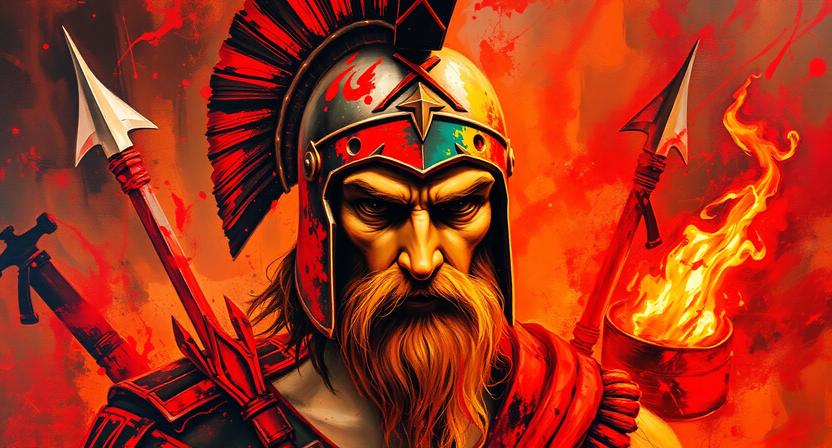
War is perhaps the most obvious expression of Mars symbolism. Mars governs soldiers, armies, combatants, and the act of fighting itself. It represents warfare as a physical reality involving force, courage, and survival.
Many ancient cultures associated Mars with a god of war because the planet symbolized aggression, bravery, victory, and destruction.
Weapons are extensions of Mars energy. Swords, knives, firearms, bombs, and missiles amplify force and create immediate impact.
Mars therefore represents the principle of force itself, regardless of whether that force is used constructively or destructively.
Dangerous Work & Professions
Mars also governs professions that require decisive action under pressure. These careers often involve situations where hesitation can be dangerous.
Examples include soldiers, firefighters, police officers, surgeons, mechanics, and emergency responders. Individuals in these professions must act quickly and confidently, often with little time for reflection.
Mars energy supports these roles by providing courage, focus, and the ability to respond instantly when circumstances demand action.
Desire & Passion
Mars plays a major role in sexuality, but in a very specific way. A common misconception in astrology is that Mars rules sex itself. In reality, Mars rules the libido, the sex drive, and the restless biological urge that pushes someone toward sexual expression.
The sex drive can often feel like an irritating or agitating force inside the body. It builds tension and demands release. This restless pressure fits Mars symbolism well, since Mars is the planet associated with friction, intensity, and even acute discomfort.
The act of sex itself is actually ruled by Venus, not Mars. This distinction makes symbolic sense within astrology. Venus represents pleasure, enjoyment, harmony, and sensual experience. Sex, as an act, is generally pleasurable and connective, which aligns much more closely with Venus than with Mars.
Mars instead governs the uncomfortable urge that pushes someone toward that pleasure in the first place.
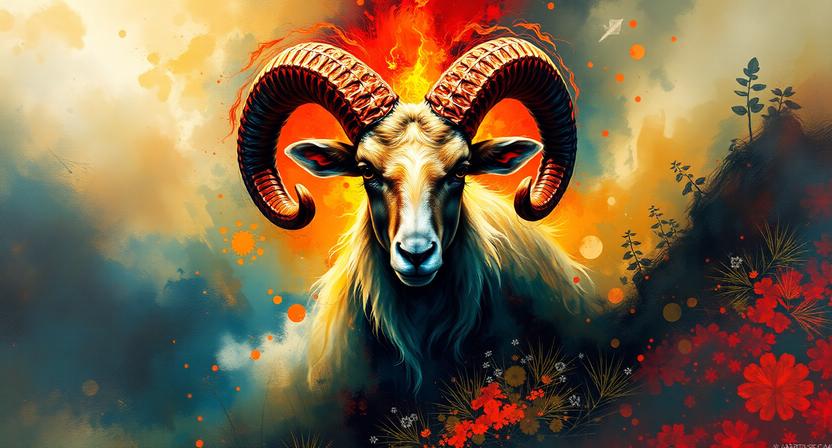
There is also a fascinating symbolic resonance in the imagery associated with Mars. The animal most commonly connected with Mars is the ram, whose defining feature is its horns. At the same time, the word horny is widely used as slang to describe sexual arousal. The ram is known for charging forward and using its horns aggressively, mirroring the assertive, forward-driving energy of libido itself. The symbolic resonance fits remarkably well and likely exists for a reason.
Masculinity
Mars is deeply connected with masculinity and the archetype of the male principle. In traditional astrology, Mars represents men, maleness, and masculine energy, while Venus represents women and feminine energy.
Mars symbolizes traits historically associated with masculinity, such as strength, assertiveness, competitiveness, and the willingness to confront challenges directly.
This symbolism is so strong that the astronomical symbol for Mars became widely adopted as the symbol used to represent masculinity in modern society. The symbol consists of a circle with an arrow extending outward from it.
The arrow represents direction, motion, and outward projection, reflecting Mars’ assertive and active nature.
Competition & Survival
Competition is a natural expression of Mars energy. Wherever individuals strive to outperform one another, test their strength, or prove their ability, the influence of Mars becomes visible.
Competition creates opposition, and Mars is the planetary force that thrives in environments where effort, determination, and direct confrontation are required. This is why Mars is strongly associated with athletics, contests, and any arena where people push themselves to win.
At a deeper level, competition is closely tied to survival. Throughout much of human history, survival depended on strength, courage, and the ability to overcome rivals. Resources such as food, territory, and mates were often limited, and individuals or groups had to compete in order to obtain them. Mars represents the instinct that pushes organisms to fight for those resources when necessary, ensuring that life continues through struggle and persistence.
Even in modern societies where survival is less immediately threatened, this instinct remains deeply rooted in human psychology. People still feel a powerful drive to test themselves against others, to overcome obstacles, and to prove their capabilities. When expressed constructively, this competitive energy can push individuals to refine their abilities, develop resilience, and achieve remarkable feats through determination and effort.
Courage & the Will to Act
Mars is deeply connected with courage, but not in the romanticized sense that courage means the absence of fear. In reality, courage is the willingness to act in spite of fear, and this is exactly the territory of Mars. Fear is a natural biological response designed to protect the body from danger. When something threatening appears, the nervous system often urges a person to freeze, retreat, or avoid the situation altogether. Mars represents the opposite impulse—the force that pushes a person to move forward anyway.
This is why Mars is associated with boldness and daring. It gives individuals the ability to override hesitation and step into action even when the outcome is uncertain. In moments where every instinct is warning someone to hold back, Mars provides the surge of determination that says go anyway. It is the inner force that allows a person to take risks, confront challenges directly, and push through psychological resistance.
Many of the moments people later describe as courageous are actually moments when Mars energy becomes active. Speaking up in a difficult situation, confronting an adversary, standing firm in one’s beliefs, or stepping forward when others hesitate all require this same energetic principle. Mars does not eliminate fear, but it provides the strength to push past it and act regardless.
Because of this, Mars is closely linked with the willingness to face danger or uncertainty head-on. It is the force that moves individuals from paralysis into motion. When fear attempts to immobilize the body, Mars reintroduces momentum. It replaces hesitation with action and transforms anxiety into forward movement.
In this sense, Mars represents the raw will to act. It is the energy that refuses to remain frozen in the face of difficulty. Instead, it pushes outward, confronts the obstacle, and moves directly toward the challenge. This ability to push past fear and step into action is one of the clearest and most powerful expressions of Mars energy.
Ultimately, Mars represents one of the most fundamental forces in astrology: the energy of action itself. It governs the instinct to move, pursue, defend, compete, and overcome resistance. Through strength, anger, courage, passion, and initiative, Mars reflects the powerful impulses that push life forward.
Although Mars is often associated with aggression or conflict, its deeper purpose is movement. Without Mars, ideas would remain unrealized, goals would go unpursued, and boundaries would go undefended.
When expressed constructively, Mars becomes a source of vitality, determination, and courage. It is the spark that transforms potential into action and gives individuals the strength to confront life directly.