Draconic astrology is a branch of astrology that aims to explore the deeper, often hidden layers of personality, recurring life patterns, and soul-level motivations. Unlike a typical natal chart where the ascendant is the anchor, a draconic chart is created by rotating the chart so that the North Node placement aligns with 0° Aries, shifting all other planetary positions by the same degree.
This preserves the relationships between planets while placing them in new signs, supposedly highlighting subconscious drives, karmic themes, and internal impulses that may not be immediately apparent in the natal chart. Often referred to as a “soul chart” or “inner chart,” draconic astrology offers a complementary perspective, providing insight into the underlying forces shaping a person’s life.
To better understand this fascinating system, here are 20 key facts that illuminate how draconic astrology works, its history, and what it can reveal about you.
1) The term “draconic” comes from the lunar nodes
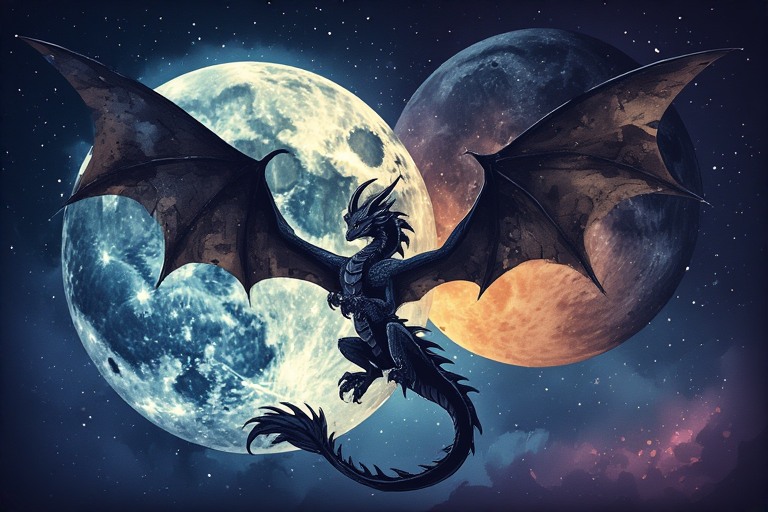
The name draconic traces back to the Latin draco, meaning dragon, because in traditional astrological imagery the Moon’s nodes were called the Dragon’s Head (North Node) and the Dragon’s Tail (South Node), reflecting ancient eclipse lore and mythic symbolism. Eclipses occur when the Moon passes near these nodes — the points where the Moon’s orbit intersects the Sun’s path — so early astrologers imagined a dragon or serpent devouring the Sun or Moon, giving rise to the dragon metaphor embedded in the terminology. (synthesisastrology.com)
2) Draconic charts are constructed by aligning the North Node to 0° Aries
As mentioned above, calculating a draconic chart begins by identifying the natal North Node’s zodiac position and then rotating the chart so that this node becomes 0 degrees Aries. All other planets, angles, and points are shifted by the same amount of rotation. Although the houses and aspects remain exactly the same as in the natal chart, the zodiac signs change, creating a new symbolic framework. This is why draconic charts are often described as alternative versions of the natal chart, focusing on deeper patterns rather than surface personality traits. (synthesisastrology.com)
3)Draconic charts are interpreted as representing deeper patterns and themes
Astrologers who work with draconic astrology often say that it reveals unconscious drives, enduring motivations, and internal patterns that underlie the more overt personality traits shown in the natal chart. While the natal chart describes how a person expresses themselves in the world, the draconic chart is interpreted as showing what continually motivates them at a core level, regardless of external circumstances. This is why many practitioners call it a “soul chart,” although interpretations vary among astrologers. (synthesisastrology.com)
4)The draconic chart is sometimes called the “soul chart” or “inner chart
Many astrology sites and practitioners use terms like “soul chart,” “inner chart,” or “deep pattern chart” to describe draconic charts because they are interpreted as addressing the inner compass or deeper core drives of a person. In this view, the draconic placements are less about learned behavior or outward circumstances and more about the essential qualities or long-term themes that shape a life’s trajectory. (thalira.com)
5)The Moon’s nodes have a long symbolic history in astrology
The nodes — North and South — have been used in astrology for centuries to represent directional forces rather than physical bodies. In Western astrology, the North Node often symbolizes growth, life direction, and where one feels pulled to evolve, while the South Node is associated with past patterns, comfort zones, or recurring habits. These interpretive traditions provide the symbolic foundation for draconic astrology’s focus on deeper, often repeated life themes. (thalira.com)
6)In sidereal and Vedic astrology, the nodes are named Rahu and Ketu
In sidereal or Vedic astrology, the North Node is called Rahu and the South Node is Ketu. Rahu is frequently associated with worldly desire, ambition, and driving forces that propel experience, while Ketu signifies areas of detachment, spiritual insight, and lessons already internalized. Although draconic astrology uses a tropical framework, understanding Rahu and Ketu adds dimension to nodal symbolism and contextualizes the language of deeper drives used by some astrologers. (en.wikipedia.org)
7)Draconic astrology is a transformational technique, not a separate zodiac system
Unlike tropical astrology, which is tracked by seasons, or sidereal astrology, which is anchored to the fixed star backdrop, draconic astrology does not recalculate planetary positions independently. Instead, it transforms the existing natal chart through a consistent rotational shift based on the North Node, preserving geometric relationships between planets while changing the symbolic context through sign placement. (kerykeion.net)
Because the same rotational offset is applied to every planet and angle in the draconic chart, the angular relationships (aspects such as oppositions, squares, and trines) remain identical to those in the natal chart. This means that the deeper structural dynamics of a chart — how planets relate to each other — stay constant, even though the signs change, creating a complementary layer of interpretation rooted in symbolic language rather than raw positional data. (kerykeion.net)
9)Draconic astrology is often used in psychological and spiritual interpretation
Many astrologers employ draconic charts when they are interested in internal motivations, psychological depth, or spiritual themes that feel persistent across different life contexts. It is particularly popular in forms of astrology that explore personal growth, psychological development, or evolutionary pathways rather than predictive forecasting. (thalira.com)
10)Draconic charts help explain recurring life themes
Because draconic charts emphasize internal patterns and central inclinations, astrologers often consult them when a person feels pulled toward repeated experiences, deep longings, or unresolved drives that seem to lie beneath surface personality traits. These themes sometimes appear as persistent motifs in relationships, career paths, or personal challenges that repeat across life stages. (synthesisastrology.com)
11)The draconic chart is typically read alongside the natal chart
Most practitioners do not treat the draconic chart as a stand‑alone interpretation. Instead, they compare it with the natal (tropical) chart to see how deeper drives may reinforce or contrast with external behaviors and life circumstances. This comparative approach offers a layered reading that can reveal tensions or harmonies between inner motivations and outward expression. (thalira.com)
12)Draconic astrology can be used in relationship analysis
Astrologers sometimes compare one person’s draconic chart with another person’s natal chart in synastry to explore deep connections that feel particularly familiar, resonant, or pivotal. When draconic placements align strongly with another person’s natal placements, it may indicate a persistent or significant interpersonal dynamic that transcends ordinary personality compatibility. (synthesisastrology.com)
13)Draconic astrology emphasizes thematic insight more than prediction
While many astrological techniques focus on timing and prediction (such as transits or progressions), draconic astrology is interpreted more as a way to understand long-term patterns, core drives, and internal frameworks. It is often used for reflective interpretation rather than specifying when external events will occur. (thalira.com)
14)The modern formalization of draconic astrology began in the 20th century
Although lunar node symbolism is ancient, draconic astrology as a technique that rotates the chart around the North Node was formalized relatively recently by Western astrologers. Influential astrologers like Dennis Elwell, Pamela Crane, and Victor Olliver helped develop the system and interpretive traditions that many practitioners use today, although its historical roots are less well documented than older astrological systems. (synthesisastrology.com)
15)Draconic astrology does not replace the natal chart
The natal chart remains the primary tool for mapping personality and external life expression. The draconic chart adds depth by highlighting underlying patterns or recurrent themes that might not be evident in the natal chart alone. It is best seen as a complementary layer rather than a replacement. (thalira.com)
16)Interpretations vary among astrologers
There is no single universally accepted way to interpret every draconic placement. Some practitioners emphasize spiritual or karmic interpretations, others psychological or motivational themes, and some approach it symbolically without metaphysical framing. This diversity reflects broader interpretive differences in modern astrology more generally. (thalira.com)
17)Draconic astrology can highlight inner harmonies or conflicts
When a draconic placement aligns with a strong natal placement, it may indicate a strong internal resonance that supports or reinforces outward behavior. When natal and draconic placements diverge significantly, astrologers often interpret this as an internal conflict or a difference between a person’s deeper drives and their external life choices. (thalira.com)
18)The nodal axis is tied to eclipses and lunar motion
The Moon’s nodes are geometrically defined points where the Moon’s orbit intersects the ecliptic, and these intersections are intimately involved in producing solar and lunar eclipses. The symbolic connection to eclipse phenomena is part of why nodal points are associated with threshold experiences, turning points, and recurring patterns in life. (synthesisastrology.com)
19)Draconic astrology can deepen self-understanding
By comparing tropical and draconic placements, astrologers offer a layered interpretation that shows both how a person presents themselves in the world and what deeper motivations may be shaping their life patterns. This combination can provide a richer, more nuanced picture of personality and internal drives. (thalira.com)
20)Understanding Rahu and Ketu adds cross-cultural depth
Although draconic astrology itself uses a tropical framework, knowing the Vedic names Rahu and Ketu for the lunar nodes adds symbolic depth because those names come with a rich interpretive tradition emphasizing ambition, desire, detachment, and spiritual lessons — themes that resonate with many astrologers who work with deeper life patterns. (en.wikipedia.org)
In exploring these 20 key facts, it becomes clear that draconic astrology offers a unique and profound lens for understanding the deeper currents of our lives. By rotating the natal chart around the North Node, this system aims to reveal subconscious drives, recurring patterns, and soul-level themes that might otherwise go unnoticed.
Whether viewed alongside a natal or sidereal chart, draconic astrology does not replace traditional astrology but enriches it, offering insight into karmic lessons, internal motivations, and the forces shaping personal growth. For those seeking a deeper understanding of themselves or the patterns that guide their lives, the draconic chart provides a layered, nuanced perspective, helping illuminate both the challenges and potentials that lie beneath the surface.