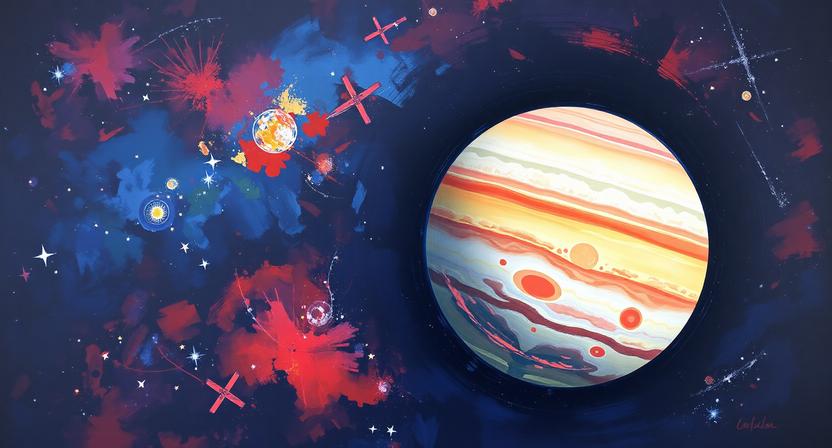
Neptune in Gemini describes a generation whose imagination flows through language, ideas, and communication itself. Neptune dissolves boundaries, softens clarity, and heightens sensitivity, while Gemini – the twins – governs thought, speech, learning, and the exchange of information. When these two forces come together, they do not simply blend—they subtly reshape the mental environment. This is not a placement that operates through direct action or obvious change, but through suggestion, tone, and the quiet reconfiguration of how meaning is formed and interpreted.
Rather than producing fixed beliefs or rigid systems of thought, Neptune in Gemini introduces fluidity into the mind. It encourages a way of thinking that is adaptable, imaginative, and often nonlinear. Ideas are not just processed logically; they are felt, interpreted, and reshaped through perception. This creates a generation that is highly attuned to nuance in communication, but also more susceptible to confusion, contradiction, and shifting narratives. The result is a complex relationship with truth—one that prioritizes meaning and impression as much as factual accuracy.
The Meaning of Neptune in Gemini
Neptune in Gemini creates a mental landscape that is highly receptive, imaginative, and permeable. Gemini is traditionally associated with logic, facts, and the rapid exchange of information, but Neptune dissolves the rigidity of these qualities. Instead of clear distinctions and concrete conclusions, there is a blending of ideas, an openness to interpretation, and a tendency for meanings to shift depending on context.
This placement often corresponds with a generation that changes how communication itself functions. Language becomes less about delivering precise information and more about evoking ideas, moods, and associations. Words take on layered meanings, and communication becomes something that can inspire, mislead, or transform depending on how it is used. There is often a strong connection to storytelling, symbolism, and media, as these become primary vehicles for expressing complex or intangible concepts.
Because Gemini is naturally connected to the 3rd house, the domain of skills, communication, and learning. Neptune’s presence here deeply influences how information is absorbed and shared. Learning may become more intuitive than structured, with individuals relying on feeling and impression rather than strict logic. At the same time, this can lead to difficulties in concentration, inconsistency in thought, or susceptibility to misinformation. The mind becomes like a sponge, absorbing everything around it, but not always filtering or organizing it effectively.
At its highest expression, Neptune in Gemini allows for a profound synthesis between intellect and imagination. It enables individuals to perceive connections that are not immediately obvious, to communicate in ways that resonate emotionally as well as intellectually, and to bring a sense of artistry into language itself. However, without grounding, it can also lead to mental fog, indecision, or a tendency to drift between ideas without arriving at clarity.
Neptune in Gemini Man
A man with Neptune in Gemini often possesses a mind that is endlessly curious yet difficult to pin down. He may be drawn to conversation, learning, and the exchange of ideas, but his approach is rarely linear or fixed. Instead of building a single, stable worldview, he tends to move fluidly between perspectives, adapting his thoughts based on new information, impressions, or influences.
This can give him a natural gift for communication. He may be an engaging speaker or writer, capable of expressing ideas in ways that feel vivid, imaginative, and emotionally compelling. He often understands the power of language, not just as a tool for conveying facts, but as a way to shape perception and influence how others think or feel. His words can inspire, intrigue, or even confuse, depending on how his energy is expressed.
At times, however, this placement can make him inconsistent or elusive. He may struggle to commit to a single idea or belief, frequently changing his mind or reinterpreting his own thoughts. In some cases, he may unintentionally blur the truth, not out of dishonesty, but because his perception itself is fluid. When grounded, he becomes someone who can bridge logic and imagination, offering insights that are both intellectually stimulating and creatively inspired.
Neptune in Gemini Woman
A woman with Neptune in Gemini tends to experience the world through a mind that is both highly sensitive and deeply perceptive. She often picks up on subtleties in communication that others overlook, including tone, implication, and underlying meaning. Her thoughts may move quickly, but not always in a straight line, instead weaving together ideas, impressions, and emotional responses.
She is often drawn to forms of expression that allow her to translate her inner world into language. Writing, storytelling, and creative communication may come naturally to her, as she has an intuitive sense of how words can capture complex and intangible experiences. For her, communication is not just about exchanging information—it is about conveying feeling, atmosphere, and perception.
At the same time, this heightened sensitivity can make her vulnerable to confusion or overwhelm. She may absorb the thoughts and opinions of others without realizing it, leading to uncertainty about what she truly believes. In environments that demand precision and clarity, she may feel scattered or misunderstood. However, when she develops grounding and discernment, she can become an exceptionally insightful communicator, capable of expressing ideas in a way that feels both imaginative and deeply authentic.
Neptune in Gemini Dates & Years
Neptune moves slowly through the zodiac, spending roughly 14 years in each sign and shaping entire eras rather than isolated moments. When Neptune moves through Gemini, the collective focus consistently turns toward communication, information systems, media, and the nature of thought itself. Below are key transits, along with a snapshot of what unfolded during each period:
1889 – 1902 — This period aligned with a rapid expansion in mass communication and information flow. Newspapers became more widespread and influential, literacy rates increased, and journalism began shaping public perception on a larger scale. It was also the era when early motion pictures emerged, introducing a new, more immersive form of storytelling that relied on imagery rather than direct language. Information was no longer just transmitted—it was interpreted, framed, and experienced, reflecting Neptune’s tendency to blur the line between fact and perception.
1723 – 1737 — This era saw the continued rise of print culture and intellectual exchange following the Scientific Revolution. Pamphlets, books, and written discourse played a central role in spreading ideas across Europe. At the same time, misinformation, propaganda, and speculative thinking were also present, particularly in political and philosophical debates. Neptune’s influence can be seen in the way ideas spread rapidly but were not always grounded in clear or verifiable truth, creating a more fluid intellectual environment.
1559 – 1573 — Occurring during the height of the Renaissance and the ongoing religious upheaval of the Reformation, this period was marked by intense ideological conflict and transformation. Written texts, translations, and printed materials became powerful tools for shaping belief systems and influencing public thought. Language itself became a battleground, as competing narratives sought to define truth and authority. Neptune’s presence is reflected in the blurring of religious and philosophical boundaries, as well as the emotional and symbolic power of words during this time.
1395 – 1409 — This timeframe followed the social and intellectual disruptions of the late medieval period. As Europe continued to recover from earlier crises, there was a gradual reorganization of knowledge and communication. Oral traditions, manuscripts, and early scholarly efforts played a key role in preserving and transmitting ideas. At the same time, uncertainty and shifting belief systems created an environment where truth was often unclear or contested. Neptune’s influence appears in the subtle reshaping of how knowledge was understood and passed down, often blending fact with interpretation and tradition.
Looking ahead, Neptune is expected to return to Gemini around 2126 – 2140 — a period that will likely bring another profound transformation in communication and information systems. Based on historical patterns, this transit may coincide with advancements in digital media, artificial intelligence, and the merging of human thought with technology. As before, the theme will not be pure clarity or pure confusion, but a complex mixture of both, where the boundaries between information, perception, and reality become increasingly fluid.
Neptune in Gemini is a placement that transforms the mind into something fluid, imaginative, and deeply responsive to its environment. It softens rigid thinking and introduces a more intuitive, interpretive approach to communication and learning. While this can create challenges around clarity, consistency, and truth, it also opens the door to creativity, insight, and a richer understanding of how meaning is formed.
At its highest expression, this placement allows for a blending of intellect and imagination that can elevate communication into an art form. It teaches that words are not just carriers of information, but instruments of perception—capable of shaping how reality itself is experienced. Through Neptune in Gemini, the mind becomes not just a tool for thinking, but a medium for vision, interpretation, and endless possibility.