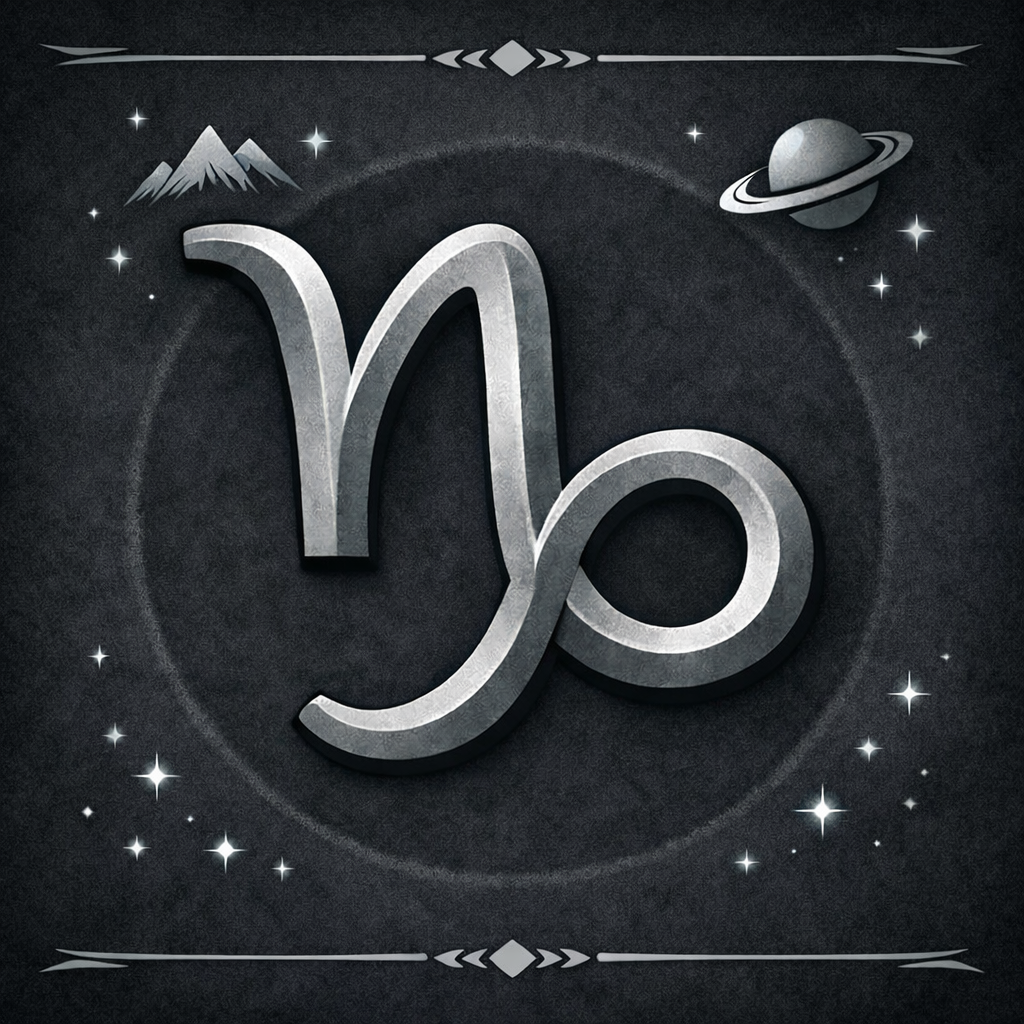
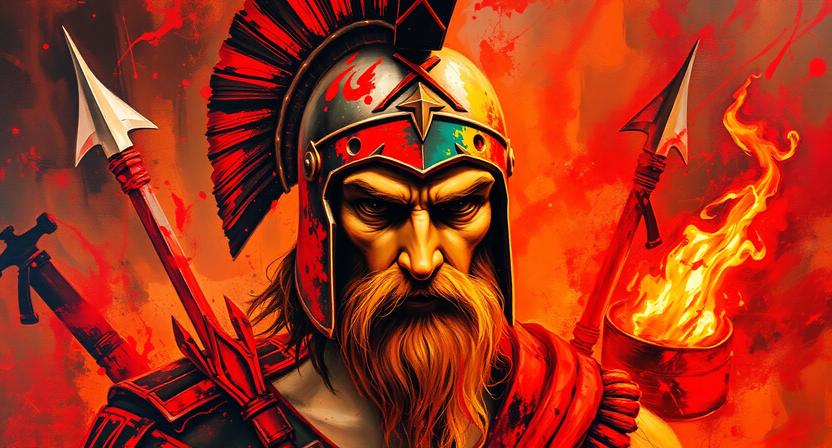
Capricorn—the mountain goat—is the tenth sign of the zodiac. It is ruled by Saturn, the planet of structure and discipline, and is a feminine, cardinal earth sign. Feminine signs consolidate energy inward, and Capricorn directs that force into self-mastery, long-term ambition, and measurable achievement. As a cardinal sign, Capricorn initiates with intention—it does not rush impulsively, nor does it act without calculation—but instead moves with strategic patience, laying foundations that can withstand time and pressure. Its element, earth, places it in the realm of practicality, responsibility, and tangible results, making Capricorn grounded, resilient, and driven by a steady determination to build something real and enduring in the world.
Capricorn Words & Phrases
adulthood, aged, ageless, ancient, antiquated, authority, backbone, bones, boss, calcified, CEO, commercial sector, coming of age, conservative, continuity, continuous, delay, deliberate, destiny, elected leader, enduring, enterprise, established, eternal, everlasting, executive, extension, extended, Father Time, firm, fortitude, fossilized, goat, government, grown up, hardened, heights, high rise, immortal, institutional, karma (of the 1st House), knees, lasting, legacy, lingering, lofty, long, long term commitment, longevity, mature, matured, maturity, memorable, methodical, mountain, mountain goat, mountain peak, Mount Everest, never ending, old age, old-timer, outcome (of the 1st House), patience, patient, patriarchy, peak, perseverance, persistent, persistence, perpetuity, political, politician, professional world, public sphere,redwood tree, Republican, reputation, responsibility, result (of the 1st House), ripe, scar, seasoned, senior, serious, slow, solemn, stable, steadfast, steadfastness, stoic, stone, stretch, structured, summit, survival, tall, ten, tenacious, tenacity, tenure, tenured, time, timeless, top, tradition, traditional, undying, venerable, vertical, weathered, wilderness
The Symbolism Of The Goat
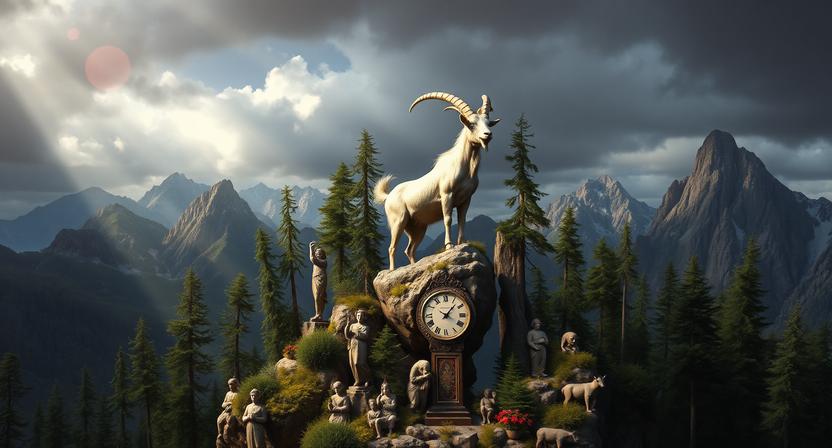
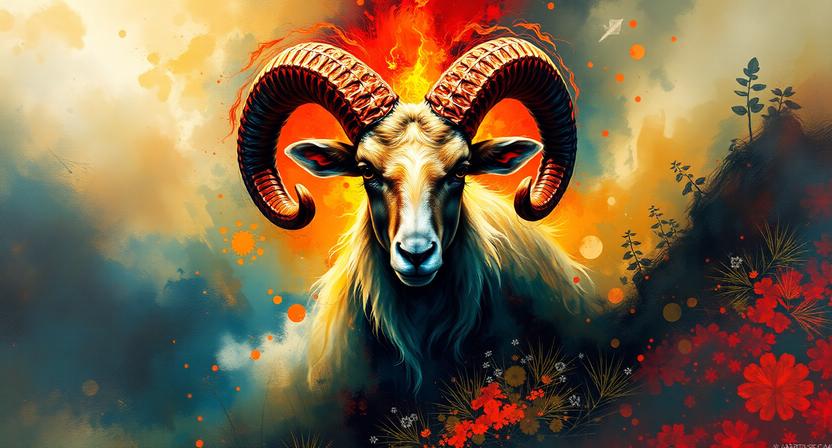
Across history and culture, the goat has rarely been a neutral creature. It is an animal of survival and elevation, most vividly embodied in the mountain goat clinging to sheer cliffs. In regions where rugged landscapes shaped daily life—such as the highlands of Greece or the alpine stretches of Switzerland—the goat became a living symbol of resilience. It thrives where other animals cannot, navigating narrow ledges and inhospitable stone. Because of this, the goat often represents the capacity to endure hardship and ascend through difficulty. The image of a goat standing calmly on a precipice has long mirrored the human aspiration to rise above limitation through patience, balance, and tenacity.
In mythology, goats frequently appear as companions of gods tied to wilderness and instinct. The Greek god Pan—half man, half goat—embodies untamed nature, fertility, and raw vitality. His Roman counterpart, Faunus, carries similar symbolism. Here, the goat expresses something primal and earthy, a reminder of humanity’s animal roots and connection to instinctual life. Yet the goat is not only wild; it is also sacrificial. In ancient ritual practices across the Near East and Mediterranean, goats were offered as sacred substitutes, bearing communal burdens. The biblical concept of the “scapegoat,” described in Book of Leviticus, ritualizes this symbolism—one goat symbolically carried away the sins of the people into the wilderness. In this context, the goat becomes a vessel for atonement and purification.
In astrology, the mountain goat reaches its most refined symbolic form in Capricorn. Here the goat is not wandering through forests but climbing toward a summit. The image suggests ambition and long-term ascent. It is not the reckless charge of an animal but a careful, deliberate climb. This echoes how many ancient cultures viewed high mountains as sacred spaces—closer to the heavens and removed from ordinary life. The goat’s steady climb up craggy slopes becomes an allegory for disciplined effort and earned authority.
Even in later folklore and medieval imagination, goats retained dual meanings. They could represent stubbornness or defiance, yet also independence and self-sufficiency. Unlike herd animals that require lush pasture, the mountain goat survives on sparse vegetation and steep stone. It is an emblem of those who thrive in difficult conditions. Across religion, myth, and cultural symbolism, the goat stands at the crossroads of instinct and aspiration, earth and summit, sacrifice and sovereignty—an animal that climbs, reminding us that elevation is achieved one careful step at a time.
The Symbolism Of Number 10
The number ten has long carried the meaning of completion and structure. Because it follows nine and returns us to a new cycle at eleven, ten represents both an ending and a foundation for what comes next. Many ancient systems recognized this sense of wholeness. In the Hebrew tradition, the Ten Commandments form a complete moral framework. In the philosophy of Pythagoras, the tetractys—a triangular figure totaling ten points—symbolized cosmic harmony and the structure of reality itself. Ten marks a full set, a contained order, something finished and established.
Culturally, ten often functions as a measure of totality because of the human body itself: ten fingers provide the basis for the decimal system that spread across civilizations. In mathematics and science, base-10 became the dominant organizing principle, reinforcing ten as a symbol of order, counting, and measurable stability. Even in everyday language, to “rate something a ten” implies perfection or fullness. The number carries a sense of solidity—nothing missing, nothing excessive.
In numerology, ten reduces to one (1 + 0), blending individuality with the amplifying force of zero. The one stands for initiative and identity, while the zero symbolizes potential and eternity. Together they create a number that suggests contained power—strength that is defined yet expansive. Ten is not chaotic energy; it is energy given form. It represents contained authority and the ability to bring a cycle to completion before beginning again.
Interestingly, in the English language, the root “ten” is connected to words meaning “to hold” or “to keep,” as seen in terms like contain, maintain, and retain. This linguistic thread aligns beautifully with the symbolism of Capricorn in astrology. Capricorn is known for holding its ground, staying put, and remaining unwavering in the face of pressure. The number ten, with its themes of preservation, structure, and endurance, reflects this same steady force. It suggests persistence that does not waver, strength that does not scatter, and commitment that does not dissolve. In this way, ten becomes more than a number—it becomes a symbol of what is firmly established and carefully maintained over time.
The Capricorn Constellation
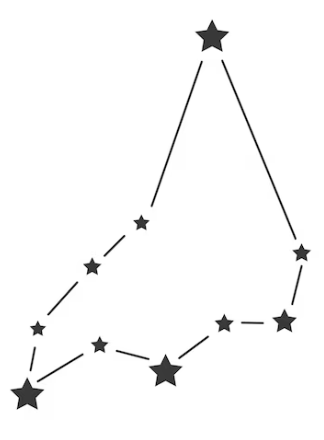
The constellation of Capricornus is one of the oldest recognized star patterns in the sky. Its name means “horned goat” in Latin, and it has been observed and recorded for thousands of years. Ancient Babylonian astronomers associated it with a goat-fish hybrid as early as the second millennium BCE, linking it to the god Ea, a deity of wisdom and the primordial waters. The Greeks later connected the constellation to Pan, who, according to myth, transformed into a sea-goat while fleeing the monster Typhon. This blending of land and sea symbolism—goat and fish—carried forward into astrology, where Capricorn is often depicted as the sea-goat.
Astronomically, Capricornus is not a particularly bright constellation. Its stars are relatively faint compared to neighboring patterns like Sagittarius or Aquarius. However, what it lacks in brightness it makes up for in shape. When traced carefully, its main stars—Deneb Algedi, Dabih, and Nashira—form a wide triangular outline that many observers note resembles a mountain peak rising from the horizon. This mountain-like appearance is remarkably fitting given the symbolic association of Capricorn with climbing, elevation, and high terrain. It is as if the sky itself sketches a summit in starlight.
Capricornus also holds seasonal significance. In the tropical zodiac, the Sun enters Capricorn at the December solstice, marking the point of greatest darkness in the Northern Hemisphere and the gradual return of light. In ancient Rome, this period was linked to renewal and endurance through winter’s harsh conditions. Even though the constellation and the astrological sign no longer align precisely due to the precession of the equinoxes, the symbolic timing remains powerful: Capricorn marks a turning point, when the Sun begins its slow climb back toward longer days—another subtle reflection of ascent and persistence.
Several notable celestial objects reside within Capricornus. It contains the globular cluster Messier 30 (M30), a dense sphere of ancient stars estimated to be over 12 billion years old. The constellation also lies along the ecliptic, meaning the Moon and planets frequently pass through it. Though modest in visual drama, Capricornus carries immense historical depth. It is a constellation rooted in some of humanity’s earliest sky lore, shaped like a mountain, and forever associated with the themes of endurance, height, and the steady climb toward the light.
Capricorn In Tropical vs. Vedic Astrology
The sign of Capricorn exists in both Western (tropical) and Vedic (sidereal) astrology, yet the framework surrounding it differs in meaningful ways. In tropical astrology, Capricorn is tied to the December solstice, the moment when the Sun begins its return toward longer days in the Northern Hemisphere. Because of this seasonal anchor, Capricorn is often interpreted through themes of ambition, endurance, authority, and long-term achievement. It represents the disciplined climb toward mastery in the visible world—career, status, structure, and responsibility. The symbolism is closely connected to time, maturity, and worldly accomplishment.
In Vedic astrology, Capricorn corresponds to Makara, a Sanskrit term often translated as “crocodile” or “sea creature,” though it is also depicted as a sea-goat hybrid. Unlike the tropical zodiac, which is fixed to the seasons, the Vedic system uses the sidereal zodiac, which is aligned with the actual constellations. Due to the precession of the equinoxes, most people’s Capricorn placements in tropical astrology fall into Sagittarius in the sidereal system. This alone creates a major interpretive shift in many birth charts.
Symbolically, Makara carries a slightly different tone. While Western astrology tends to emphasize Capricorn’s public ambition and structured ascent, Vedic astrology often frames Makara through karma, duty (dharma), and material responsibility. It is ruled by Saturn (Shani in Sanskrit) in both systems, but Vedic astrology places a particularly strong emphasis on Saturn’s role as the karmic taskmaster. Capricorn/Makara can therefore signify endurance through hardship, humility, and lessons learned over time. The focus is less on personal ambition alone and more on fulfilling one’s obligations within the broader social and cosmic order.
Another distinction lies in house emphasis and planetary strength calculations. Vedic astrology uses divisional charts (such as the Navamsa) and specific dignity systems that can alter how Capricorn functions in prediction. The interpretive style is often more concrete and event-oriented, while tropical astrology may lean more psychological and archetypal. Even so, both traditions agree on core themes: Capricorn/Makara signifies discipline, structure, patience, and persistence. The difference lies not in the essence of the sign itself, but in the cosmological lens through which that essence is understood.
Origin & Word Resonance
The word Capricorn comes from the Latin term Capricornus, which literally means “horned goat.” It is formed from two roots: caper (goat) and cornu (horn). The image is direct and concrete—a goat distinguished by its horns. In ancient Rome, Capricorn was already associated with this horned animal, and the name carried both pastoral and symbolic weight. Goats were hardy, sure-footed creatures, able to survive in rocky and mountainous terrain. The emphasis on the horn is also important; horns have long symbolized strength, defense, authority, and dominance across many cultures.
The Latin Capricornus itself was inherited from earlier Greek tradition. The Greeks used the term Aigokerōs (meaning “goat-horned”) for the constellation we now call Capricornus. This points to a continuity of meaning stretching back into Mesopotamian star lore, where a goat-fish hybrid was already present in the sky. Over time, the sea-goat imagery became firmly embedded in Western astrology, blending terrestrial resilience (the goat) with aquatic depth (the fish tail). The etymology preserves the land-based animal, but the mythological imagery expands beyond it.
Interestingly, the word Capricorn entered the English language through medieval Latin and Old French during the development of astrological and astronomical texts in Europe. By the late Middle Ages, it was firmly established as both a constellation name and a zodiac sign. The structure of the word has remained remarkably stable for centuries, reflecting how deeply rooted the symbol is in Western tradition.
Etymologically, Capricorn is straightforward—“horned goat”—yet symbolically it has accumulated layers of meaning. The horns suggest elevation and prominence; the goat suggests endurance and sure footing. Together, the name captures an image of something that climbs, persists, and stands its ground. Even at the level of language, Capricorn carries the sense of strength shaped by time and terrain, a fitting reflection of the sign’s enduring symbolism.
How To Interpret Capricorn In A Birth Chart
When I interpret Capricorn in a birth chart, I immediately look for three core manifestations: delay, heights, and government or institutional themes. The house Capricorn occupies shows where these patterns are most likely to surface, but the chart as a whole reveals who or what carries them.
Delay is usually the first signal. In the area Capricorn governs, something tends to move slowly or ripen with time. Plans may stretch out. Commitments may solidify later. Recognition may come after sustained effort. In my experience, this does not always describe the native directly. Sometimes it describes a partner who is older or slow to commit, a parent whose responsibilities increase with age, a friend whose progress stalls, or a project that requires long-term patience. The common thread is timing. That part of life unfolds on a slower clock.
Heights are just as important, and I mean that literally. Capricorn frequently corresponds with physical elevation. I’ve seen this show up as tall individuals becoming central to the story, events taking place on hills or mountains, work in high-rise buildings, or meaningful experiences on upper floors, rooftops, or cliffs. Sometimes the native is the one climbing. Other times someone connected to that house is elevated—socially or physically. In some cases, the symbolism attaches to an object or setting, such as a skyscraper, a mountain landscape, or even recurring imagery involving peaks or giants. The mountain theme tends to appear in tangible ways.
Finally, Capricorn often brings government, corporate hierarchy, or formal institutions into focus. This can manifest through involvement with politics, law, regulation, or structured organizations. It may be the native stepping into a position of authority, or it may be a spouse working in public administration, a family member dealing with legal systems, or an employer tightening rules and policies. Wherever Capricorn operates, structure solidifies and authority becomes visible. And by authority, I mean authority that must be earned, not given. Capricorn is not about being born into nobility (that’s Leo). It’s about leaders who are elected, or people who have risen to command through hard work.
In practice, I read Capricorn as an indicator of where life becomes slower, higher, and more governmental. The specifics vary from chart to chart, but those three themes—delay, literal elevation, and institutional structure—consistently define its expression.
Ultimately, Capricorn is the sign of time, elevation, and structure. It manifests through delay that matures with age, through literal and symbolic heights that place someone or something above ground level, and through systems of authority such as government, corporations, and institutional hierarchies. Its symbolism stretches from the mountain goat climbing toward a summit, to the number ten with its themes of holding place and endurance, to a constellation that itself resembles a peak in the sky. Whether it appears as a slow-building responsibility, a tall figure or elevated setting, or involvement with formal power structures, Capricorn consistently marks the part of life where patience is required, gravity is felt, and lasting achievement is earned rather than given.