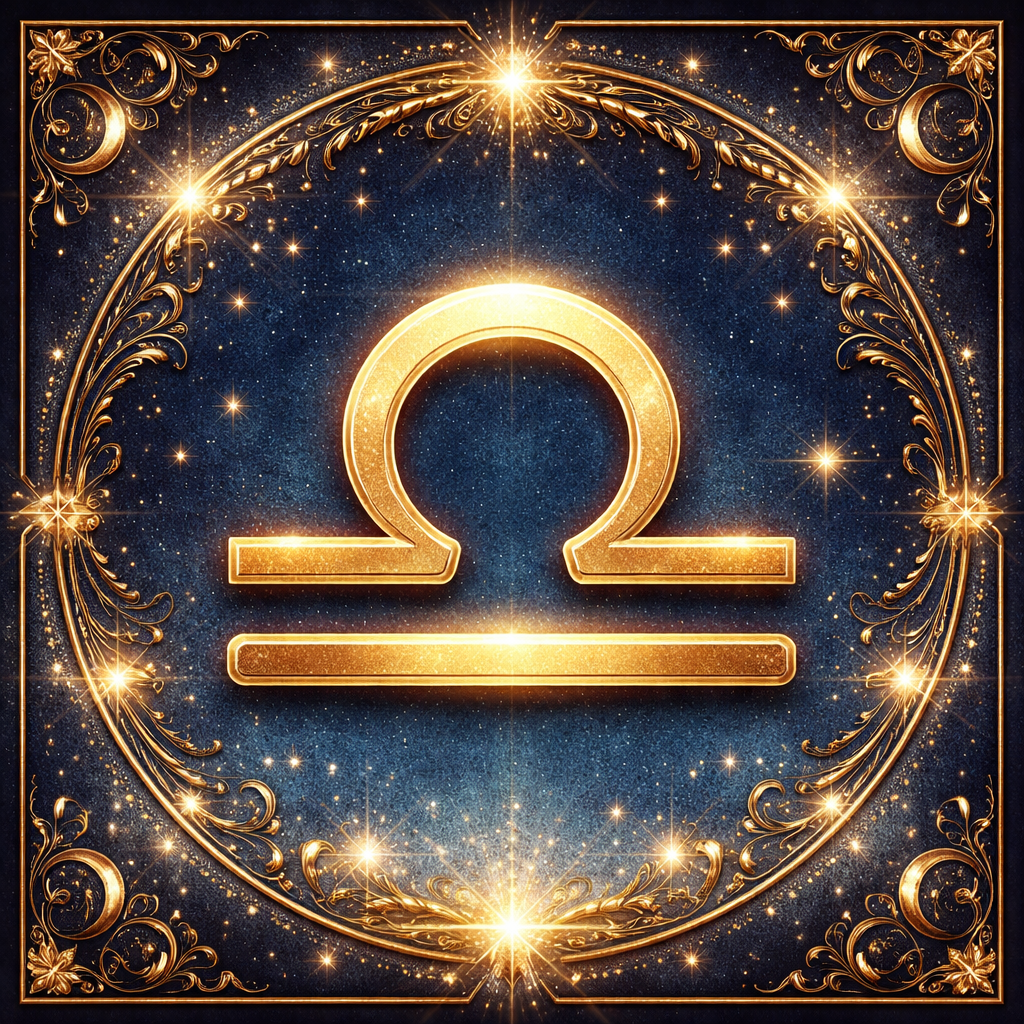
Libra—the scales—is the seventh sign of the zodiac. It is a masculine, cardinal air sign. Masculine signs are outwardly expressive, and Libra directs that energy through dialogue, comparison, and conscious engagement with others. As a cardinal sign, Libra initiates—not through force, but through relationship—seeking to establish harmony where imbalance exists. Its element, air, places it in the realm of ideas, principles, and social exchange, making Libra thoughtful, diplomatic, and acutely aware of perspective. Where some signs assert themselves through individuality or control, Libra advances through measured cooperation and refined judgment—guided not by impulse, but by a desire for equilibrium, fairness, and aesthetic balance—constantly weighing, adjusting, and recalibrating so that opposing forces may coexist in a state of dynamic and deliberate harmony.
The image of the weighing scale is one of humanity’s oldest symbols of moral measurement and social order. In the ancient world, scales were not merely commercial tools but sacred instruments of judgment. In the funerary texts of ancient Ancient Egypt, the heart of the deceased was weighed against the feather of Ma’at, the goddess of truth and cosmic balance. This “Weighing of the Heart” was not metaphorical poetry—it was a literal image of the soul placed upon scales to determine its fate. Here, the scale symbolized ethical equilibrium, the idea that every action carries weight, and that the universe itself operates according to a precise and impartial standard.
In the Greek tradition, scales were likewise bound to divine justice. Themis and later Dike were depicted holding scales to represent the fair distribution of consequence. The Romans carried this imagery forward in Justitia, who came to embody judicial balance and civic law. The blindfold sometimes added to her image emphasized impartiality: the scales do not care who stands before them; they only register weight. In this context, scales represent the suspension between two sides—the calm stillness before a verdict—where truth must settle naturally once all evidence has been placed.
Beyond myth, scales were essential to trade and civilization itself. In marketplaces across Mesopotamia, Greece, Rome, and beyond, merchants relied on balance scales to ensure fair exchange. A scale made trust visible. It transformed abstract value into measurable equivalence, reinforcing the principle that reciprocity governs human interaction. Even today, the scale remains a global emblem of courts and legal systems, reminding societies that justice is not arbitrary but weighed, considered, and ideally proportionate.
Symbolically, scales represent more than fairness—they signify tension held in suspension. Two forces pull downward, and harmony is achieved only when they meet in equal measure. This makes the scale an enduring metaphor for dynamic equilibrium, whether in ethics, relationships, commerce, or governance. It captures a profound philosophical truth: balance is not the absence of weight, but the careful calibration of opposing forces, held in poised and conscious alignment.
The Symbolism Of Number 7
The number seven has long been regarded as a symbol of spiritual completion and sacred order. In the Book of Genesis, creation unfolds across six days, culminating in the sanctified seventh—a day of rest that seals the process with wholeness. This pattern establishes seven as a number of fulfillment, a cycle brought to its intended conclusion. Throughout the Bible, seven appears repeatedly: seven heavens, seven seals, seven trumpets—each instance reinforcing the idea of divine structure and cosmic design. It suggests that reality is not random but patterned, unfolding according to a higher rhythm.
In the ancient world, seven was also tied to the visible heavens. Classical astronomy recognized seven wandering celestial bodies—the Sun, the Moon, Mercury, Venus, Mars, Jupiter, and Saturn—giving rise to the seven-day week that still governs modern timekeeping. In Mesopotamian and Hellenistic traditions, these seven “planets” were believed to shape fate itself. Greek myth speaks of the Seven Against Thebes, while other cultures preserved the motif of seven sages, seven gates, or seven trials. The recurrence of the number across civilizations hints at its association with cosmic structure and mystical knowledge, as though seven marked the boundary between the earthly and the divine.
In numerology, seven is often described as the seeker. Where one initiates and six harmonizes, seven withdraws to contemplate. It is linked to introspection, analysis, and spiritual inquiry—a number that turns inward to uncover hidden truths. Because it follows six (a number of balance and responsibility) and precedes eight (a number of power and material manifestation), seven occupies a liminal space: it pauses between completion and expansion. For this reason, it has long symbolized inner wisdom, contemplation, and metaphysical depth.
Across religion, myth, and esoteric systems, seven represents more than quantity. It signifies a pattern of ascent: seven notes in the musical scale, seven colors in the rainbow, seven stages of initiation in various traditions. Again and again, it appears as a ladder of refinement—a measured progression toward integration. Whether in scripture, cosmology, or symbolic philosophy, seven endures as the number of refined perfection and sacred progression, suggesting that true completion is not merely structural, but spiritual.
The Libra Constellation
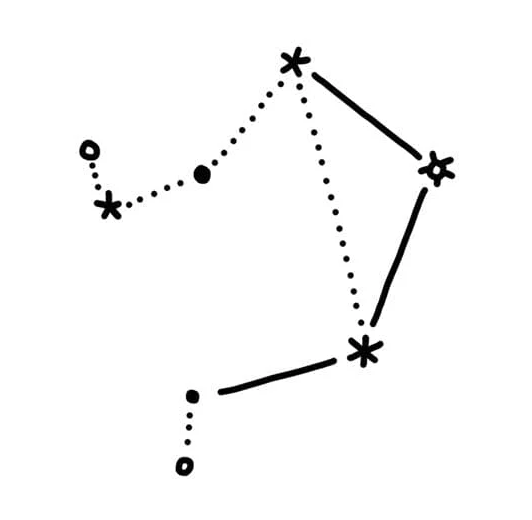
The constellation of Libra is one of the few zodiac constellations that represents an inanimate object rather than a human or animal figure. Its name is Latin for “the scales,” and it is directly associated with balance, measurement, and judgment. Yet this was not always its identity. In earlier Babylonian star catalogues, the stars that now form Libra were linked to the claws of the neighboring constellation Scorpius. The brightest stars of Libra still preserve this memory in their names: Zubenelgenubi and Zubeneschamali derive from Arabic phrases meaning “southern claw” and “northern claw.” Only later did Roman astronomers formalize Libra as its own constellation, separating it symbolically from Scorpio and emphasizing its distinct identity as the scales of justice.
Astronomically, Libra is relatively faint compared to some of the more visually striking constellations. It lies along the ecliptic—the apparent path of the Sun across the sky—ensuring its inclusion among the zodiac. Though modest in brightness, it occupies a significant position in the seasonal cycle. Around two thousand years ago, the Sun entered Libra at the time of the autumnal equinox, when day and night were nearly equal in length. This celestial alignment reinforced Libra’s symbolic association with balance and equilibrium, as the light and darkness of the year stood in near-perfect proportion.
Libra also contains several noteworthy deep-sky objects. Among them are the globular clusters NGC 5897 and NGC 6656, as well as multiple distant galaxies observable with telescopes. While it lacks a dominant first-magnitude star, its quiet presence along the zodiacal band gives it structural importance in mapping the heavens. The constellation serves as a reminder that not all influence is dramatic or radiant; some regions of the sky hold significance through position and relationship rather than sheer brilliance.
Culturally and symbolically, Libra’s emergence as a distinct constellation reflects a shift in emphasis—from the instinctual power of the scorpion’s claws to the deliberate calibration of the scales. Suspended between the intense symbolism of Virgo and Scorpio, Libra occupies a transitional space in the zodiac. Its stars may be subtle, but their arrangement encodes an enduring idea: that harmony arises not from force, but from the careful weighing of opposing sides under the vast architecture of the sky.
Libra In Tropical vs. Vedic Astrology
In tropical astrology, Libra begins at 0° at the moment of the autumnal equinox, anchoring the sign to the seasonal cycle rather than the visible stars. This system—used in most Western astrology—prioritizes the relationship between Earth and Sun, so Libra becomes a symbol of seasonal balance and relational awareness. Because the equinox marks near-equal day and night, Libra is interpreted as the principle of equilibrium, diplomacy, partnership, fairness, and aesthetic refinement. Its meaning is psychologically oriented: it describes how individuals seek harmony, negotiate differences, and respond to others in social space. The emphasis is less on astronomy and more on symbolic timing—Libra represents the point in the yearly solar journey when light and darkness stand in poised proportion.
In Vedic astrology, also called Jyotisha, Libra corresponds to the sidereal constellation system, meaning it is aligned more closely with the actual fixed stars in the sky. Due to the precession of the equinoxes, the sidereal zodiac used in Vedic astrology is currently about 23–24 degrees behind the tropical zodiac. Thus, a person considered a Libra in tropical astrology may fall into Virgo in the sidereal system. In Vedic interpretation, Libra (Tula) retains themes of balance and trade, but its meaning is framed through karma, dharma, and concrete life outcomes rather than purely psychological traits. Greater weight is given to planetary dignity, house rulership, and timing systems (dashas), so Libra’s expression depends heavily on its planetary ruler, Venus, and its condition in the birth chart.
Another distinction lies in emphasis. Tropical astrology often highlights Libra’s diplomatic temperament, aesthetic sensibility, and partnership orientation as personality descriptors. Vedic astrology, by contrast, treats Libra more structurally—examining how it governs marriage, contracts, business agreements, and public dealings within the karmic framework of the chart. The sign’s association with balance is not merely symbolic; it can indicate tangible matters such as alliances, negotiations, and material exchanges that shape one’s destiny. In this way, tropical Libra leans toward psychological harmony and interpersonal dynamics, while Vedic Libra leans toward relational karma and practical agreements.
Ultimately, both systems recognize Libra as the sign of balance and partnership, yet they derive that meaning from different foundations—one seasonal and symbolic, the other stellar and karmic. The contrast reflects a broader philosophical divergence: tropical astrology maps the soul’s development through the rhythm of the seasons, while Vedic astrology maps life through the measurable movement of the stars and the unfolding of karmic law.
Origin & Word Resonance
The word Libra comes directly from Latin, where lībra meant “a balance” or “a pair of scales.” In ancient Rome, a libra was a physical weighing instrument used in commerce, taxation, and legal proceedings, grounding the term in the practical act of measurement. From the same root comes libra pondo—“a pound by weight”—which gives us the modern abbreviation “lb.” still used today. Long before Libra became associated with a constellation or zodiac sign, it referred to a tool that ensured proportion, equivalence, and accountability in daily life. Its symbolism, therefore, originated not in myth but in material reality.
When Roman astronomers designated a section of the zodiac as Libra, they elevated this everyday instrument into the heavens. Unlike many constellations named for gods or beasts, Libra retained the identity of an object—an implement of balance. The name carried with it the implication of measured judgment and calibrated exchange, concepts central to Roman civic life. In this sense, the constellation reflects a cultural value: justice is something that must be weighed carefully, not declared impulsively. The word’s endurance in legal and commercial vocabulary underscores how deeply the idea of balance is embedded in Western linguistic tradition.
There is also an intriguing linguistic resonance in English: Libra is a near-homonym of “liberate” and “liberation.” While etymologically distinct—liberation derives from the Latin liber, meaning “free”—the phonetic similarity creates a symbolic bridge. Balance and freedom are conceptually intertwined. To be liberated is often to be released from imbalance, oppression, or unfair burden. In this way, the sound of Libra subtly echoes the idea of freedom through restored equilibrium. When scales are brought into balance, injustice is corrected; when injustice is corrected, liberation follows. Though the roots differ, the convergence of sound and symbolism enriches the word’s interpretive depth.
Ultimately, the origin of Libra reveals a progression from instrument to ideal. What began as a simple weighing device became a celestial emblem of justice, reciprocity, and proportion. Its linguistic relatives remind us that fairness, value, and even freedom depend upon careful calibration. The word itself carries the imprint of civilization’s effort to measure what matters—and to restore balance where it has been lost.
How To Interpret Libra In A Birth Chart
When I interpret Libra in a birth chart, I immediately look to where the principle of balance and opposition is active in your life. Libra rarely operates in isolation. It almost always points to another person—someone across from you. Depending on the context, that figure may appear as a partner, a spouse, a collaborator… or as a rival, competitor, even an open adversary. Libra governs the space of encounter. So when I see Libra strongly placed, I ask: who is standing opposite you? Who mirrors you, challenges you, completes you, or contests you?
Very often, Libra shows up as a relationship axis. In consultations, this can manifest as marriage, long-term partnership, contractual bonds, or significant romantic involvement. But just as frequently, it reveals itself through opposition. The same energy that produces attraction can produce rivalry. I always remind clients that Libra does not automatically mean harmony—it means engagement. It describes the dynamic between two sides. Whether that dynamic is cooperative or competitive depends on the condition of the sign’s ruler, Venus, and the aspects involved. Libra tells me that your life moves forward through interaction, not isolation.
Another consistent theme I watch for is exchange. Libra is transactional by nature. When activated by transits, progressions, or timing techniques, it often correlates with agreements, negotiations, purchases, legal matters, or formal commitments. Something is being weighed. Something is being offered in return for something else. In a natal chart, Libra can describe a person who instinctively calculates social balance—who gives and expects reciprocity. In predictive work, it frequently indicates that a deal has occurred, is occurring, or soon will occur. I’ve seen Libra periods coincide with contracts signed, lawsuits filed, marriages formalized, and partnerships dissolved—all forms of measured exchange between two parties.
Ultimately, when I read Libra in your chart, I am looking for the “other.” I am looking for the point where your identity meets someone else’s will. Libra teaches through reflection. It places you in situations where you must respond, negotiate, compromise, or contend. Whether that appears as a lover, a spouse, a business partner, or an opponent, the lesson is the same: your growth comes through relationship. Libra does not ask who you are alone. It asks who you become when you stand face-to-face with another and the scales begin to move.
Libra, the scales, emerges as a sign rooted in balance, relationship, and measured exchange—a symbol born from an ancient weighing instrument that rose from the marketplace and courtroom into the heavens. Its constellation reflects equilibrium in the sky, its etymology preserves the language of proportion and value, and the number seven subtly reinforces its place as a point of poised transition in the zodiacal cycle. Whether understood through tropical astrology’s seasonal symbolism or Vedic astrology’s karmic framework, Libra consistently marks the meeting point between two forces. In the birth chart, it rarely acts alone; it appears as partner or opponent, spouse or rival, contract or negotiation—signifying that life advances through interaction. Libra reminds us that harmony is not passive peace, but the deliberate calibration of opposing sides, where justice, reciprocity, and even freedom arise from the careful act of weighing what stands before us.