Key Takeaways: Cancer is the fourth sign of the zodiac, and its meaning centers on protection as a structural function. In a birth chart, Cancer indicates where incubation, shelter, or defensive structures arise — whether through people, mothers, circumstances, institutions, or psychological patterns. Whatever Cancer touches becomes fortified, enclosed, and preserved.It is thus the sign of home.
Cancer –the crab – is the fourth sign of the zodiac. It is a feminine, cardinal water sign. Feminine signs are inwardly responsive, and Cancer expresses that energy through feeling, intuition, and protection. As a cardinal sign, Cancer initiates through care, often taking the lead in creating safety, comfort, and emotional connection. Its element, water, reflects depth and sensitivity, making Cancer emotionally perceptive, nurturing, and profoundly receptive to its environment. Where some signs act through logic or impulse, Cancer moves through instinct—guided not by detached thought, but by memory, mood, and the quiet currents of the heart—constantly seeking to shelter what it loves and preserve what feels meaningful.
Across cultures, the crab has long symbolized the paradox of softness protected by strength. Its hard outer shell and tender interior made it an enduring emblem of protection and vulnerability existing together. Living at the shifting edge of land and sea, the crab occupies a liminal space — neither fully terrestrial nor fully aquatic — and thus came to represent the threshold between worlds: conscious and unconscious, known and unknown, safety and exposure. Its sideways movement added another layer of meaning, suggesting indirect action, cyclical thinking, and approaches that are subtle rather than confrontational.
In Greek mythology, the crab appears in the story of Heracles and the Lernaean Hydra. Sent by Hera to distract the hero during his battle, the crab was crushed underfoot. Yet for its loyalty, it was placed among the stars as Cancer. Here, the crab embodies steadfast devotion and sacrificial defense — a small but determined guardian acting out of allegiance. Even in defeat, it becomes immortalized, reinforcing the theme that protective instinct and emotional loyalty carry cosmic significance.
In ancient Egypt, the scarab beetle is more commonly discussed, but crabs and other shell-bearing creatures were also associated with rebirth and the life-giving waters of the Nile. Across coastal societies — from the Mediterranean to East Asia — crabs symbolized the cycles of the moon and tides, their movements echoing the rhythms of waxing and waning waters. In Chinese tradition, crabs can signify prosperity and success, particularly because the word for crab (蟹, xiè) is phonetically associated with harmony and examination success in certain contexts. Their molting process — shedding an old shell to grow — further established the crab as a quiet emblem of renewal, retreat, and re-emergence.
In folklore more broadly, the crab often appears as a creature of the shoreline — a guardian of caves, coves, and hidden places. Because it carries its dwelling upon its back, it naturally came to represent home as something internal, not merely external. The shell functions as armor, refuge, and boundary all at once. Throughout history and myth, the crab reminds us that true strength may not advance in a straight line. It protects, it withdraws, it waits for the tide — and in doing so, it preserves what matters most.
The Symbolism Of Number 4
The number four has long symbolized structure, stability, and foundation. In the physical world, four points create the first solid form: a square. A table with four legs stands firmly; a house rests on four corners. Because of this, many traditions associate the number with order made manifest — the moment when an idea becomes something tangible and built. If one represents origin and three suggests growth, four is where growth takes form and becomes livable.
In numerology, four is often regarded as the number of the builder. It represents discipline, responsibility, and the steady effort required to create something lasting. Rather than brilliance or inspiration, four emphasizes methodical progress and practical labor. It is the energy of laying bricks, establishing boundaries, and creating systems that endure beyond the individual. Where other numbers may symbolize vision or movement, four anchors and stabilizes.
Throughout world traditions, four repeatedly appears as a symbol of completeness in the material realm. There are four cardinal directions — north, south, east, and west — which map physical space. Many cultures speak of four elements — earth, air, fire, and water — as the building blocks of existence. In various Indigenous traditions, the medicine wheel turns upon four sacred directions. Even time itself is commonly divided into four seasons, reflecting nature’s cyclical order. The repetition of this pattern across civilizations suggests that four became synonymous with wholeness expressed through structure.
In scripture, the number four often carries cosmic meaning. In the Book of Revelation, four living creatures surround the throne, symbolizing universality and the totality of creation. The “four corners of the earth” appears as a poetic expression of worldly completeness. Across traditions, then, four does not merely count — it frames. It marks boundaries, defines space, and establishes the container within which life unfolds. In this way, four remains one of humanity’s most enduring symbols of grounded order and enduring foundation.
The Constellationof Cancer
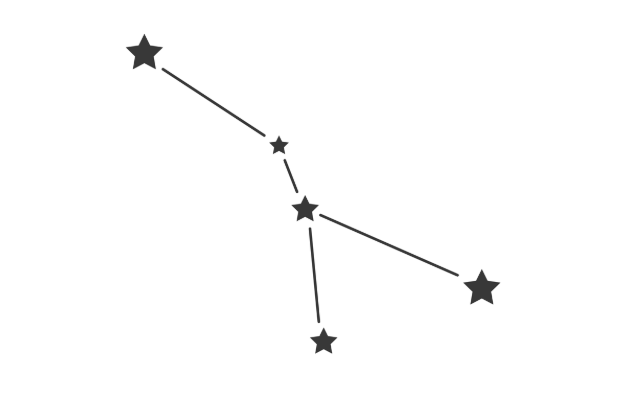
The constellation Cancer is one of the oldest recorded star patterns in the sky, yet it is also among the faintest. Located between Gemini and Leo, it occupies a subtle stretch of the zodiac that can be difficult to see with the naked eye. Unlike brighter constellations marked by obvious star shapes, Cancer appears more like a dim cluster of scattered lights. This faintness gave it an elusive reputation in antiquity, sometimes referred to as the “Dark Sign” because its stars lack the brilliance of its neighbors.
Its mythological origin comes from Greek mythology, where the crab was sent by Hera to disrupt Heracles during his battle with the Lernaean Hydra. Though crushed, the crab was immortalized in the heavens as the constellation Cancer — a reminder that loyalty and sacrifice can earn celestial honor. Ancient astronomers, including Claudius Ptolemy, cataloged Cancer in early star lists, ensuring its place in the classical zodiac that shaped Western astronomy and astrology for centuries.
One of Cancer’s most fascinating features is the Beehive Cluster, also known as Praesepe. Visible to the naked eye under dark skies as a misty patch, this open star cluster contains hundreds of stars and lies about 577 light-years from Earth. Ancient observers noticed it long before telescopes existed, describing it as a cloudy nebula. With binoculars, it resolves into a glittering swarm, living up to its “beehive” name. Nearby lies another open cluster, M67, notable for being one of the oldest known open clusters, estimated to be around four billion years old.
Astronomically, Cancer also marks an important celestial line: the Tropic of Cancer. This latitude is named after the constellation because, in ancient times, the Sun appeared in Cancer during the northern hemisphere’s summer solstice. Due to the gradual wobble of Earth’s axis — a phenomenon called precession — the Sun no longer occupies Cancer at that moment, yet the name remains. Though visually understated, the constellation Cancer quietly holds deep historical, mythological, and astronomical significance — a dim shell in the sky containing a rich interior of story and stellar wonder.
Cancer In Tropical vs. Vedic Astrology
The sign of Cancer exists in both Western (tropical) astrology and Vedic (sidereal) astrology, yet the two systems frame and calculate it differently. In Tropical astrology, Cancer begins at the summer solstice and is anchored to the Earth–Sun relationship rather than the fixed stars. It is a season-based zodiac, meaning 0° Cancer marks the height of light in the northern hemisphere. In this framework, Cancer symbolizes peak emotional fullness, protective instinct, and the urge to create sanctuary at the moment when life is most fertile and expressive.
By contrast, Vedic astrology — also known as Jyotisha — uses a sidereal zodiac, which aligns signs with the observable constellations. Because of the astronomical phenomenon of precession, the sidereal zodiac currently runs roughly 24 degrees behind the tropical zodiac. This means a person considered a Cancer in tropical astrology may fall into Gemini in Vedic astrology. In Jyotisha, Cancer (Karka) is ruled by the Moon (Chandra) and is often interpreted with greater emphasis on the mind’s fluctuations, emotional sensitivity, and karmic memory. The Moon is central in Vedic chart analysis, so Cancer’s lunar qualities are often treated as psychologically foundational rather than simply nurturing.
The interpretive tone also differs. Tropical astrology tends to describe Cancer in personality-oriented language — focusing on emotional intelligence, caregiving, attachment patterns, and the need for security. It frames Cancer as protective, maternal, and deeply intuitive, often emphasizing family systems and inner-child themes. Vedic astrology, while acknowledging nurturing qualities, more frequently integrates Cancer into a broader karmic and house-based framework. Its meaning shifts significantly depending on house placement, planetary dignity, and planetary periods (dashas), placing less emphasis on generalized personality traits and more on destiny patterns and life circumstances.
In essence, tropical astrology interprets Cancer through a seasonal, psychological lens, while Vedic astrology interprets it through a stellar, karmic lens. One ties the sign to the turning of light and symbolic archetypes of emotional development; the other ties it to the constellational sky and the unfolding of karma across time. Though the symbolic language overlaps — protection, memory, nourishment, sensitivity — the philosophical foundations beneath those interpretations are distinct.
Origin & Word Resonance
The word Cancer in astrology comes from the Latin word cancer, meaning “crab.” The Romans translated it directly from the Greek word karkinos (καρκίνος), which also meant crab. In Greek mythology, the creature was the crab sent by Hera to interfere with Heracles, later immortalized as the constellation. When Roman astronomers and astrologers adopted the Greek zodiac, they preserved the animal symbolism but Latinized the name. From there, Cancer entered Old French and Middle English, eventually becoming the astrological term we use today.
The medical term cancer shares the same linguistic root, but its application developed separately. Ancient physicians, including Hippocrates, used the Greek word karkinos to describe certain tumors because the swollen veins surrounding them resembled the legs of a crab. Later, the Roman physician Galen continued using the Latin cancer in medical texts. The overlap, then, is not symbolic but visual and anatomical. Both astrology and medicine borrowed the same word from classical languages due to resemblance — one to the animal in myth, the other to the appearance of a growth. The connection is etymological rather than philosophical; it is shared language, not shared meaning.
There are other interesting sound relationships surrounding the word. While not a true homonym, Cancer phonetically echoes “canker,” a term historically used for spreading sores or corrosion, again reinforcing the medical branch of the word’s evolution. Yet in astrology, the meaning remains firmly rooted in the image of the crab — shell, protection, sideways motion, and tidal association. The divergence between disease and zodiac is therefore a matter of metaphor applied in different fields, not an intrinsic conceptual link.
It is also intriguing to consider the number four, traditionally associated with Cancer as the fourth sign of the zodiac. Though not a linguistic homonym in strict etymological terms, four sounds like “fort,” a fortified structure built for defense. Symbolically, this parallel feels fitting. Cancer governs themes of home, shelter, and protection — emotional fortification as much as physical. A fort protects what is inside its walls just as a crab protects itself within its shell. While the similarity between four and fort is coincidental in origin, the symbolic resonance aligns remarkably well with Cancer’s longstanding associations with security, boundary, and containment.
How To Interpret Cancer In A Birth Chart
When I interpret Cancer in a birth chart, I start with one unwavering principle: Cancer signifies protection. Not sentimentality. Not moodiness. Not even nurturing as a primary theme. Those may appear, but they are secondary. At its core, Cancer describes a protective function. Whenever I see Cancer activated — whether by house cusp, planetary placement, or rulership — I ask myself: What is being sheltered here? Who is acting as the protector? Where is the armor?
It is important to understand that this does not automatically mean the native themselves is being guarded or doing the guarding. Cancer can describe anyone or anything in the chart that takes on a protective role. A planet in Cancer may show a person in the native’s life who behaves as a shield. A Cancer-ruled house may describe an area of life that becomes fortified, insulated, or defended. Even events can manifest through Cancer as protective interventions — barriers that arise, shelters that appear, containment that preserves something vulnerable. The expression might look like caregiving, housing, security systems, nationalism, emotional bonding, or literal armor — but those are expressions of the deeper pattern. The underlying current is preservation through enclosure.
When I read Cancer, I think in terms of shells, walls, wombs, and containers. I look for insulation — emotional, physical, or situational. Sometimes this is gentle, like a parent protecting a child. Sometimes it is structural, like property, vehicles, or institutions that house and defend. Sometimes it is psychological, like guarded memory or defensive posture. But the common denominator is always the same: something is being kept safe inside defined boundaries.
Everything else flows from that. Sensitivity exists because something must be monitored. Attachment exists because something must be retained. Retreat exists because something must be shielded. When Cancer is active, I do not begin with emotion — I begin with protection as the governing force. Emotion is simply one of the ways that protection expresses itself.
Cancer is not merely emotional, maternal, or nostalgic — it is architectural. From the crab’s shell to the square stability of the number four, from ancient myth to the faint constellation that quietly holds its place in the heavens, Cancer symbolizes the act of guarding what matters. In astrology, this sign does not simply feel; it fortifies. It does not merely nurture; it encloses and preserves. Whether expressed as a home, a womb, a boundary, a lineage, or a literal shield, Cancer represents the sacred instinct to protect life at its most vulnerable. Strip away the secondary traits and what remains is simple and enduring: Cancer is the force that builds the walls so something inside can survive.